
One of the first questions manufacturers ask when planning a new PCB assembly factory is:
How much does an SMT production line cost in 2026?
There is no single price.
An SMT production line can range from a relatively simple lower-volume configuration to a highly automated production system with multiple pick-and-place machines, 3D SPI, AOI, advanced material handling, traceability, and factory integration.
The final investment depends on factors such as:
- Production capacity
- PCB complexity
- Component range
- Placement quantity
- Required placement speed
- Equipment brand
- New vs pre-owned equipment
- Inspection requirements
- Automation level
- Number of pick-and-place machines
- Feeders and accessories
- Factory utilities
- Installation and training
As a broad 2026 market-planning reference, complete professional SMT lines can move from the low six-figure USD range into several hundred thousand dollars, while high-speed international-brand lines with extensive inspection and automation can exceed USD 1 million.
Very simple prototype or lower-cost equipment packages can be substantially below these levels, while advanced mass-production lines can be substantially above them.
Therefore, the most useful question is not simply:
“What does an SMT line cost?”
It is:
“What SMT line configuration do I need for my PCB, capacity, quality requirements, and budget?”
What Equipment Is Included in an SMT Production Line?
A typical automatic SMT production line may include:
PCB Loader → Solder Paste Printer → SPI → Pick and Place Machine(s) → Reflow Oven → AOI → PCB Unloader
Supporting equipment may include:
- PCB conveyors
- Buffers
- NG buffers
- Barcode scanners
- PCB vacuum loaders
- Magazine loaders/unloaders
- Feeder storage
- Stencil cleaning equipment
- Solder paste management equipment
- Rework equipment
- X-ray inspection where required
- Traceability software
The definition of a “complete SMT line” is therefore important when comparing quotations.
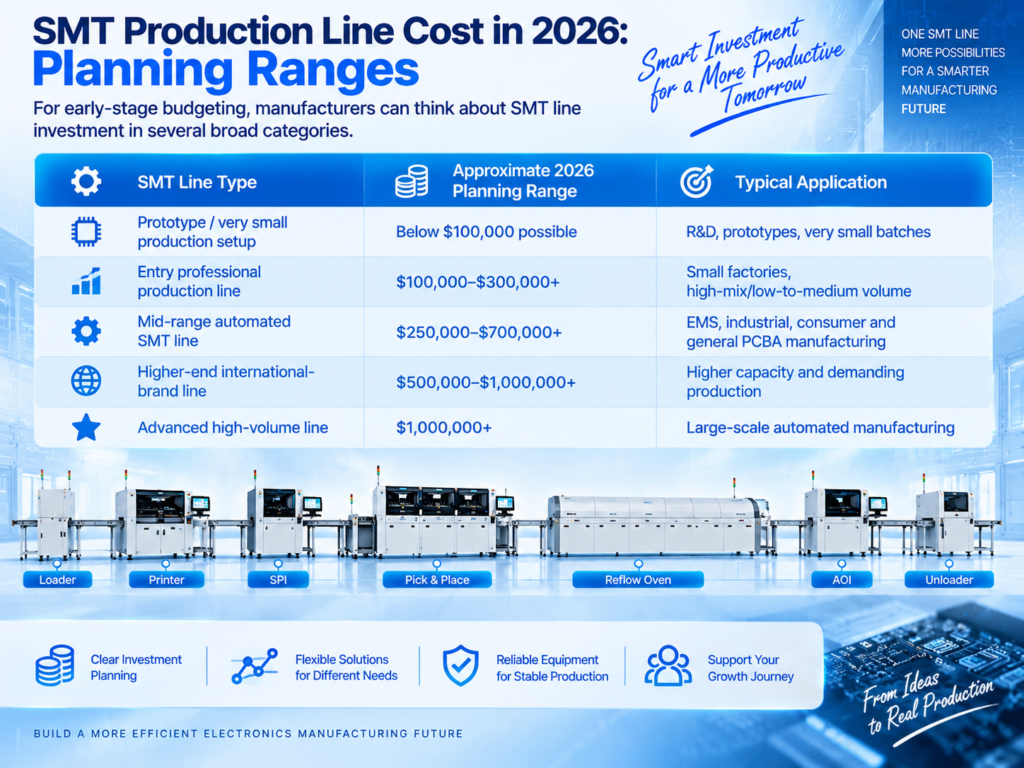
SMT Production Line Cost in 2026: Planning Ranges
For early-stage budgeting, manufacturers can think about SMT line investment in several broad categories.
Important: These are broad market-planning ranges, not quotations.
The same production target can result in very different investment levels depending on equipment brand, machine condition, inspection configuration, feeder quantity, placement capacity, and local installation costs.
Why Do SMT Line Prices Vary So Much?
The biggest reason is that two lines described as “fully automatic SMT lines” may have completely different production capabilities.
For example:
Line A
- One automatic printer
- One mid-speed pick-and-place machine
- Standard reflow oven
- AOI
- Basic conveyors
Line B
- Automatic printer
- 3D SPI
- Multiple high-speed modular placement machines
- Large feeder capacity
- High-performance reflow oven
- 3D AOI
- Buffers
- Barcode system
- Full traceability
Both are automatic SMT lines.
Their investment levels are completely different.
Solder Paste Printer Cost
The solder paste printer is one of the first major machines in the SMT process.
Its job is to transfer solder paste through the stencil onto PCB pads.
Machine price depends on features such as:
- Manual vs automatic operation
- PCB size
- Vision alignment
- Printing accuracy
- Automatic stencil cleaning
- Squeegee control
- PCB clamping
- Production speed
- Traceability
A lower-volume factory may use a simpler printing system, while higher-volume production generally benefits from fully automatic inline printing.
Printing should not be treated as a low-priority process simply because placement equipment is more expensive.
Poor solder paste printing can create defects that become visible only after placement and reflow.
SPI stands for Solder Paste Inspection.
It checks solder paste deposition before component placement.
Depending on the system, SPI can measure:
- Paste volume
- Height
- Area
- Position
Adding SPI increases initial line investment, but it also provides process information before expensive components are placed and soldered.
Whether SPI is required depends on:
- PCB complexity
- Component pitch
- Product requirements
- Quality strategy
- Customer requirements
Do not automatically remove SPI only to reduce the equipment budget.
The pick-and-place section is often one of the largest parts of the SMT equipment budget.
Pricing varies dramatically because placement machines differ in:
- Placement speed
- Number of heads
- Placement architecture
- Accuracy
- Component range
- Feeder capacity
- PCB size
- Camera systems
- Software
- Automation features
A machine designed for flexible high-mix industrial production is very different from a modular system designed for extremely high-volume production.
Major equipment brands used in global SMT manufacturing include:
- Fuji
- Panasonic
- ASM
- Yamaha
- JUKI
- Hanwha
Brand selection should be based on production requirements, service availability, feeder ecosystem, spare parts, and total cost of ownership—not brand name alone.
How Many Pick and Place Machines Do You Need?
This is one of the most important SMT line cost questions.
Suppose a PCB contains:
600 SMT placements
Your production target is:
100 PCBAs/hour
The theoretical placement demand is:
600 × 100 = 60,000 placements/hour
However, you should not simply purchase a machine rated at 60,000 CPH.
Actual throughput is affected by:
- Component mix
- Feeder arrangement
- Head travel
- Component recognition
- PCB transfer
- Large or difficult components
- Changeover
- Machine efficiency
The required machine configuration should be calculated using the actual BOM and PCB.
Feeders Can Significantly Affect the Budget
The placement machine itself is not the complete placement investment.
You may also need:
- 8 mm feeders
- 12 mm feeders
- 16 mm feeders
- 24 mm feeders
- Wider feeders
- Tray handling
- Special feeders
A high-mix EMS factory may require a large feeder inventory to reduce changeover time.
Therefore, when comparing quotations, ask:
How many feeders are included?
A lower machine quotation can become much less attractive once the required feeder package is added.
After placement, the PCB enters the reflow oven.
Industrial reflow systems can differ in:
- Number of heating zones
- Cooling zones
- Conveyor width
- Thermal control
- Heating uniformity
- Flux management
- Exhaust
- Nitrogen capability
- Software
- Recipe management
A larger oven with more advanced process control generally costs more.
However, the correct oven should be selected according to the PCB and production requirements.
Do You Need Nitrogen Reflow?
Not every SMT production line requires nitrogen.
Whether nitrogen is beneficial or required depends on:
- Product
- Solder paste
- PCB finish
- Component structure
- Process window
- Quality requirements
- Nitrogen also adds:
- Equipment configuration cost
- Gas supply infrastructure
- Operating cost
It should therefore be selected based on process requirements rather than automatically included in every line.
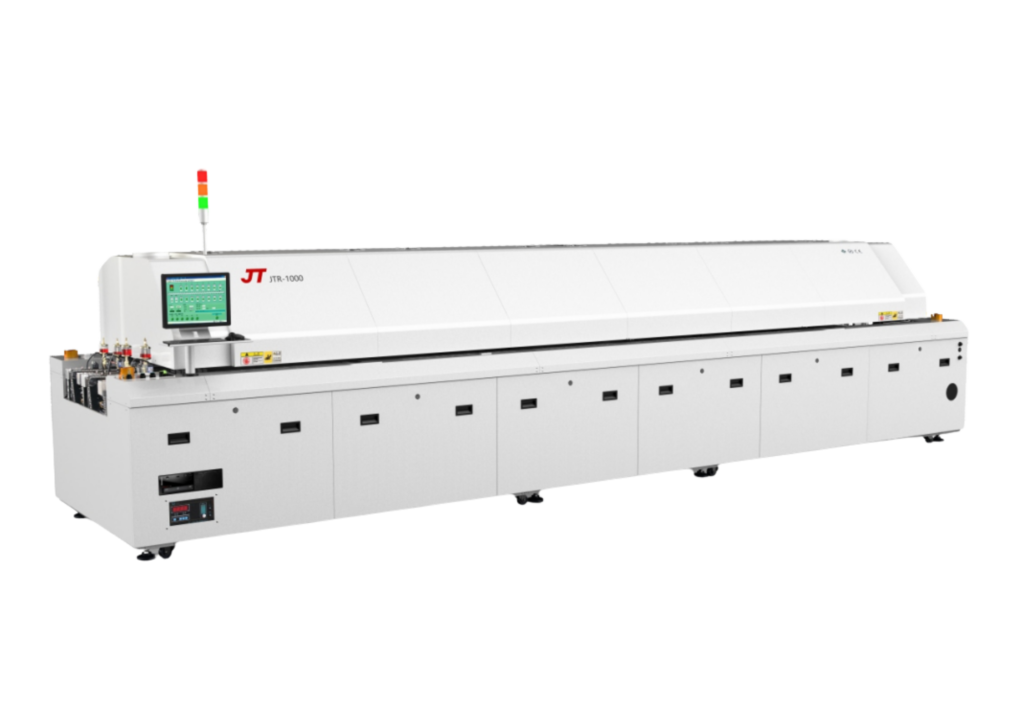
AOI stands for
Automated Optical Inspection.
Post-reflow AOI can inspect characteristics such as:
- Missing components
- Component position
- Polarity
- Certain solder-joint conditions
- Other visible assembly defects
AOI pricing depends on:
- 2D vs 3D technology
- Camera configuration
- Resolution
- Inspection speed
- Software
- Programming
- Line integration
Inspection equipment should be selected according to actual PCB complexity and defect risks.
Some PCBAs contain hidden solder joints such as:
- BGA
- Certain QFN structures
- Other packages where optical access is limited
- X-ray inspection may be useful where required.
However, not every SMT line needs inline X-ray inspection.
Depending on production volume and inspection strategy, manufacturers may use:
- Offline X-ray
- Inline X-ray
- Sampling inspection
Adding expensive inspection equipment without a defined manufacturing requirement can unnecessarily increase line investment.
PCB Handling Equipment Cost
A complete line may also require:
- Loader
- Unloader
- Conveyors
- Buffers
- NG buffers
- Cooling conveyors
- PCB turning systems
These machines may individually cost much less than a high-end placement machine, but a complete line can contain many handling units.
They should be included in the project budget.
Entry-Level SMT Line Configuration
A professional entry-level production line might use:
PCB Loader → Automatic/Semi-Automatic Printer → Pick and Place Machine → Reflow Oven → AOI → Unloader
SPI may be added depending on the product.
This configuration may suit:
- New electronics factories
- High-mix production
- Industrial electronics
- Lower-to-medium production volume
The objective is flexibility without unnecessary automation.
Mid-Volume SMT Production Line
A stronger automated configuration may be:
Automatic Loader → Automatic Printer → 3D SPI → Pick and Place Machine(s) → Reflow Oven → AOI → Unloader
Additional equipment may include:
- Buffers
- Barcode readers
- Traceability
- Offline X-ray
This type of configuration can be suitable for EMS manufacturers and OEM factories requiring higher throughput and stronger process control.
High-Volume SMT Production Line
Higher-volume manufacturing may use:
Automatic Loader → Automatic Printer → 3D SPI → Multiple High-Speed Pick and Place Modules → Reflow Oven → 3D AOI → Buffer/Inspection → Automatic Unloader
Additional systems can include:
- Full traceability
- Automatic material management
- Smart feeders
- Line monitoring
- Factory software integration
- Automated PCB handling
At this level, the placement section can become a major part of the total investment.
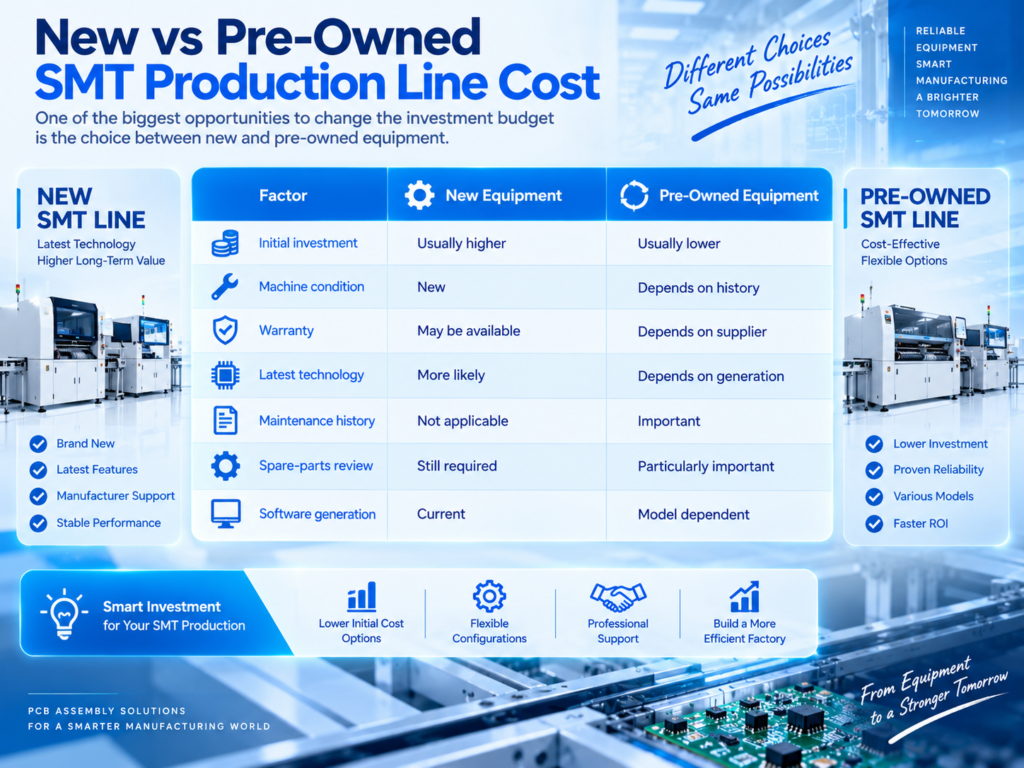
New vs Pre-Owned SMT Production Line Cost
One of the biggest opportunities to change the investment budget is the choice between new and pre-owned equipment.
A suitable pre-owned SMT line can significantly reduce initial capital requirements.
However, machine condition matters more than age alone.
What Should You Check on a Pre-Owned Pick and Place Machine?
Evaluate:
- Placement heads
- Cameras
- Sensors
- Vacuum system
- Feeders
- Nozzles
- Conveyor
- Motion system
- Software
- Computer/control system
- Maintenance records
- Spare-parts availability
A lower purchase price is not valuable if the machine produces excessive downtime.
Hybrid New + Pre-Owned SMT Line
Factories do not necessarily need to choose between an entirely new line and an entirely used line.
A hybrid configuration may combine:
- Pre-owned international-brand pick-and-place machines
- New solder paste printer
- New SPI/AOI
- New reflow oven
- New PCB handling equipment
- or another combination based on production requirements.
This can provide a different balance between:
Initial Investment + Equipment Capability + Maintenance Risk + Serviceability
Machine Price Is Not the Total SMT Project Cost
A common budgeting mistake is to add the major machine prices and treat the result as the complete factory investment.
Actual project cost can include:
Equipment + Feeders + Accessories + Installation + Utilities + Exhaust + Training + Spare Parts + Tooling + Software + Factory Preparation + Shipping
Depending on the project, additional costs may include:
- Import duties
- Local taxes
- Insurance
- Rigging
- Factory renovation
These costs vary significantly by country and project.
Factory Utilities
SMT equipment may require:
- Electrical power
- Compressed air
- Exhaust
- HVAC/environmental control
- Nitrogen where applicable
- Network connections
Factory owners should confirm equipment requirements before installation.
A line quotation does not necessarily include factory infrastructure.
ESD Control
PCBA manufacturing should also consider appropriate ESD control.
Factory investment may include:
- ESD workstations
- Flooring
- Grounding
- Storage
- Material handling
- Operator equipment
This is another example of why machine purchase price alone does not represent total factory setup cost.
Stencils and Tooling
Each PCB model may require production tooling such as:
- Stencil
- PCB support tooling
- Fixtures
- Test fixtures
High-mix factories may accumulate substantial tooling requirements over time.
Tooling should therefore be included in operating and product-introduction budgets.
Spare Parts
Initial spare parts may include items for:
- Pick-and-place machines
- Printer
- Reflow oven
- AOI/SPI
- Conveyors
Critical spares should be selected according to:
Failure Probability × Downtime Impact × Lead Time × Part Cost
A low-cost spare part can deserve local inventory if its failure would stop the entire production line.
Maintenance Cost
SMT line investment continues after installation.
Maintenance may include:
- Preventive maintenance
- Consumables
- Spare parts
- Technical labor
- External service
Calibration or verification where applicable
Emergency repair
Maintenance requirements depend on:
- Equipment model
- Machine condition
- Operating hours
- Number of shifts
- Production environment
- Product mix
There is no reliable universal rule that annual SMT maintenance always equals a fixed percentage of the machine purchase price.
Energy and Operating Cost
Operating costs can include:
- Electricity
- Compressed air
- Nitrogen where applicable
- Exhaust
- Maintenance
- Consumables
- Labor
- Spare parts
Reflow ovens and factory environmental systems can represent meaningful ongoing energy consumption.
When comparing equipment, evaluate both initial investment and long-term operation.
Total Cost of Ownership
A more useful financial model is:
SMT Line TCO = Equipment + Installation + Utilities + Feeders + Tooling + Training + Spare Parts + Maintenance + Energy + Labor + Downtime + Process Losses
A machine with the lowest purchase price does not necessarily provide the lowest total cost.
The Hidden Cost of Downtime
Suppose your SMT line produces:
120 PCBAs/hour
A placement machine failure stops production for:
5 hours
The planned production affected is:
120 × 5 = 600 PCBAs
Some production may be recovered later, but the interruption can still affect:
- Scheduling
- Labor utilization
- Delivery
- Downstream production
This is why spare-parts availability and technical support should be included in equipment selection.
How Production Capacity Affects SMT Line Cost
Higher output usually requires:
- Faster placement
- More placement modules
- More feeders
- Faster PCB handling
- Greater reflow capacity
- Faster inspection
- Better material logistics
But line speed should be calculated from the PCB.
For example:
500 placements/PCB × 200 PCB/hour = 100,000 placements/hour
This gives a starting point for placement-capacity analysis.
Actual equipment requirements should include efficiency and component-mix considerations.
High-Mix vs High-Volume SMT Line Cost
High-Mix Production
High-mix factories may prioritize:
- Large feeder capacity
- Fast changeover
- Flexible placement
- Recipe management
- Offline preparation
- Flexible inspection
Maximum CPH may not be the primary purchasing criterion.
High-Volume Production
High-volume factories may prioritize:
- Placement throughput
- Parallel modules
- Continuous material supply
- Automated handling
- Low downtime
- Traceability
The two factories may spend similar amounts but allocate the investment very differently.
Should You Buy the Fastest Pick and Place Machine You Can Afford?
Not necessarily.
Suppose:
- Printer: 100 PCB/hour
- Placement: 180 PCB/hour
- Reflow: 120 PCB/hour
- AOI: 90 PCB/hour
Finished output is approximately limited by AOI at 90 PCB/hour.
Increasing placement capacity to 250 PCB/hour would not automatically increase finished output.
The line should be balanced.
How to Reduce SMT Production Line Investment
Several strategies can reduce unnecessary capital expenditure.
Start with the PCB and BOM
Do not select machines before understanding the product.
Calculate Required Capacity
Avoid paying for production speed that will rarely be used.
Consider Suitable Pre-Owned Equipment
Well-selected pre-owned international-brand machines can reduce initial investment.
Use a Hybrid Equipment Strategy
Combine new and pre-owned machines where appropriate.
Avoid Unnecessary Automation
Not every factory needs every optional buffer, inspection system, or software package from day one.
Plan Future Expansion
A modular line can allow additional placement capacity or inspection equipment to be added later.
When Should You Spend More on an SMT Line?
Higher initial investment may be justified when it provides required improvements in:
- Capacity
- Component compatibility
- Process control
- Inspection
- Changeover
- Automation
- Traceability
- Equipment utilization
- Supportability
The decision should be based on production economics rather than equipment specifications alone.
SMT Production Line Solutions from Fuliu Electronics
Established in 2014, Fuliu Electronics is dedicated to providing customers with high-quality PCBA intelligent manufacturing solutions and services.
With extensive experience in the SMT industry, we specialize in dependable equipment, professional technical support, and complete SMT production line solutions.
Our equipment portfolio includes SMT pick and place machines from Fuji, Panasonic, ASM, Yamaha, JUKI, and Hanwha, together with ERSA reflow ovens from Germany, MagicRay SPI/AOI inspection systems, automatic solder paste printers, PCB handling equipment, pre-owned SMT equipment, SMT spare parts, machine leasing, and maintenance services.
Instead of simply asking, “How much does an SMT line cost?”, manufacturers can develop a configuration based on actual production requirements and total cost of ownership.
As part of our global growth strategy, Fuliu Electronics is actively expanding into international markets, with key focus areas including India, Vietnam, the Philippines, Indonesia, the Middle East, South Africa, and Europe.
Conclusion
So, how much does an SMT production line cost in 2026?
There is no single correct number.
For initial planning, a professional SMT line may require an investment from the low six figures to several hundred thousand US dollars, while higher-end automated lines using international-brand equipment and advanced inspection can exceed USD 1 million.
But price alone does not determine whether an SMT line is a good investment.
For a new PCBA factory, the lowest-cost line is not automatically the most economical solution. At the same time, purchasing more placement speed, inspection equipment, or automation than the production requirement justifies can unnecessarily increase capital expenditure.
The most effective approach is to start with the PCB, BOM, target boards per hour, product mix, and budget, then configure the equipment around those requirements.
If you are planning an SMT production line in 2026, Fuliu Electronics can help evaluate your PCB dimensions, BOM, component range, placements per PCB, target capacity, factory layout, inspection requirements, preferred equipment brands, new/pre-owned equipment strategy, and investment budget to develop a suitable SMT production line configuration and quotation.
Frequently Asked Questions
There is no universal fixed price. For planning purposes, professional SMT lines can range from the low six figures to several hundred thousand US dollars, while advanced international-brand high-volume lines can exceed $1 million. Very small or simplified setups can cost less.
The placement section is often one of the largest investments, especially when multiple high-speed machines and large feeder packages are required.
Prices vary widely from compact lower-capacity machines to high-speed modular production systems. Brand, speed, accuracy, feeder capacity, component range, condition, and included accessories can change the price significantly.
Not universally, but SPI can provide valuable process control by inspecting solder paste before component placement. Its value increases for products with demanding printing and quality requirements.
No. X-ray is particularly useful for selected hidden solder joints and products where the inspection requirement justifies it. Some factories use offline X-ray rather than inline equipment.
The initial investment is usually lower, but buyers should evaluate machine condition, maintenance history, software, spare-parts availability, technical support, and expected downtime.