
When manufacturers evaluate an SMT production line, the initial equipment price is often the first number they compare.
However, the purchase price is only part of the long-term investment.
After installation, manufacturers also need to consider:
- Preventive maintenance
- Spare parts
- Consumables
- Technician labor
- Calibration and inspection
- Cleaning
- Utilities
- Unplanned repairs
- Production downtime
Together, these factors contribute to the SMT line maintenance cost and the overall total cost of ownership.
A machine with a lower purchase price is not necessarily less expensive over its service life. Conversely, a higher-cost machine does not automatically guarantee lower maintenance expenses.
The real cost depends on equipment condition, production hours, product mix, maintenance practices, spare-parts availability, operator capability, and technical support.
SMT Line Maintenance Cost Explained
This guide explains the major costs involved in maintaining an SMT production line and how manufacturers can build a more realistic maintenance budget.
What Equipment Is Included in an SMT Production Line?
A typical SMT production line may include:
PCB Loader → Automatic Solder Paste Printer → SPI → Pick and Place Machine(s) → Reflow Oven → AOI → PCB Unloader
Additional equipment can include:
- Conveyors
- Buffers
- Barcode readers
- Traceability systems
- PCB handling equipment
- Vacuum systems
- Air compressors
- Fume extraction
- Nitrogen systems where required
Each machine has different maintenance requirements.
Therefore, SMT line maintenance should be planned at the complete-line level, not only around the pick and place machine.
Why Is There No Fixed SMT Line Maintenance Cost?
There is no universal annual maintenance cost that applies to every SMT factory.
Two factories using similar machines may have very different maintenance expenses because of differences in:
- Production hours
- Number of shifts
- Machine age
- Component mix
- Placement volume
- Changeover frequency
- Factory environment
- Maintenance quality
- Spare-parts strategy
- Local technician costs
A line running three shifts per day will generally experience different maintenance demands from the same equipment running only a few days per week.
For this reason, maintenance budgets should be based on the actual operating environment.
What Makes Up SMT Line Maintenance Cost?
A practical maintenance budget can be divided into several categories:
Preventive Maintenance + Spare Parts + Consumables + Technical Labor + Calibration/Inspection + Unplanned Repairs + Downtime
Not all of these costs appear directly on an equipment-service invoice.
Downtime, for example, may create a larger business impact than the cost of the replacement component itself.
Preventive Maintenance Cost
Preventive maintenance is planned work performed before a machine fails.
Depending on the equipment, it can include:
- Cleaning
- Lubrication
- Filter replacement
- Belt inspection
- Nozzle inspection
- Feeder inspection
- Conveyor adjustment
- Sensor cleaning
- Fan inspection
- Electrical inspection
- Software or data backup
- Mechanical checks
Preventive maintenance requires:
- Technician time
- Consumables
- Spare parts
- Planned production stoppage
Although this creates an ongoing cost, good preventive maintenance can reduce the risk of larger unplanned failures.
Pick and Place Machine Maintenance Cost
The pick and place machine is one of the most complex pieces of equipment in an SMT line.
Maintenance areas can include:
- Placement heads
- Nozzles
- Feeders
- Cameras
- Sensors
- Vacuum system
- Filters
- Belts
- Linear motion components
- Conveyor
- Lubrication points
- Electrical systems
Actual requirements vary between machine platforms.
Manufacturers using Fuji, Panasonic, ASM, Yamaha, JUKI, Hanwha, or other placement equipment should follow maintenance procedures appropriate to the specific machine model.
Nozzle Maintenance
Nozzles are directly involved in component pickup and placement.
They can become affected by:
- Dust
- Solder paste contamination
- Adhesive residues
- Mechanical wear
- Component debris
Poor nozzle condition can contribute to:
- Pickup errors
- Component drops
- Placement instability
- Machine stops
Routine inspection and cleaning should therefore be included in the maintenance plan.
Feeder Maintenance
Feeders are another important maintenance area.
Depending on feeder type and machine platform, potential maintenance items can include:
- Feed mechanisms
- Tape guides
- Sensors
- Gears
- Motors
- Springs
- Mechanical interfaces
A production line may contain dozens or even hundreds of feeders.
As a result, feeder maintenance can represent a significant portion of the total SMT maintenance workload.
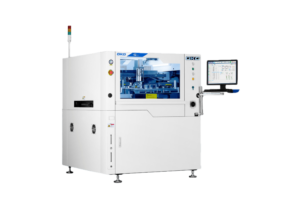
Automatic solder paste printers require routine maintenance to maintain stable printing.
Important areas include:
- Stencil cleaning system
- Squeegees
- Conveyor
- PCB clamping
- Camera system
- Sensors
- Cleaning paper
- Solvent systems
- Mechanical motion
Consumables can include:
- Cleaning paper
- Cleaning agents
- Squeegee-related parts
Poor printer maintenance can affect solder paste deposition and create downstream defects that appear later at SPI, AOI, or after reflow.
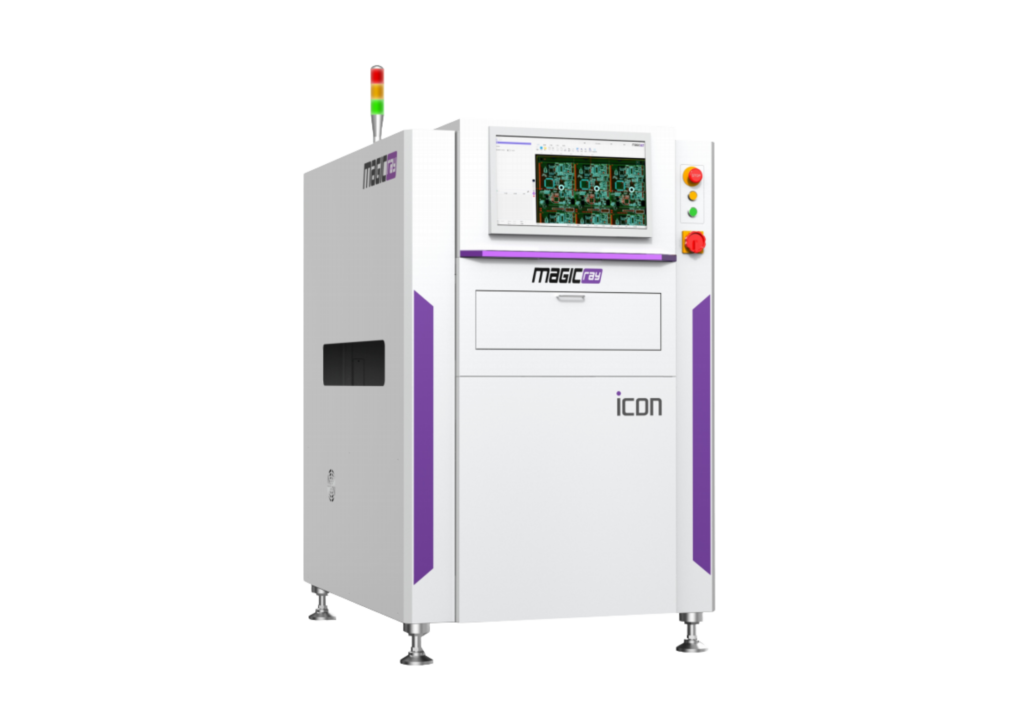
Solder Paste Inspection systems generally require less mechanical maintenance than placement machines, but they still require routine care.
Potential maintenance areas include:
- Optical system
- Lighting
- Cameras
- Conveyor
- Sensors
- Computer/control system
Regular inspection and cleaning can help maintain measurement stability.
Calibration or verification requirements should follow the equipment manufacturer’s procedures and the factory’s quality system.
Reflow Oven Maintenance Cost
A reflow oven operates continuously at elevated temperatures and requires regular maintenance.
Important areas can include:
- Flux management
- Exhaust
- Filters
- Fans
- Motors
- Heaters
- Conveyor chains
- Conveyor rails
- Lubrication
- Cooling system
- Temperature sensors
Flux residues can accumulate inside the oven over time.
The amount of maintenance required depends partly on:
- Solder paste
- Flux chemistry
- Production volume
- Operating temperature
- Maintenance frequency
Ignoring oven cleaning can eventually affect airflow, exhaust, and process stability.
Conveyor Maintenance in a Reflow Oven
The conveyor transports PCBAs through the thermal process.
Maintenance may include:
- Chain cleaning
- Lubrication
- Width adjustment
- Rail inspection
- Tension inspection
Poor conveyor condition can result in unstable PCB transport or production interruption.
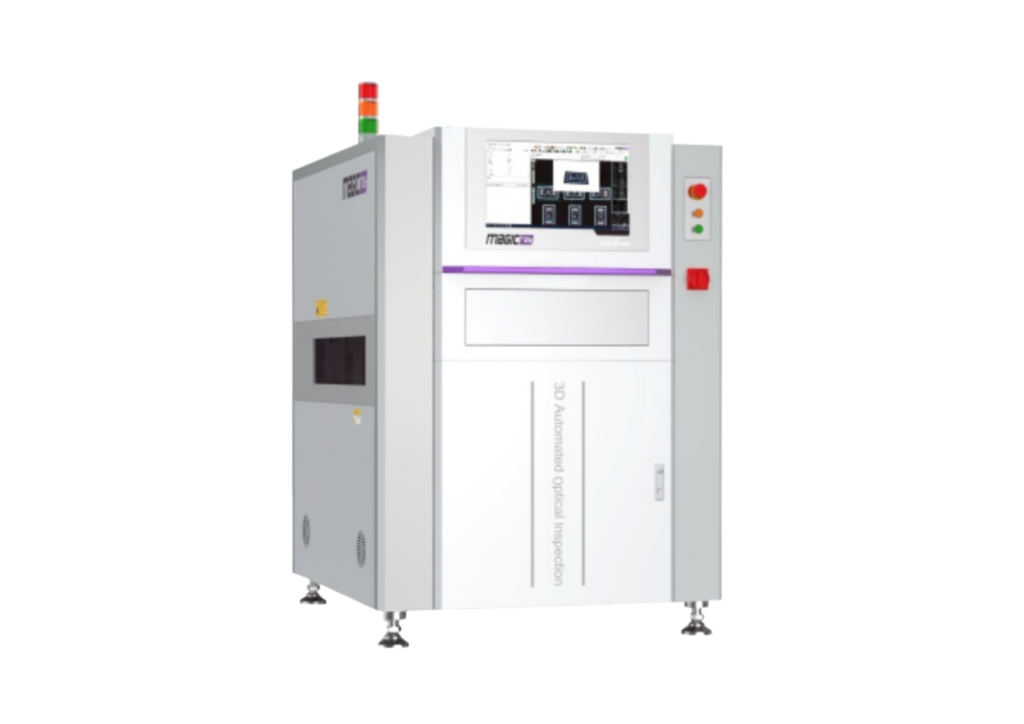
AOI maintenance can include:
- Camera cleaning
- Lighting inspection
- Conveyor maintenance
- Sensor cleaning
- Computer maintenance
- Data storage management
- Program optimization is also important.
Although programming work is not always classified as machine maintenance, poorly optimized inspection programs can increase false calls and consume engineering labor.
PCB Handling Equipment Maintenance
Loaders, unloaders, conveyors, and buffers are mechanically simpler than placement machines but still require maintenance.
Typical items include:
- Belts
- Motors
- Sensors
- Cylinders
- Rails
- Width adjustment systems
- Magazine mechanisms
A low-cost conveyor failure can still stop the entire line.
Therefore, supporting equipment should not be ignored in the maintenance plan.
Spare Parts Cost
Spare parts are one of the most visible maintenance expenses.
Depending on the equipment, spare parts may include:
- Nozzles
- Belts
- Filters
- Sensors
- Motors
- Bearings
- Fans
- Heaters
- Conveyor components
- Vacuum components
- Feeder parts
- Electrical components
The cost depends heavily on machine brand, model, age, and part availability.
Critical Spare Parts vs Routine Spare Parts
It is useful to divide spare parts into two categories.
Routine Parts
These are used regularly or replaced as part of normal maintenance.
Examples can include:
- Filters
- Belts
- Cleaning materials
- Selected seals
Critical Parts
These may not fail frequently, but a failure can stop production for a long period if the part is unavailable.
Examples depend on the machine but may include:
- Motors
- Controllers
- Specialized sensors
- Head components
- Heating components
- Computer/control hardware
Factories should identify critical parts according to the actual equipment installed.
How Much Spare Parts Inventory Should You Keep?
Keeping every possible component in stock is expensive.
Keeping no spare parts creates downtime risk.
A better strategy is to evaluate:
Failure Probability × Downtime Impact × Part Lead Time × Part Cost
High-impact components with long procurement lead times may justify local stock even if they fail infrequently.
Routine low-cost consumables should usually be maintained at appropriate minimum stock levels.
Consumables Cost
Consumables are sometimes excluded when companies calculate “maintenance cost,” but they still affect operating budgets.
SMT-related consumables may include:
- Printer cleaning paper
- Cleaning agents
- Filters
- Lubricants
- Wipes
- Nozzle-cleaning materials
- Maintenance chemicals
Consumable usage depends on production volume and maintenance procedures.
Factories should track actual monthly consumption rather than relying only on initial estimates.
Maintenance Labor Cost
Maintenance requires skilled personnel.
Factories may use:
- Internal technicians
- Equipment engineers
- External service providers
- Machine supplier support
- Labor cost depends on:
- Machine complexity
- Technician skill
- Local labor rates
- Number of machines
- Production schedule
- Service agreement
A factory operating continuously may require stronger in-house technical capability because waiting for external support can create long production interruptions.
Emergency Repair Cost
Preventive maintenance cannot eliminate every failure.
Unexpected problems may include:
- Sensor failure
- Motor failure
- Feeder malfunction
- Conveyor failure
- Heater failure
- Computer/control issue
- Vacuum problem
Emergency repairs can create costs from:
Replacement Parts + Technician Labor + Expedited Shipping + Production Downtime
This is why maintenance planning should include a contingency budget.
Downtime Is Often the Largest Hidden Cost
Suppose a component costing a relatively small amount stops the placement machine for several hours.
The replacement part itself may be inexpensive.
But the factory can also lose:
- Production output
- Operator utilization
- Delivery time
- Upstream/downstream balance
Therefore:
Maintenance Cost ≠ Replacement Part Cost
A better view is: Failure Cost = Repair Cost + Lost Production + Recovery Cost
This makes spare-parts availability and technical response time important purchasing considerations.
Example of Downtime Cost
Assume an SMT line produces 120 PCBAs per hour.
If an equipment failure stops production for four hours:
120 × 4 = 480 PCBAs of planned output affected
This does not mean all 480 boards become a direct financial loss, because production may be recovered later.
However, it illustrates why downtime should be included when evaluating maintenance strategy.
Machine Age and Maintenance Cost
As SMT equipment ages, maintenance requirements may change.
Older equipment can experience:
- Mechanical wear
- Aging cables
- Aging sensors
- Computer obsolescence
- Control-system limitations
- Reduced spare-parts availability
However, machine age alone does not determine condition.
A well-maintained older machine may perform better than a newer machine with poor maintenance history.
When evaluating pre-owned SMT equipment, condition and supportability are more useful indicators than age alone.
Production Hours Matter
A machine running:
8 hours/day
will generally experience a different maintenance load from one operating:
24 hours/day
High-utilization factories should consider:
- More frequent preventive maintenance
- Larger spare-parts stock
- Stronger technician coverage
- Planned maintenance windows
Maintenance intervals should follow the equipment manufacturer’s recommendations and actual operating conditions.
Product Mix Can Affect Maintenance
High-mix production may require:
- Frequent feeder changes
- More nozzle changes
- More recipe changes
- More conveyor-width adjustment
- Frequent setup
These activities can increase wear and maintenance workload.
High-volume production may have fewer changeovers but much higher machine operating hours.
Therefore, both production models create different maintenance demands.
Factory Environment Affects Equipment Maintenance
SMT machines perform best in an appropriately controlled manufacturing environment.
Potential environmental factors include:
- Dust
- Temperature
- Humidity
- Power quality
- Compressed-air quality
- Floor vibration
- General cleanliness
Poor environmental conditions can increase contamination or equipment stress.
Facility conditions should therefore be considered part of equipment-care strategy.
Compressed Air Quality
Machines using compressed air depend on suitable air quality.
Contamination or moisture can affect pneumatic components.
Factories should follow the equipment manufacturer’s utility specifications and maintain the facility air system appropriately.
This is a facility maintenance cost that can indirectly affect SMT equipment reliability.
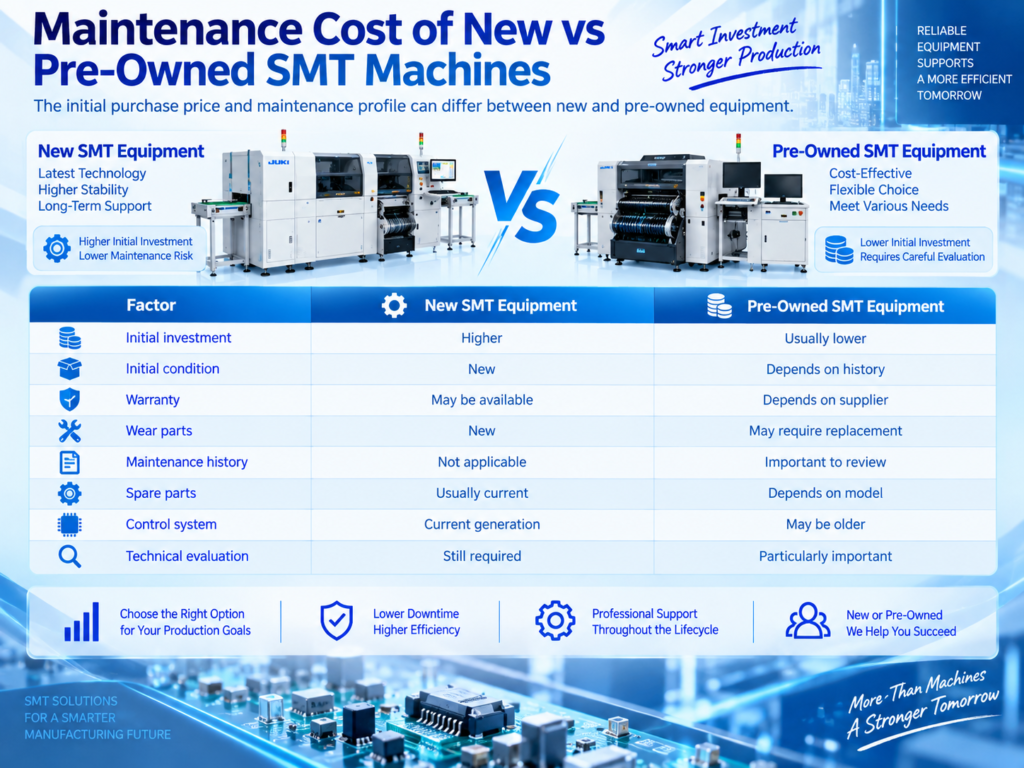
The initial purchase price and maintenance profile can differ between new and pre-owned equipment.
Pre-owned equipment should not automatically be considered expensive to maintain.
The key variables are:
- Machine condition
- Maintenance history
- Model support
- Spare parts
- Technician expertise
- Previous operating environment
Maintenance Cost vs Machine Purchase Price
Consider two machines:
Machine A
- Lower purchase price
- Difficult spare-parts sourcing
- Limited technical support
- Longer repair time
Machine B
- Higher purchase price
- Better parts availability
- Established technical support
- Faster maintenance response
Machine A may initially appear cheaper.
However, if it causes substantially more downtime, its total cost of ownership may be higher.
This is why equipment procurement should consider maintenance before purchase.
Preventive vs Corrective Maintenance
Preventive Maintenance
Work is scheduled before failure.
Advantages can include:
- Planned downtime
- Early wear detection
- Better spare-parts planning
- Lower risk of unexpected interruption
Corrective Maintenance
Maintenance is performed after a failure occurs.
It may be unavoidable for unexpected faults, but relying only on corrective maintenance increases production risk.
A practical maintenance program normally combines scheduled preventive work with the ability to respond quickly to unexpected failures.
How to Build an SMT Preventive Maintenance Schedule
A maintenance plan can be organized by frequency.
Daily Tasks
Depending on equipment:
- Machine cleaning
- Nozzle inspection
- Sensor inspection
- Printer cleaning
- General visual checks
- Weekly Tasks
Possible activities include:
- Feeder inspection
- Conveyor checks
- Filter checks
- Vacuum-system inspection
- Machine-area cleaning
Monthly or Periodic Tasks
These may include:
- Lubrication
- Belt inspection
- Mechanical checks
- Reflow oven cleaning
- Fan inspection
- Electrical inspection
Longer-Interval Maintenance
Depending on the machine:
- Major mechanical inspection
- Component replacement
- Calibration/verification
- Software/data backup
- Specialized service
Actual intervals should always follow the relevant equipment manual and operating conditions.
How to Calculate an SMT Maintenance Budget
Instead of using one fixed percentage of machine price, build the budget from actual categories.
A simplified annual model is:
Annual SMT Maintenance Budget = Planned Maintenance + Spare Parts + Consumables + Maintenance Labor + External Service + Contingency
Downtime can then be tracked separately as an operational cost.
For example:
For a new factory without historical data, the initial budget should be refined after several months of operation.
Track Maintenance Cost per Machine
Factories should avoid grouping all maintenance expenses into one general account.
Track cost by equipment:
- Printer
- SPI
- Pick and place machine
- Reflow oven
- AOI
- Loader/unloader
- Conveyors
This helps identify which equipment is consuming the most maintenance resources.
Track Maintenance Cost per Production Hour
Another useful metric is:
Maintenance Cost per Operating Hour = Total Maintenance Cost ÷ Equipment Operating Hours
This allows manufacturers to compare:
- Different machines
- Different production lines
- Different years
However, cost alone should not be used without considering machine output and product complexity.
Track Mean Time Between Failures
Factories can also monitor equipment reliability indicators such as failure frequency and repair duration.
Useful operational data includes:
- Failure date
- Machine
- Failure type
- Root cause
- Part replaced
- Downtime
- Repair time
- Technician
- Cost
Over time, this data can identify recurring failures.
Why Maintenance Records Matter
Without records, factories may repeatedly repair the same problem without identifying the underlying cause.
Maintenance records can help identify:
- Frequently failing components
- Machines with increasing downtime
- Recurring feeder problems
- Preventive maintenance gaps
- Parts that should be stocked
- Equipment approaching replacement consideration
Data turns maintenance from reactive repair into equipment management.
How to Reduce SMT Line Maintenance Costs
Manufacturers can reduce long-term maintenance cost without reducing necessary maintenance.
- Follow Preventive Maintenance
Regular cleaning, inspection, lubrication, and replacement of wear items can reduce avoidable failures.
- Train Operators
Operators should understand:
- Correct startup/shutdown
- Basic cleaning
- Feeder handling
- Nozzle handling
- Alarm response
- When to call maintenance
Incorrect operation can create unnecessary equipment damage.
- Maintain Critical Spare Parts
Stock high-impact parts based on:
- Failure risk
- Procurement lead time
- Downtime impact
- Maintain Feeders and Nozzles
Do not focus only on the main machine.
Feeders and nozzles directly affect placement performance.
- Keep the Factory Environment Controlled
Clean equipment and appropriate utility conditions can reduce contamination-related problems.
- Analyze Repeated Failures
If the same fault occurs repeatedly, investigate the root cause rather than repeatedly replacing parts.
- Standardize Equipment Where Practical
Using common machine platforms across multiple lines can sometimes simplify:
- Technician training
- Spare-parts inventory
- Feeder management
- Maintenance procedures
However, equipment standardization should not override actual production requirements.
- Choose Equipment with Available Technical Support
Service capability should be evaluated during procurement, not only after the machine fails.
Maintenance Cost When Expanding an SMT Factory
When adding a second or third line, consider whether existing maintenance resources can support the additional equipment.
Ask:
- Do we have enough technicians?
- Can spare parts be shared?
- Are machine platforms standardized?
- Do we need additional service contracts?
- Can maintenance be performed without stopping multiple lines?
Factory expansion increases maintenance workload even if individual machines are highly reliable.
Should You Repair or Replace an Older SMT Machine?
Replacement may be worth evaluating when:
- Downtime is increasing
- Critical parts are difficult to obtain
- Repair cost is rising
- Control hardware is obsolete
- Product requirements exceed machine capability
- Maintenance consumes excessive engineering time
However, replacement should not be based on age alone.
Compare:
Continued Maintenance Cost + Downtime Risk
against:
Replacement Investment + Installation + Training + Production Transition
Maintenance Should Be Included in SMT Line ROI
When calculating ROI for a new SMT line, include:
- Equipment purchase
- Installation
- Utilities
- Training
- Spare parts
- Maintenance
- Labor
- Energy
- Downtime
- Expected equipment utilization
A cheaper machine can have poor ROI if it requires frequent repair.
A more expensive machine can also have poor ROI if its additional capability is never used.
The objective is to match the equipment to actual production requirements.
SMT Maintenance Planning for a New Factory
A new factory should establish maintenance systems before mass production begins.
Prepare:
- Equipment list
- Maintenance manuals
- Maintenance schedule
- Spare-parts list
- Consumables list
- Technician responsibilities
- Maintenance records
- Emergency support contacts
- Critical-parts inventory
- Planned maintenance windows
This reduces dependence on emergency maintenance after production ramps up.
Questions to Ask an SMT Equipment Supplier
Before purchasing equipment, ask:
- What routine maintenance is required?
- What are the recommended maintenance intervals?
- Which parts are consumables?
- Which spare parts should be stocked?
- What special tools are required?
- Is technician training available?
- Is remote technical support available?
- How are spare parts supplied?
- Are older machine models still supported?
- What should be inspected on pre-owned equipment?
- What maintenance documentation is provided?
The answers can significantly affect long-term ownership cost.
Information Needed to Estimate Maintenance Requirements
For a more realistic maintenance assessment, provide:
- Machine brand and model
- Machine age
- Equipment condition
- Production hours per day
- Number of shifts
- Production days per month
- Product mix
- Placement volume
- Number of feeders
- Existing maintenance history
- Current spare-parts inventory
- Factory location
- Technician availability
- Current downtime data
- Future capacity requirements
This provides a better basis for maintenance planning than using a universal percentage of equipment price.
SMT Equipment and Maintenance Support from Fuliu Electronics
Established in 2014, Fuliu Electronics is dedicated to providing customers with high-quality PCBA intelligent manufacturing solutions and services.
With extensive experience in the SMT industry, we specialize in dependable equipment, professional technical support, and complete SMT production line solutions.
Our product portfolio includes SMT pick and place machines from Fuji, Panasonic, ASM, Yamaha, JUKI, and Hanwha, together with ERSA reflow ovens from Germany, MagicRay SPI/AOI inspection systems, automatic solder paste printers, supporting equipment, pre-owned SMT equipment, and SMT spare parts.
Fuliu Electronics also provides machine leasing and maintenance services, helping manufacturers evaluate both equipment acquisition and long-term operation.
For customers planning a new SMT line, expanding an existing factory, or evaluating pre-owned equipment, maintenance considerations can be included during the equipment-selection stage.
Important factors include:
- Machine condition
- Production volume
- Product mix
- Spare-parts availability
- Maintenance requirements
- Existing technician capability
- Factory layout
- Automation requirements
- Investment budget
This helps manufacturers consider not only the initial machine price but also the long-term total cost of ownership.
As part of our global growth strategy, Fuliu Electronics is actively expanding into international markets, with key focus areas including India, Vietnam, the Philippines, Indonesia, the Middle East, South Africa, and Europe.
Frequently Asked Questions
There is no universal fixed amount. Maintenance cost depends on machine type, age, production hours, number of shifts, spare-parts prices, technician costs, product mix, and maintenance practices.
It depends on the line and operating conditions. Pick and place machines have many mechanical and feeding systems, while printers and reflow ovens also require regular cleaning and maintenance.
Include preventive maintenance, spare parts, consumables, technician labor, external service, emergency repairs, and an appropriate contingency.
Yes. Feeder condition directly affects component feeding and placement performance, so feeder inspection and maintenance should be part of the program.
Maintenance frequency depends on the machine model, production hours, environment, and manufacturer recommendations. Use the equipment manual rather than one universal schedule.
Not necessarily. Maintenance depends on machine condition, history, model support, spare-parts availability, and previous maintenance. A properly maintained pre-owned machine can still be a practical production asset.