
The global electronics industry continues to expand rapidly, driven by increasing demand for electric vehicles, consumer electronics, industrial automation, telecommunications, medical devices, renewable energy systems, and IoT products. As a result, more entrepreneurs, OEMs, EMS providers, and electronics manufacturers are investing in PCB assembly (PCBA) facilities to strengthen their production capabilities and reduce dependence on outsourced manufacturing.
However, building a PCB assembly factory is far more complex than simply purchasing SMT equipment. A successful factory requires careful planning, optimized production flow, suitable facility infrastructure, reliable quality control systems, experienced personnel, and scalable manufacturing processes.
Whether you are building your first SMT factory or expanding an existing production facility, this guide explains how to build a PCB assembly factory step by step—from business planning and facility design to equipment selection, installation, commissioning, and long-term operational success.
Why Build Your Own PCB Assembly Factory?
Owning an in-house PCB assembly facility provides manufacturers with greater control over production quality, delivery schedules, intellectual property, and manufacturing costs.
Major advantages include:
- Faster product development
- Shorter lead times
- Better quality control
- Reduced outsourcing costs
- Higher production flexibility
- Improved customer responsiveness
- Greater supply chain security
- Long-term competitive advantage
For companies producing medium- or high-volume electronics, in-house SMT manufacturing can become a valuable strategic investment.
Step 1: Define Your Production Goals
Every successful factory begins with a clear production strategy.
Before purchasing equipment, determine:
- What products will you manufacture?
- What industries will you serve?
- What PCB sizes will be processed?
- What annual production capacity is required?
- Will production focus on prototypes, low-volume, or mass production?
- Which quality certifications are required?
Clearly defined objectives help determine factory size, equipment configuration, staffing requirements, and investment priorities.
Step 2: Select the Right Factory Location
The location of your PCB assembly factory directly affects operating costs and logistics efficiency.
Important considerations include:
- Reliable electrical supply
- Stable internet connectivity
- Convenient transportation
- Skilled labor availability
- Supplier proximity
- Environmental regulations
- Expansion opportunities
- Customer accessibility
Choosing the right location reduces operational risk and supports long-term business growth.
Step 3: Design the Factory Layout
A well-designed layout minimizes unnecessary movement and improves production efficiency.
A typical PCB assembly factory is divided into dedicated functional areas:
- Raw material warehouse
- Incoming material inspection (IQC)
- ESD-controlled component storage
- PCB loading area
- SMT production line
- AOI/X-Ray inspection area
- ICT/FCT testing area
- Rework station
- PCB cleaning area
- Final quality inspection (FQC)
- Packaging area
- Finished goods warehouse
- Engineering office
- Maintenance room
An efficient material flow reduces bottlenecks and improves productivity.
Step 4: Prepare Factory Infrastructure
SMT equipment requires supporting infrastructure to operate reliably.
Essential infrastructure includes:
- Stable electrical power
- UPS backup systems
- Compressed air supply
- Nitrogen system (if required)
- HVAC and temperature control
- Humidity control
- Dust extraction
- ESD flooring
- Grounding systems
- Network infrastructure
- Fire protection systems
Maintaining stable environmental conditions improves soldering quality and equipment reliability.
Step 5: Choose the Right SMT Production Line
The SMT production line is the heart of the factory.
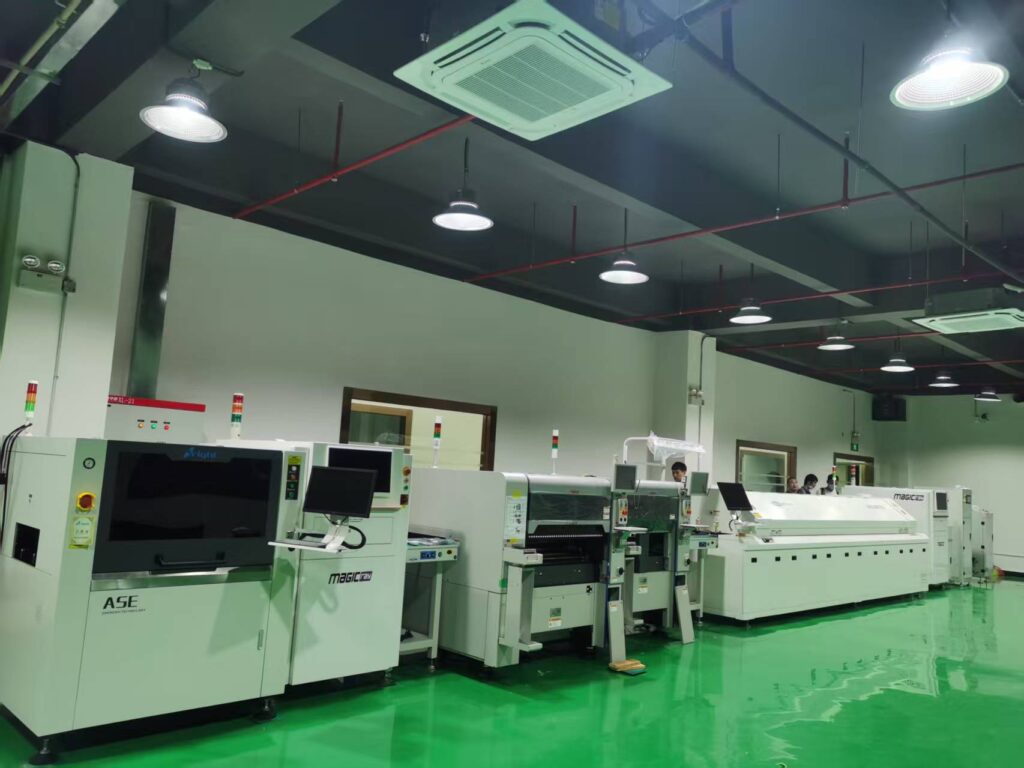
A complete production line typically includes:
- Automatic PCB Loader
- Automatic Solder Paste Printer
- SPI (Solder Paste Inspection)
- High-Speed Pick and Place Machine
- Precision Chip Mounter
- Multi-Zone Reflow Oven
- AOI Inspection Machine
- X-Ray Inspection System (optional)
- ICT/FCT Testing Equipment
- PCB Cleaning Machine (optional)
- PCB Unloader
- Conveyor Systems
Equipment should be selected based on production volume, PCB complexity, and future expansion requirements.
Step 6: Implement Quality Control Systems
Quality management should be integrated into every stage of production.
Typical inspection processes include:
Incoming Quality Control (IQC)
Verifies PCB quality and component conformity before production.
Solder Paste Inspection (SPI)
Measures solder paste volume, height, and printing accuracy.
Automated Optical Inspection (AOI)
Detects:
- Missing components
- Incorrect polarity
- Component offset
- Rotation errors
- Solder bridges
- Tombstoning
X-Ray Inspection
Evaluates hidden solder joints on BGA, QFN, and CSP packages.
Functional Testing (FCT)
Verifies electrical performance before shipment.
Implementing multiple inspection stages improves first-pass yield and reduces customer returns.
Step 7: Establish ESD Protection
Electrostatic discharge can damage sensitive electronic components without visible signs.
A professional PCB assembly factory should implement:
- ESD flooring
- Wrist straps
- ESD workbenches
- Conductive chairs
- Ionizers
- ESD-safe storage racks
- Humidity monitoring
- Employee training
Proper ESD control protects both products and production yield.
Step 8: Build an Experienced Engineering Team
Even the most advanced equipment depends on skilled personnel.
A typical PCB assembly factory requires:
- Production managers
- SMT process engineers
- Equipment engineers
- Quality engineers
- Maintenance technicians
- AOI programmers
- SPI engineers
- Production operators
- Warehouse personnel
- Procurement specialists
Continuous training ensures consistent production quality and efficient equipment utilization.
Step 9: Implement Manufacturing Software
Modern PCB assembly factories rely on software to improve visibility and control.
Common systems include:
- MES (Manufacturing Execution System)
- ERP integration
- SPC (Statistical Process Control)
- Barcode traceability
- Production dashboards
- Equipment monitoring
- Maintenance scheduling
- Material management
These systems support data-driven decision-making and Industry 4.0 manufacturing.
Step 10: Plan for Future Expansion
Many manufacturers underestimate future production growth.
A scalable factory design should allow for:
- Additional SMT lines
- Larger PCB sizes
- Higher production volumes
- More inspection stations
- Warehouse expansion
- Increased automation
Planning ahead reduces future renovation costs and production interruptions.
Common Challenges When Building a PCB Assembly Factory
Understanding common challenges helps avoid costly mistakes.
Typical issues include:
Poor Factory Layout
Inefficient material flow increases labor costs and production delays.
Selecting Equipment Based Only on Price
Low-cost equipment may result in lower reliability, higher maintenance costs, and reduced productivity.
Insufficient Inspection Capability
Skipping SPI, AOI, or X-Ray inspection often leads to increased rework and lower product quality.
Underestimating Utility Requirements
Compressed air, electrical power, HVAC, and ESD protection should be designed before equipment installation.
Lack of Employee Training
Proper equipment operation, maintenance, and quality management require continuous technical training.
Why Many Manufacturers Choose Turnkey SMT Solutions
Instead of purchasing machines from multiple suppliers, many companies select turnkey SMT solutions.
Benefits include:
- Single project partner
- Integrated equipment configuration
- Factory layout planning
- Installation and commissioning
- Operator training
- Unified technical support
- Faster production startup
- Lower implementation risk
Turnkey projects simplify factory construction and reduce coordination between multiple vendors.
How Long Does It Take to Build a PCB Assembly Factory?
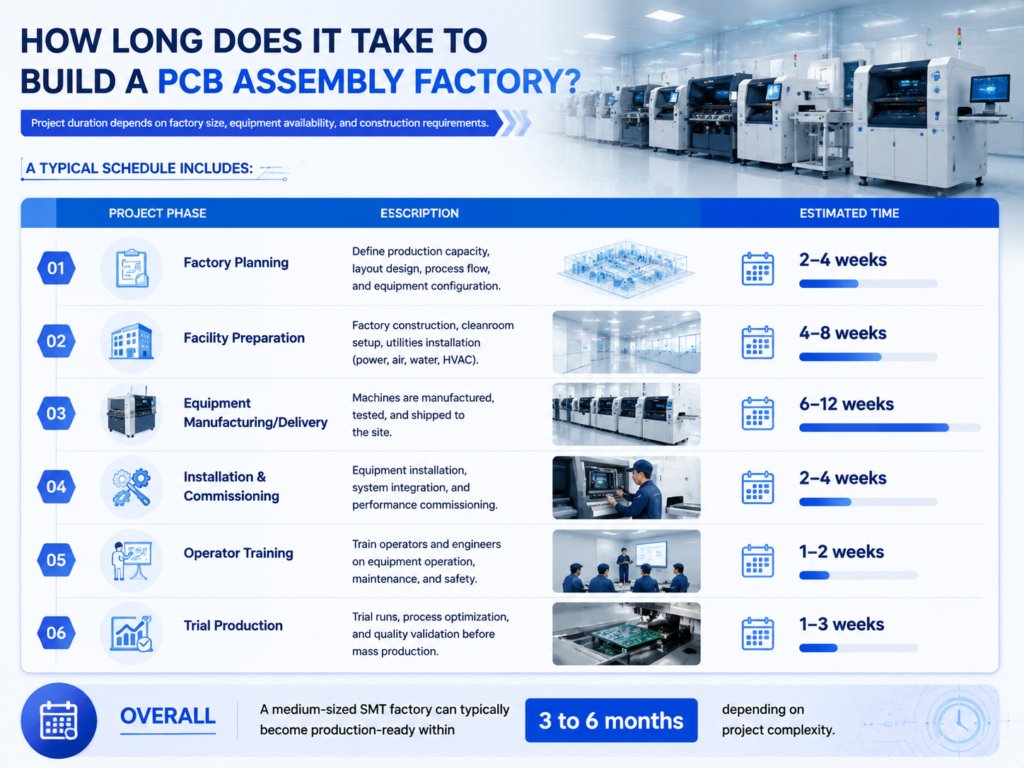
Project duration depends on factory size, equipment availability, and construction requirements.
Overall, a medium-sized SMT factory can typically become production-ready within 3 to 6 months, depending on project complexity.
Why Choose Fuliu Electronics?
Established in 2014, Fuliu Electronics is dedicated to providing customers with high-quality PCBA intelligent manufacturing solutions and comprehensive technical services.
With extensive experience in the SMT industry, Fuliu Electronics supplies complete SMT production line solutions featuring internationally recognized brands such as Fuji, Panasonic, ASM, Yamaha, JUKI, and Hanwha, together with ERSA reflow ovens, MagicRay SPI/AOI inspection systems, automatic solder paste printers, refurbished SMT equipment, SMT spare parts, equipment leasing, maintenance services, and complete turnkey factory integration.
Serving customers across India, Vietnam, the Philippines, Indonesia, the Middle East, South Africa, and Europe, Fuliu Electronics supports customers throughout every stage of factory development—from production planning and layout design to equipment installation, commissioning, operator training, process optimization, preventive maintenance, and long-term technical support.
Conclusion
Building a PCB assembly factory is a significant investment that requires careful planning, the right equipment, and a strong operational strategy. Success depends not only on selecting high-performance SMT machines but also on designing an efficient factory layout, implementing robust quality control, preparing reliable infrastructure, and building a skilled engineering team.
By partnering with an experienced turnkey SMT provider, manufacturers can reduce implementation risks, accelerate production startup, and establish a scalable, future-ready PCB assembly facility capable of meeting evolving market demands.
Frequently Asked Questions
A complete PCB assembly factory typically requires a PCB loader, solder paste printer, SPI system, pick and place machines, reflow oven, AOI inspection machine, conveyors, testing equipment, PCB unloader, and supporting infrastructure such as compressed air, ESD protection, and HVAC.
The required space depends on production capacity and the number of SMT lines. In addition to production equipment, manufacturers should allocate space for warehouses, inspection areas, testing stations, offices, and future expansion.
For most manufacturers, turnkey solutions simplify project management by providing integrated equipment, installation, commissioning, training, and long-term technical support through a single supplier.
AOI is essential for detecting assembly defects early, improving first-pass yield, reducing manual inspection, and maintaining consistent product quality.
Most medium-sized PCB assembly factories can be completed and begin production within three to six months, depending on facility preparation, equipment delivery, and commissioning.
Evaluate your target market, production volume, PCB complexity, automation requirements, factory infrastructure, quality standards, budget, and future expansion plans before selecting equipment and suppliers.