
As electronic products become smaller, faster, and more complex, maintaining consistent product quality has become increasingly challenging. Modern PCBs often contain thousands of components, including fine-pitch ICs, BGAs, QFNs, and miniature passive devices. Even a single missing resistor or poor solder joint can lead to product failure, costly rework, or warranty claims.
To ensure manufacturing quality, Automated Optical Inspection (AOI) has become a standard process in modern SMT production lines. However, with numerous AOI systems available on the market, choosing the right equipment is not always straightforward.
Different manufacturers have different production volumes, PCB designs, quality requirements, and budgets. Selecting an AOI machine that aligns with your manufacturing needs is essential for maximizing inspection efficiency and return on investment.
How to Choose an AOI Inspection Machine
In this guide, we’ll explain how to choose an AOI inspection machine, compare key specifications, and discuss the factors manufacturers should evaluate before making an investment.
What Is an AOI Inspection Machine?
An AOI (Automated Optical Inspection) machine is an automated inspection system that uses high-resolution cameras, advanced lighting, and intelligent image processing software to detect manufacturing defects on assembled PCBs.
AOI systems automatically compare the manufactured PCB against a reference model or inspection criteria to identify defects during production.
Typical defects detected include:
- Missing components
- Incorrect components
- Wrong polarity
- Component rotation
- Component offset
- Solder bridges
- Insufficient solder
- Tombstoning
- Lifted leads
- Foreign objects
AOI greatly improves inspection speed and consistency compared with manual visual inspection.
Why Is AOI Important?
Without automated inspection, many defects may remain undetected until functional testing—or worse, after products reach customers.
AOI helps manufacturers:
- Improve first-pass yield (FPY)
- Reduce manual inspection
- Detect defects earlier
- Lower rework costs
- Improve product reliability
- Increase production efficiency
- Support quality traceability
AOI is now considered an essential part of most medium- and high-volume SMT production lines.
Inline AOI vs. Offline AOI
One of the first decisions is whether to choose an inline or offline inspection system.
Inline AOI
Inline AOI is integrated directly into the SMT production line.
Advantages include:
- Real-time inspection
- Immediate defect detection
- Automatic board handling
- Higher production efficiency
- Continuous manufacturing
Inline systems are ideal for medium- and high-volume production.
Offline AOI
Offline AOI operates independently from the production line.
Advantages include:
- Lower investment
- Flexible inspection
- Suitable for prototypes
- Easy implementation
Offline systems are often used in R&D laboratories, low-volume production, or secondary quality verification.
Key Factors When Choosing an AOI Inspection Machine
Several technical specifications directly affect inspection performance.
Inspection Accuracy
Inspection accuracy is one of the most important considerations.
A high-quality AOI system should reliably detect:
- Fine-pitch solder defects
- Tiny passive components
- Component alignment errors
- Small solder bridges
Higher resolution generally improves inspection capability for miniature electronics.
Camera Resolution
Camera resolution affects image quality and defect recognition.
Modern AOI machines commonly use:
- High-resolution industrial cameras
- Multiple camera configurations
- Top-view cameras
- Angled cameras
Higher-resolution cameras improve inspection of increasingly compact PCB designs.
Lighting Technology
Lighting plays a critical role in image quality.
Advanced AOI machines often use:
- RGB LED lighting
- White LED lighting
- Multi-angle illumination
- Structured lighting
- Programmable lighting profiles
Proper lighting helps identify subtle solder defects that are difficult to detect under uniform illumination.
Inspection Speed
Production capacity should match inspection throughput.
Evaluate:
- Cycle time
- Boards per hour
- Components inspected per second
- Maximum PCB size
- Conveyor speed
The AOI system should keep pace with the SMT production line without becoming a bottleneck.
Detection Capability
Verify which defects the system can detect.
Common inspection capabilities include:
- Missing components
- Wrong components
- Incorrect polarity
- Rotation errors
- Component shift
- Lifted leads
- Solder bridges
- Insufficient solder
- Excess solder
- Foreign material
Different AOI software platforms may vary in detection performance.
Software Intelligence
Modern AOI performance depends heavily on software.
Important software features include:
- Intelligent defect classification
- Automatic programming
- CAD data import
- Library management
- Statistical analysis
- SPC integration
- MES connectivity
- False call reduction
Powerful software reduces programming time while improving inspection consistency.
False Call Rate
False calls occur when acceptable boards are incorrectly identified as defective.
High false call rates increase:
- Manual verification
- Inspection time
- Production costs
Choose systems with intelligent algorithms that minimize unnecessary inspections while maintaining high defect detection rates.
Programming Time
New product introduction (NPI) often requires frequent program changes.
Efficient programming features include:
- Automatic CAD import
- Component libraries
- Recipe management
- Offline programming
- AI-assisted optimization
Shorter programming time improves manufacturing flexibility.
Ease of Operation
Operator-friendly interfaces reduce training time.
Look for:
- Intuitive software
- Large touchscreens
- Guided workflows
- Automatic recipe selection
- Clear alarm displays
Easy operation improves productivity while reducing operator errors.
Integration with the SMT Line
Modern AOI equipment should integrate seamlessly with other SMT equipment.
Compatible systems typically support:
- Conveyor communication
- SPI integration
- MES connectivity
- Barcode traceability
- Production monitoring
- Factory automation
Strong integration enables real-time quality control throughout the production process.
AOI Camera Configurations
Different camera arrangements support different inspection requirements.
2D AOI
Suitable for:
- Standard SMT inspection
- Component presence
- Polarity verification
- Position inspection
3D AOI
3D AOI measures:
- Solder height
- Coplanarity
- Component height
- Lifted leads
3D inspection is increasingly used for advanced electronics and automotive applications.
Multi-Camera AOI
Multi-camera systems combine:
- Vertical cameras
- Angled cameras
- Multiple lighting directions
These configurations improve inspection of complex solder joints and hidden features.
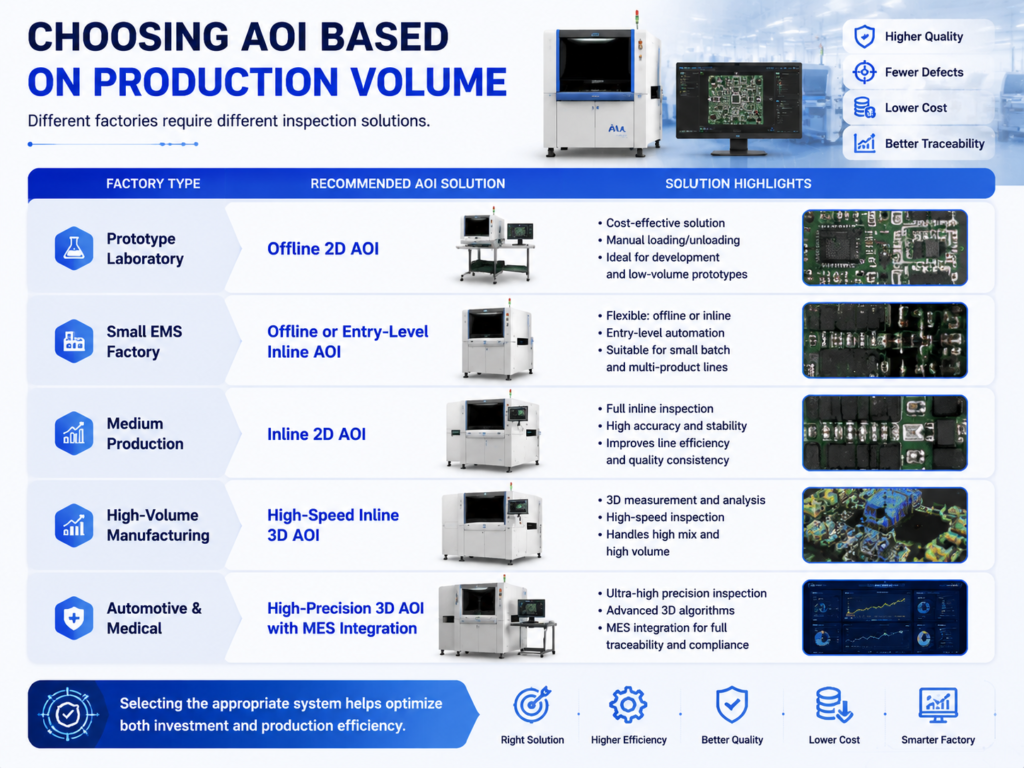
Choosing AOI Based on Production Volume
Different factories require different inspection solutions.
Selecting the appropriate system helps optimize both investment and production efficiency.
AOI and Industry 4.0
Modern AOI machines increasingly support intelligent manufacturing.
Industry 4.0 features include:
- MES integration
- SPC data collection
- Barcode traceability
- Cloud monitoring
- Production dashboards
- Remote diagnostics
- AI-assisted inspection
- Predictive maintenance
These capabilities improve process control and enable data-driven quality management.
Questions to Ask Before Purchasing an AOI Machine
Before selecting a supplier, consider the following:
- What PCB sizes can the machine inspect?
- Does it support both 2D and 3D inspection?
- What is the inspection speed?
- How accurate is the defect detection?
- What is the false call rate?
- Is CAD import supported?
- Can it integrate with my SMT line?
- What training is included?
- Is local technical support available?
- Are spare parts readily available?
A comprehensive evaluation helps reduce investment risk.
Common Mistakes When Choosing an AOI Machine
Many manufacturers focus only on purchase price.
Other common mistakes include:
- Ignoring software capabilities
- Underestimating future production growth
- Selecting insufficient inspection speed
- Overlooking integration requirements
- Choosing equipment without reliable technical support
- Ignoring programming efficiency
- Not evaluating total cost of ownership
Considering the complete lifecycle value often leads to a better investment.
Why Choose Fuliu Electronics?
Established in 2014, Fuliu Electronics is dedicated to providing customers with high-quality PCBA intelligent manufacturing solutions and comprehensive technical services.
With extensive experience in the SMT industry, Fuliu Electronics supplies complete SMT production line solutions featuring internationally recognized brands such as Fuji, Panasonic, ASM, Yamaha, JUKI, and Hanwha, together with ERSA reflow ovens and advanced MagicRay SPI/AOI inspection systems, automatic solder paste printers, refurbished SMT equipment, SMT spare parts, equipment leasing, and maintenance services.
Serving customers across India, Vietnam, the Philippines, Indonesia, the Middle East, South Africa, and Europe, Fuliu Electronics helps manufacturers select the most suitable AOI inspection solutions through factory planning, equipment integration, installation, commissioning, technical training, and long-term after-sales support.
Conclusion
Choosing the right AOI inspection machine is about more than comparing technical specifications. Manufacturers should evaluate inspection accuracy, software intelligence, throughput, integration capabilities, programming efficiency, and long-term technical support to ensure the system meets both current production needs and future growth plans.
Whether you’re establishing a new SMT production line or upgrading an existing factory, investing in a well-matched AOI solution can significantly improve product quality, reduce rework, increase first-pass yield, and strengthen overall manufacturing competitiveness.
Frequently Asked Questions
An AOI machine automatically detects assembly defects on PCBs using cameras, lighting, and image processing software, improving quality control and reducing manual inspection.
Inline AOI is best for medium- and high-volume production because it provides real-time inspection, while offline AOI is suitable for prototypes, low-volume production, and laboratory applications.
Common defects include missing components, incorrect polarity, component rotation, solder bridges, insufficient solder, lifted leads, tombstoning, and foreign objects.
3D AOI provides additional height measurement and solder profile analysis, making it particularly valuable for complex PCB assemblies and high-reliability industries such as automotive and medical electronics.
Key considerations include inspection accuracy, camera resolution, software capabilities, inspection speed, false call rate, production line integration, ease of programming, and after-sales support.
Yes. Most modern AOI systems support conveyor communication, MES integration, barcode traceability, SPC analysis, and other Industry 4.0 features for seamless production management.