
Industrial control systems often operate in demanding manufacturing environments where electronics are expected to support stable operation over long production cycles.
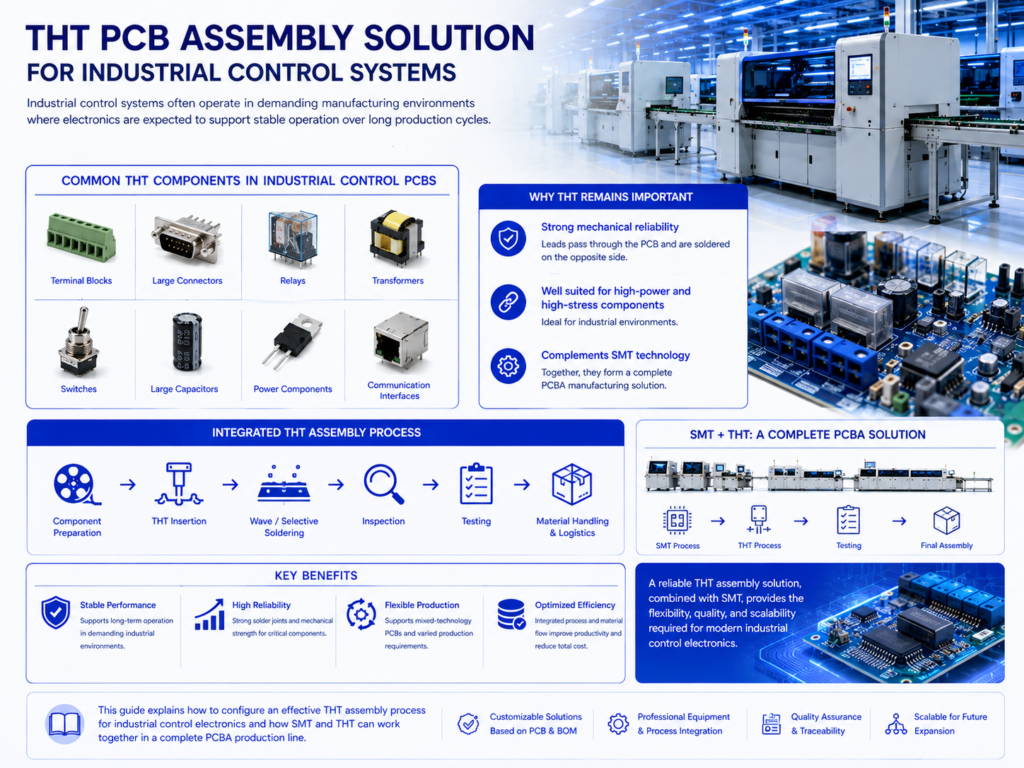
Unlike many compact consumer electronics products, industrial control PCBs frequently contain components such as:
- Terminal blocks
- Large connectors
- Relays
- Transformers
- Switches
- Large capacitors
- Power components
- Communication interfaces
Many of these components are well suited to Through-Hole Technology (THT) because their leads pass through the PCB and are soldered on the opposite side.
For this reason, THT assembly remains an important part of industrial electronics manufacturing even as SMT continues to dominate high-density PCB assembly.
A reliable THT PCB assembly solution for industrial control systems should integrate component preparation, insertion, soldering, inspection, testing, and material handling according to the actual PCB and production requirements.
THT PCB Assembly Solution for Industrial Control Systems
This guide explains how to configure an effective THT assembly process for industrial control electronics and how SMT and THT can work together in a complete PCBA production line.
Why Is THT Still Important in Industrial Control Electronics?
Surface Mount Technology offers important advantages for compact, high-density electronics.
However, THT continues to provide practical benefits for certain industrial control components.
Mechanical Support
Through-hole leads pass through the PCB rather than sitting only on surface pads.
This can provide additional mechanical support for components that experience repeated plugging, pulling, vibration, or mechanical stress.
Typical examples include:
- Connectors
- Terminals
- Switches
- Large relays
Large and Heavy Components
Some industrial components are simply not ideal for conventional SMT placement.
Transformers, large capacitors, power devices, and certain electromechanical components may require through-hole mounting.
High-Current Connections
Industrial control boards may use larger terminals and power-related components that benefit from THT mounting depending on the electrical and mechanical design.
Product Durability
Industrial electronics may be installed in equipment expected to operate for extended periods.
For suitable components, through-hole assembly can form part of a broader design strategy for mechanical robustness and service reliability.
However, THT should not be assumed to be automatically superior to SMT in every application. The correct technology depends on the component, PCB design, electrical requirements, and product environment.
Typical Industrial Control Applications Using THT PCBs
THT components can be found in many types of industrial electronics, including:
- Programmable logic controllers
- Motor control systems
- Industrial power supplies
- Variable-frequency drive control boards
- Robotics controllers
- Factory automation equipment
- Industrial communication modules
- Sensor control units
- Machine control panels
- Relay boards
- I/O modules
- Building automation controllers
- Energy management systems
Many of these products use both SMT and THT on the same PCB.
SMT + THT Is Common in Industrial Control PCBs
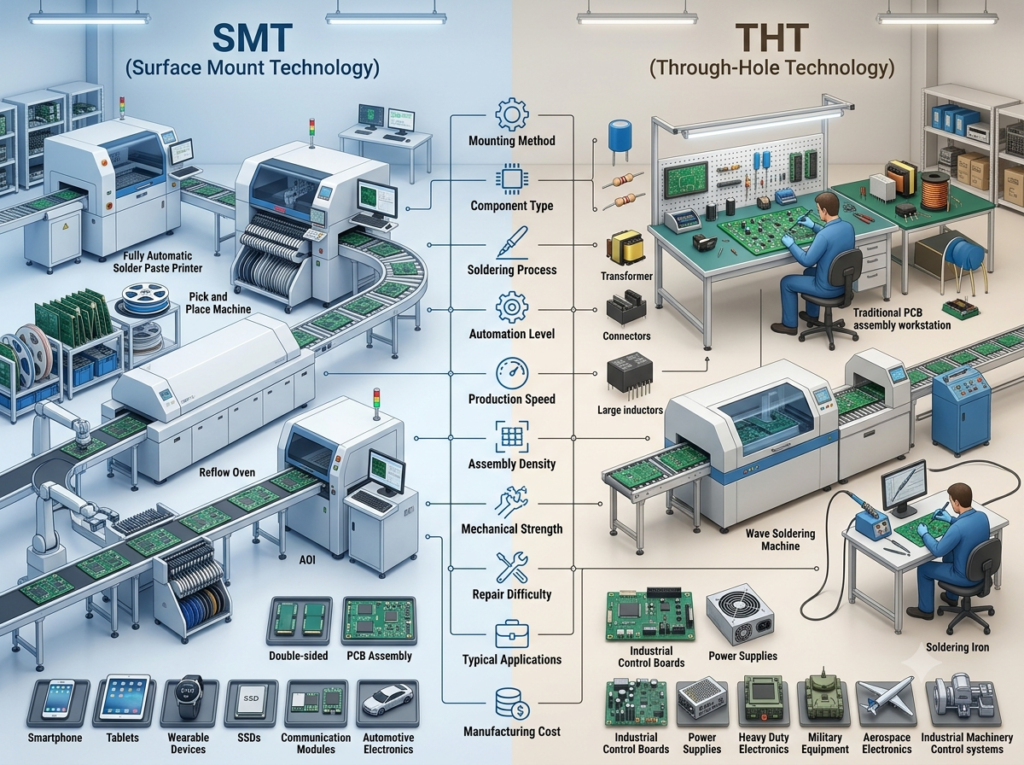
Modern industrial control boards often combine both assembly technologies.
SMT may be used for:
- ICs
- Resistors
- Capacitors
- Microcontrollers
- Communication devices
- Small passive components
THT may then be used for:
- Connectors
- Terminals
- Transformers
- Relays
- Switches
- Selected power components
A typical mixed-technology production flow may be:
Solder Paste Printing → SPI → SMT Placement → Reflow → AOI → THT/DIP Insertion → Wave or Selective Soldering → Inspection → Testing
This approach allows manufacturers to use SMT for component density and automation while retaining THT for components where through-hole mounting is more suitable.
Typical THT PCB Assembly Process
A complete THT production flow may include:
PCB Loading → Component Preparation → THT Insertion → Pre-Solder Inspection → Fluxing → Preheating → Wave Soldering → Cooling → Post-Solder Inspection → Testing → PCB Unloading
Each stage should be configured around the actual board.
PCB Loading and Handling
The line begins with PCB loading.
Depending on production volume, manufacturers may use:
- Manual PCB loading
- Automatic PCB loaders
- Conveyor systems
- Buffers
- Magazine handling
Important factors include:
- PCB dimensions
- Board thickness
- Panel format
- PCB weight
- Conveyor width
- Production direction
Reliable PCB handling becomes increasingly important as line automation increases.
THT Component Preparation
Some through-hole components require preparation before insertion.
This may include:
- Lead cutting
- Lead forming
- Component sorting
- Orientation control
- Material identification
- Kitting
For manual insertion lines, good material preparation can significantly improve productivity.
Operators should spend as much time as possible inserting components rather than searching for or preparing parts.
Manual, Semi-Automatic, or Automatic THT Insertion
Industrial control boards can contain a diverse range of components.
For this reason, THT insertion strategy depends heavily on the BOM.
Manual Insertion
Manual insertion is suitable when:
- Product mix is high
- Component types vary significantly
- Production volumes are low to medium
- Product changeovers are frequent
Semi-Automatic Insertion
Semi-automatic systems can improve operator productivity for suitable component types while maintaining flexibility.
Automatic Insertion
Automatic THT insertion may be appropriate when:
- Production volume is high
- Products are stable
- Component packaging supports automation
- Repetitive components dominate the BOM
For many industrial control manufacturers, a hybrid process combining manual and automated insertion can provide a practical balance.
Pre-Solder Inspection
Inspection before soldering helps detect insertion errors before they become more difficult to repair.
Typical checks include:
- Missing components
- Wrong components
- Incorrect polarity
- Incorrect orientation
- Improper insertion depth
- Bent leads
- Component position
This step can help improve first-pass yield.
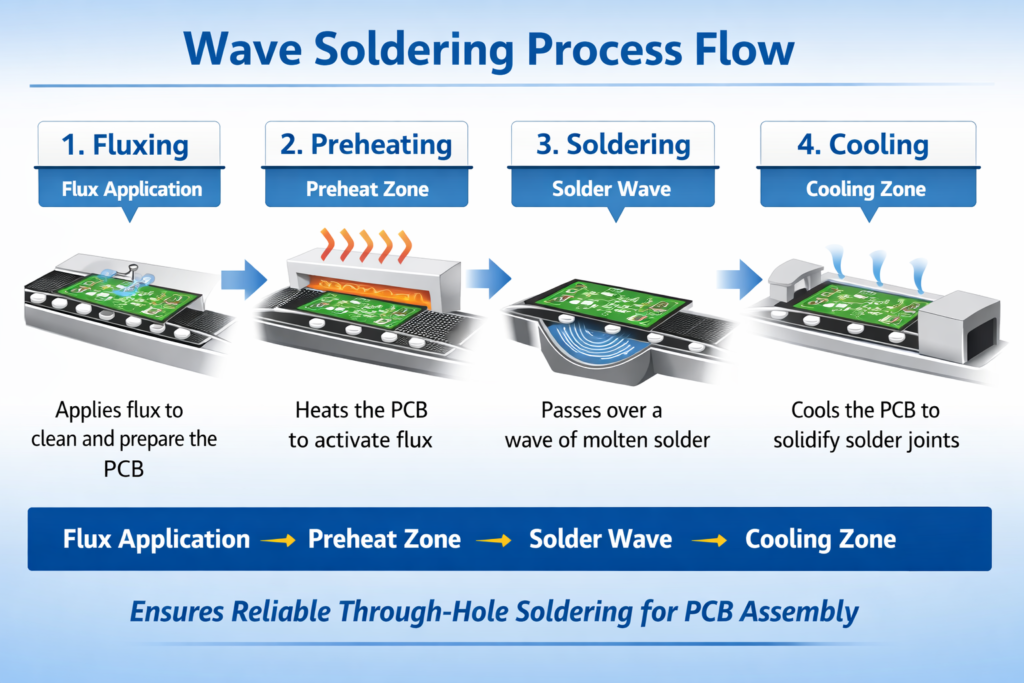
Flux Application
Flux prepares the metal surfaces for soldering and supports wetting.
In automated THT lines, spray fluxing systems are commonly used.
Important parameters include:
- Flux chemistry
- Application volume
- Spray pattern
- Conveyor speed
- Board coverage
The objective is stable, controlled application rather than excessive flux.
Preheating
Before the PCB reaches the solder wave, it normally passes through preheating.
Preheating can help:
- Activate the flux
- Reduce thermal shock
- Prepare the PCB for soldering
- Support process stability
The thermal profile depends on:
- PCB thickness
- Copper distribution
- Component thermal mass
- Flux type
- Solder alloy
- Conveyor speed
There is no universal preheat setting suitable for all industrial control boards.
Wave Soldering
Wave soldering is widely used for through-hole production when many joints need to be soldered efficiently.
The PCB passes over molten solder, allowing solder to contact the exposed leads and pads.
Important process factors include:
- Solder temperature
- Conveyor speed
- Wave height
- Contact time
- PCB orientation
- Preheat profile
- Flux coverage
- Solder bath condition
Stable process control is important because industrial control boards may contain components with different thermal masses.
When Should Selective Soldering Be Used?
Selective soldering can be useful for industrial control PCBs with mixed SMT and THT designs.
It may be considered when:
- Only selected THT joints require soldering
- Bottom-side SMT components are present
- Some PCB areas should avoid wave contact
- Localized solder application is required
Selective soldering can provide greater process control for certain board designs.
However, cycle time and equipment investment should be compared with conventional wave soldering.
Cooling
After soldering, the PCB enters a cooling stage.
Controlled cooling helps prepare boards for downstream inspection and handling.
Cooling capacity should be balanced with soldering throughput.
After soldering, manufacturers should inspect the solder joints.
Potential defects include:
- Solder bridges
- Insufficient solder
- Poor wetting
- Incomplete hole fill
- Solder icicles
- Excessive solder
Inspection may include:
- Manual visual inspection
- AOI
- X-ray for selected structures
- Electrical testing
- Functional testing
The exact inspection strategy depends on the product and customer requirements.

Industrial Control PCB Testing Requirements
Industrial control electronics often interact directly with sensors, actuators, motors, communication networks, or power systems.
For this reason, solder inspection alone may not be sufficient.
Depending on the product, testing may include:
- ICT
- Functional testing
- Power-on testing
- Communication testing
- I/O testing
- Programming
- Calibration
- Burn-in or other application-specific tests
Testing requirements should be defined during line planning because they can affect production capacity and factory layout.
Recommended THT Line Configurations for Industrial Control Systems
Different factories require different levels of automation.
Configuration 1: High-Mix Industrial Control Production
A possible configuration is:
Manual Loading → Component Preparation → Manual THT Insertion → Visual Inspection → Selective/Wave Soldering → Inspection → Functional Testing
This is suitable when:
- Product variety is high
- Batch sizes are relatively small
- Products change frequently
- THT component types vary
The main advantage is flexibility.
Configuration 2: Medium-Volume Industrial Control Production
A practical configuration may be:
Automatic PCB Loader → Insertion Conveyor → Manual/Semi-Automatic THT Insertion → Inspection Conveyor → Fluxing → Preheating → Wave Soldering → Cooling → Unloader → Inspection → Testing
This configuration can provide a balance between:
- Automation
- Flexibility
- Labor requirements
- Production throughput
It is suitable for many EMS and industrial electronics manufacturers.
Configuration 3: High-Volume Industrial Control Production
For stable, high-volume products, manufacturers may consider:
Automatic Loading → Automatic/Semi-Automatic THT Insertion → Automated PCB Transfer → Pre-Solder Inspection → Wave/Selective Soldering → Cooling → Automated Inspection → Testing → Unloading
Additional systems can include:
- Traceability
- Barcode scanning
- Buffers
- MES integration
- Automatic test handling
The investment should be justified by expected utilization and production requirements.
How to Improve THT Assembly Quality for Industrial Control PCBs
Industrial control manufacturers can focus on several key areas.
Control Component Condition
Ensure leads and component surfaces are suitable for soldering.
Standardize Component Preparation
Consistent lead forming and cutting help stabilize insertion and soldering.
Inspect Before Soldering
Correct polarity and insertion errors before the board reaches the soldering process.
Control Flux and Preheating
Stable flux application and thermal processing are essential for solder joint consistency.
Maintain the Wave Soldering Machine
Preventive maintenance should cover:
- Fluxing system
- Conveyor
- Preheater
- Solder pot
- Wave mechanism
- Cooling system
Track First-Pass Yield
Measure the number of boards that pass without rework.
Reducing rework can improve effective production capacity without increasing machine speed.
Common THT Assembly Challenges in Industrial Control Manufacturing
Large Thermal Mass Components
Transformers, terminals, and large connectors can require careful thermal process development.
Mixed Component Heights
Board geometry can affect insertion, soldering, and inspection.
High Product Mix
Frequent product changeovers can reduce efficiency.
Manual Insertion Bottlenecks
Boards with many THT components may require significant operator time.
Wave Soldering Defects
Improper process control can create bridging, insufficient solder, poor wetting, or incomplete hole fill.
Testing Bottlenecks
A fast assembly process provides limited value if functional testing cannot support the same output.
For this reason, line balancing should include testing as well as soldering.
How to Configure a THT Line Based on Production Data
Before selecting equipment, manufacturers should collect:
- PCB dimensions
- Panel dimensions
- PCB thickness
- BOM
- THT component list
- Component packaging
- Number of THT components per PCB
- Target boards per hour
- Working shifts
- Product mix
- Required soldering method
- Inspection requirements
- Testing requirements
- Factory layout
- Automation budget
Without this information, it is difficult to configure a line accurately.
Factory Layout for Industrial Control PCBA Production
A practical material flow can follow:
SMT Area → AOI → THT Insertion → Soldering → Inspection → Testing → Final Assembly
If SMT and THT production are located far apart, excessive PCB movement can increase handling time and work-in-process.
Factory layout should consider:
- Material flow
- Operator movement
- Maintenance access
- PCB buffers
- Component storage
- Exhaust
- Electrical supply
- Compressed air
- Testing space
- Future expansion
A well-planned layout can improve both efficiency and production control.
New vs Pre-Owned Equipment for Industrial PCBA Production
Industrial control manufacturers may choose new equipment, suitable pre-owned equipment, or a combination of both.
New Equipment
Potential advantages include:
- New machine condition
- Current-generation functions
- Warranty options
- Longer equipment standardization horizon
Pre-Owned Equipment
Potential benefits can include:
- Lower initial investment
- Faster capacity expansion
- Access to proven equipment platforms
When selecting pre-owned equipment, evaluate:
- Machine condition
- Configuration
- Maintenance history
- Spare parts availability
- Software
- Technical support
- Compatibility with existing production
Equipment selection should be based on total production requirements rather than purchase price alone.
THT and PCBA Production Line Solutions from Fuliu Electronics
Established in 2014, Fuliu Electronics is dedicated to providing customers with high-quality PCBA intelligent manufacturing solutions and services.
With extensive experience in the SMT industry, we specialize in dependable equipment, professional technical support, and complete SMT and PCBA production line solutions.
Our product portfolio includes SMT pick and place machines from Fuji, Panasonic, ASM, Yamaha, JUKI, and Hanwha, together with ERSA reflow ovens from Germany, MagicRay SPI/AOI inspection systems, automatic solder paste printers, supporting equipment, pre-owned SMT equipment, SMT spare parts, machine leasing, and maintenance services.
For manufacturers producing industrial control PCBs, Fuliu Electronics can help evaluate complete SMT and THT production requirements based on:
- PCB dimensions
- BOM
- THT component mix
- Production capacity
- Product variety
- Wave or selective soldering requirements
- Inspection requirements
- Testing requirements
- Factory layout
- Existing equipment
- Automation level
- Budget and expansion plans
For mixed SMT/THT products, the complete process can be considered together to reduce bottlenecks between placement, soldering, inspection, and testing.
As part of our global growth strategy, Fuliu Electronics is actively expanding into international markets, with key focus areas including India, Vietnam, the Philippines, Indonesia, the Middle East, South Africa, and Europe.
Conclusion
A reliable THT PCB assembly solution for industrial control systems should be designed around the actual PCB rather than a fixed equipment list.
Industrial control boards may require:
- SMT assembly for high-density electronic components
- THT insertion for connectors, relays, terminals, transformers, and larger components
- Wave or selective soldering
- Inspection
- Electrical and functional testing
For high-mix production, manual or semi-automatic insertion can provide valuable flexibility.
For stable high-volume products, greater automation may improve throughput and reduce repetitive manual work.
The key is to balance the complete production process:
SMT Assembly → THT Insertion → Soldering → Inspection → Testing
Rather than selecting equipment only by machine speed or purchase price, PCB assembly factories should evaluate capacity, product mix, soldering requirements, quality control, testing, factory layout, automation level, and total cost of ownership together.
If you are planning a new industrial control PCB production line, upgrading an existing THT process, or building a complete SMT + DIP/THT PCBA factory, Fuliu Electronics can help evaluate your PCB dimensions, BOM, THT component mix, target capacity, factory layout, existing equipment, inspection requirements, and automation needs to develop a suitable production solution.
Frequently Asked Questions
THT is commonly used for connectors, terminals, relays, transformers, switches, and selected power components where through-hole mounting is suitable for the electrical and mechanical design.
Yes. Many industrial control boards use SMT for smaller electronic components and THT for larger connectors, terminals, relays, and other through-hole components.
A typical line may include component preparation equipment, insertion stations, conveyors, inspection equipment, fluxing, preheating, wave or selective soldering, cooling, testing, and PCB handling equipment.
Yes, when the PCB design and component layout support wave soldering and many through-hole joints need to be processed efficiently.
Selective soldering may be useful when only specific THT areas need soldering or when bottom-side SMT components make conventional wave soldering unsuitable.
Yes. Manual insertion is often practical for high-mix, low- or medium-volume production and for components that are difficult to automate.