
Conformal coating is a thin protective layer applied to selected areas of a printed circuit board assembly to help protect electronic components and conductive surfaces from environmental exposure.
In modern electronics manufacturing, conformal coating is commonly used in products that may encounter conditions such as:
- Moisture
- Humidity
- Condensation
- Dust
- Certain contaminants
- Corrosive environments
- Temperature variation
The coating follows the contours of the PCB and components, which is why it is called “conformal.”
For manufacturers producing automotive electronics, industrial controls, energy systems, communication products, consumer electronics, or other PCBA products, conformal coating can form part of the overall environmental protection strategy.
However, a reliable PCB conformal coating process involves much more than simply spraying material onto a board.
PCB cleanliness, coating chemistry, application method, coating thickness, keep-out areas, curing, inspection, and process control all influence the final result.
What Is Conformal Coating in PCB Assembly?
This guide explains what conformal coating is, how it works, which materials are commonly used, and how manufacturers can integrate coating into a complete PCBA production line.
What Is Conformal Coating?
Conformal coating is a relatively thin protective coating applied over a PCB assembly.
Unlike potting, which may partially or completely encapsulate a board in a much thicker resin, conformal coating generally follows the shape of the PCB, solder joints, and components.
Its main purpose is to provide an additional barrier between sensitive electronics and the surrounding environment.
Depending on the coating material and application, it may help reduce risks associated with:
- Moisture exposure
- Condensation
- Dust contamination
- Chemical contaminants
- Surface corrosion
- Electrical leakage related to contamination or humidity
The exact level of protection depends on the coating chemistry, thickness, PCB design, application quality, curing process, and operating environment.
Why Is Conformal Coating Used in PCB Assembly?
Not every PCB requires conformal coating.
For electronics installed in clean, controlled indoor environments, additional coating may not always be necessary.
However, products exposed to more demanding conditions may require additional protection.
Typical applications include:
- Automotive electronics
- EV and battery management systems
- Industrial control systems
- Power electronics
- Outdoor electronics
- Energy storage systems
- Communication equipment
- Marine electronics
- Lighting systems
- Certain medical and specialized electronics
The decision to use conformal coating should be based on product requirements and operating environment.
How Does Conformal Coating Protect a PCB?
The coating creates a barrier over selected PCB surfaces.
This barrier can help reduce direct contact between the PCB and environmental contaminants.
For example, moisture combined with contamination may contribute to unwanted electrical leakage or corrosion on exposed conductive surfaces.
A suitable coating can help isolate these surfaces.
However, conformal coating should not be used as a substitute for:
- Good PCB design
- Correct component selection
- Proper soldering
- PCB cleanliness
- Suitable enclosure design
- Appropriate thermal management
It should be part of the complete product protection strategy.
Common Types of Conformal Coating Materials
Several coating chemistries are used in electronics manufacturing.
Each has different processing and performance characteristics.
Acrylic Conformal Coating
Acrylic coatings are commonly used because they can provide a balance between processing convenience and environmental protection.
Potential characteristics can include:
- Relatively simple application
- Good moisture resistance
- Relatively easy rework compared with some other materials
- Different curing options depending on formulation
Acrylic coatings may be suitable for many general electronics applications, depending on operating conditions.
Silicone Conformal Coating
Silicone coatings are often considered for applications involving wider temperature ranges or where flexibility is important.
Potential characteristics can include:
- Flexibility
- Temperature resistance
- Moisture protection
- Suitability for certain demanding environments
The specific performance depends on the formulation.
Polyurethane Conformal Coating
Polyurethane coatings can provide resistance to moisture and certain chemicals.
They may be considered for applications where chemical exposure is a concern.
However, rework can be more difficult than with some acrylic materials.
Epoxy Coating
Epoxy-based coatings can provide strong environmental protection in suitable applications.
They may be harder and more difficult to remove or repair.
Therefore, rework requirements should be considered before selecting this chemistry.
UV-Curable Conformal Coating
UV-curable coatings are attractive for automated manufacturing because curing can be relatively fast under suitable UV exposure.
They can support higher-throughput production lines.
However, areas shadowed by components may require additional curing mechanisms depending on the material.
Some products therefore use dual-cure technology.

How Is Conformal Coating Applied?
Several application methods are available.
The correct method depends on:
- Production volume
- PCB design
- Coating material
- Required thickness
- Keep-out areas
- Automation level
- Product mix
Manual Spraying
An operator manually sprays coating over the PCB.
This method can be suitable for:
- Low-volume production
- Prototypes
- High-mix manufacturing
- Simple coating requirements
Its main advantage is flexibility and relatively low initial equipment investment.
However, coating consistency can depend heavily on operator technique.
Brushing
A brush can be used to apply coating to specific PCB areas.
This is generally more suitable for:
- Repair
- Rework
- Small production quantities
- Localized application
It is not usually the preferred method for high-volume production.
Dipping
The PCB is dipped into the coating material.
This can coat large areas quickly.
However, connectors, test points, or other keep-out areas may require careful masking.
The PCB design must also be suitable for dipping.
Automatic Selective Coating
An automatic conformal coating machine uses programmable motion and controlled dispensing to apply coating only to selected PCB areas.
Depending on the equipment and material, it may use:
- Spray valves
- Film coating valves
- Needle dispensing
- Other controlled application technologies
Selective coating is commonly used in medium- and high-volume PCBA production because it can improve repeatability and reduce unnecessary coating of keep-out areas.
What Is a Selective Conformal Coating Machine?
A selective coating machine follows a programmed path over the PCB.
The production program defines:
- Coating areas
- Keep-out zones
- Application speed
- Material flow
- Valve operation
- Coating pattern
This allows manufacturers to apply coating around components such as:
- Connectors
- Test points
- Electrical contacts
- Switches
- Programming interfaces
Although selective coating can reduce masking, it may not eliminate masking completely.
Complex PCB geometry, narrow keep-out zones, tall components, and coating characteristics can still require fixtures, caps, tape, or other protection.
Typical PCB Conformal Coating Process
A typical process can follow:
PCB Inspection/Cleaning → Masking if Required → Conformal Coating → Inspection → Flash-Off → Curing → Final Inspection → Demasking if Required
For an automated production line, the flow may be:
PCB Loader → Selective Coating Machine → Inspection → Flash-Off Conveyor → Curing System → Final Inspection → PCB Unloader
The exact sequence depends on the coating material and product.
Why Is PCB Cleaning Important Before Coating?
Surface condition can have a major influence on coating adhesion and long-term performance.
Potential contaminants include:
- Flux residues
- Oils
- Fingerprints
- Dust
- Process residues
Whether cleaning is required depends on:
- Flux chemistry
- Coating material
- PCB manufacturing process
- Customer requirements
- Product reliability requirements
The important point is that the PCB surface should meet the validated coating process specification before application.
Applying coating over contamination may trap residues beneath the protective layer.
What Areas Should Not Be Conformally Coated?
Some PCB areas may need to remain free of coating.
Typical keep-out zones can include:
- Connectors
- Test points
- Electrical contacts
- Switches
- Programming ports
- Mechanical interfaces
- Certain sensors
- Heat transfer surfaces, depending on design
These areas should be identified before production.
Manufacturers may use:
- Masking tape
- Plugs
- Caps
- Custom fixtures
- Selective coating programs
The correct method depends on board design and production volume.
How Thick Should Conformal Coating Be?
There is no universal coating thickness suitable for every PCB.
Required thickness depends on:
- Coating chemistry
- Product specification
- Operating environment
- Application method
- Customer requirements
Too little material may lead to insufficient coverage.
Too much material can increase:
- Material consumption
- Curing time
- Process cost
- Risk of accumulation or other coating defects
The goal is to achieve the specified thickness consistently rather than simply applying as much coating as possible.
What Is Flash-Off?
Some conformal coatings require a flash-off period after application and before final curing.
This may allow:
- Solvent evaporation
- Coating leveling
- Initial material stabilization
Flash-off time and conditions depend on the coating chemistry.
In automated production, a flash-off conveyor or buffer may be installed between the coating machine and curing equipment.
How Is Conformal Coating Cured?
The curing method depends on the material.
Common methods include:
- Ambient curing
- Thermal curing
- UV curing
- Moisture curing
- Dual-cure systems
For example, an automatic PCBA line using UV-curable coating may integrate a UV curing system directly after application.
Other materials may require a thermal curing oven or a longer ambient curing process.
The curing equipment must be matched to:
- Coating chemistry
- Target production capacity
- PCB temperature limits
- Required curing conditions
- Factory layout
A fast coating machine provides limited value if curing becomes the production bottleneck.
How Is Conformal Coating Inspected?
Inspection is important for confirming that the coating has been applied correctly.
Common inspection points include:
- Coverage
- Missing coating
- Coating in keep-out areas
- Bubbles
- Cracks
- Excessive accumulation
- Uneven application
- Contamination
Some coating materials include UV tracers that allow operators to inspect coverage under suitable UV lighting.
Depending on production requirements, inspection may include:
- Manual visual inspection
- UV inspection
- Thickness measurement
- Automated coating inspection
The inspection method should match the product and quality requirements.

Common Conformal Coating Defects
Incomplete Coverage
Some required PCB areas may remain uncoated.
Potential causes include:
- Incorrect coating path
- Component shadowing
- Incorrect spray angle
- Insufficient material flow
Bubbles
Bubbles can occur due to material handling, application conditions, or trapped air.
The root cause should be identified before adjusting the process.
Poor Adhesion
Possible causes include:
- PCB contamination
- Incompatible materials
- Incorrect surface preparation
- Improper curing
Coating in Keep-Out Areas
Connectors or test points may receive unwanted coating due to:
- Poor masking
- Incorrect machine programming
- Excessive overspray
- Fixture problems
Excessive Coating
Applying too much material can increase cost and may create curing or quality issues.
Insufficient Curing
Incorrect time, temperature, humidity, UV exposure, or other curing conditions can prevent the coating from developing its intended properties.
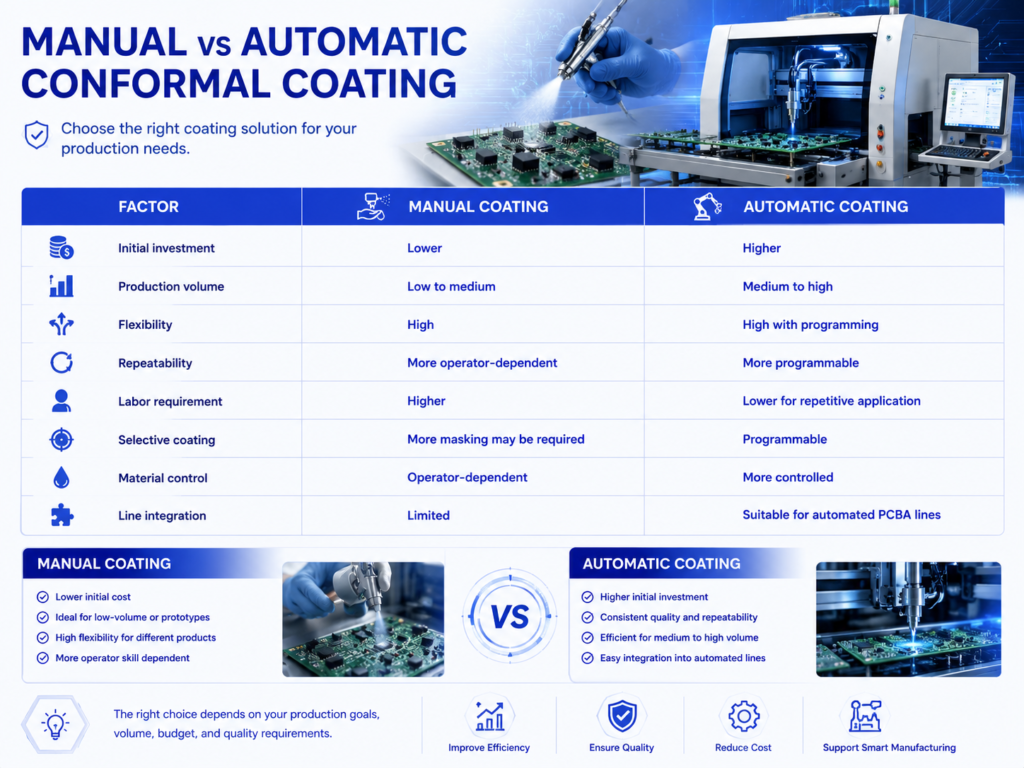
Manual vs Automatic Conformal Coating
Manual coating is not automatically inferior.
For low-volume or high-mix production, it may be more economical.
Automatic coating becomes more attractive when production volume, repeatability, labor, or integration requirements justify the investment.
Conformal Coating vs Potting
Conformal coating and potting are often confused, but they are different processes.
The correct choice depends on the product’s environmental, electrical, mechanical, and thermal requirements.

Where Does Conformal Coating Fit in a PCBA Production Line?
Conformal coating is typically a downstream process.
A complete mixed-technology PCBA flow may be:
Solder Paste Printing → SPI → SMT Placement → Reflow → AOI → THT/DIP Insertion → Wave/Selective Soldering → Inspection → Testing → Conformal Coating → Curing → Coating Inspection → Final Assembly
Where practical, relevant testing is often completed before coating because coating can make some repair operations more difficult.
This is why coating should be considered during the complete factory planning stage rather than added as an isolated process later.
How to Configure an Automatic Conformal Coating Line
Before selecting equipment, manufacturers should collect:
- PCB dimensions
- PCB thickness
- Maximum component height
- Coating areas
- Keep-out areas
- Coating material
- Material viscosity
- Target coating thickness
- Production capacity
- Product mix
- Curing method
- Inspection requirements
- Factory layout
- Existing upstream and downstream equipment
With this information, the production process can be configured more accurately.
A typical line might include:
PCB Loader → Selective Coating Machine → Inspection → Flash-Off Conveyor → Curing System → Final Inspection → PCB Unloader
Additional cleaning, masking, traceability, or testing may be included where required.
Conformal Coating and PCBA Solutions from Fuliu Electronics
Established in 2014, Fuliu Electronics is dedicated to providing customers with high-quality PCBA intelligent manufacturing solutions and services.
With extensive experience in the SMT industry, we specialize in dependable equipment, professional technical support, and complete SMT and PCBA production line solutions.
Our product portfolio includes SMT pick and place machines from Fuji, Panasonic, ASM, Yamaha, JUKI, and Hanwha, together with ERSA reflow ovens from Germany, MagicRay SPI/AOI inspection systems, automatic solder paste printers, supporting PCBA equipment, pre-owned SMT equipment, SMT spare parts, machine leasing, and maintenance services.
For customers planning a conformal coating process or a complete PCBA factory, Fuliu Electronics can help evaluate the production requirements based on:
- PCB specifications
- Coating areas
- Keep-out areas
- Coating material
- Production capacity
- Product mix
- Curing requirements
- Factory layout
- Existing SMT/THT equipment
- Automation requirements
For complete PCBA projects, coating can also be considered together with upstream processes such as SMT placement, reflow, SPI/AOI inspection, THT assembly, wave soldering, selective soldering, and testing.
As part of our global growth strategy, Fuliu Electronics is actively expanding into international markets, with key focus areas including India, Vietnam, the Philippines, Indonesia, the Middle East, South Africa, and Europe.
Conclusion
So, what is conformal coating in PCB assembly?
It is a protective coating process designed to provide an additional environmental barrier over selected PCB surfaces.
A complete conformal coating process may include:
Surface Preparation → Masking → Coating → Flash-Off → Curing → Inspection
For higher-volume manufacturing, these processes can be integrated into an automated line using selective coating equipment, conveyors, curing systems, and inspection.
The success of the process depends not only on the coating material but also on:
- PCB cleanliness
- Correct material selection
- Application method
- Coating coverage
- Thickness control
- Keep-out management
- Curing
- Inspection
- Equipment maintenance
For manufacturers building or upgrading a PCBA factory, conformal coating should be evaluated as part of the complete production flow rather than as an isolated downstream step.
If you are planning an automatic conformal coating line, upgrading a manual PCB coating process, or building a complete SMT + THT + coating PCBA production line, Fuliu Electronics can help evaluate your PCB dimensions, coating areas, coating material, target capacity, factory layout, existing equipment, and automation requirements to develop a suitable manufacturing solution.
Frequently Asked Questions
Conformal coating is a thin protective layer applied to selected PCB surfaces to help protect electronics from environmental influences such as moisture, humidity, dust, condensation, and certain contaminants.
No.
The need for coating depends on the product’s operating environment, enclosure, electrical design, customer requirements, and reliability targets.
Common categories include acrylic, silicone, polyurethane, epoxy, UV-curable coatings, and other specialized materials.
Each has different processing and performance characteristics.
Application methods can include manual spraying, brushing, dipping, dispensing, and automatic selective coating.
The correct method depends on volume, PCB design, material, and automation requirements.
It is programmable equipment that applies coating to defined PCB areas using controlled spray, film coating, dispensing, or other application technologies.
Connectors, test points, electrical contacts, switches, programming interfaces, and certain mechanical or sensor areas may need to remain coating-free depending on PCB design.