
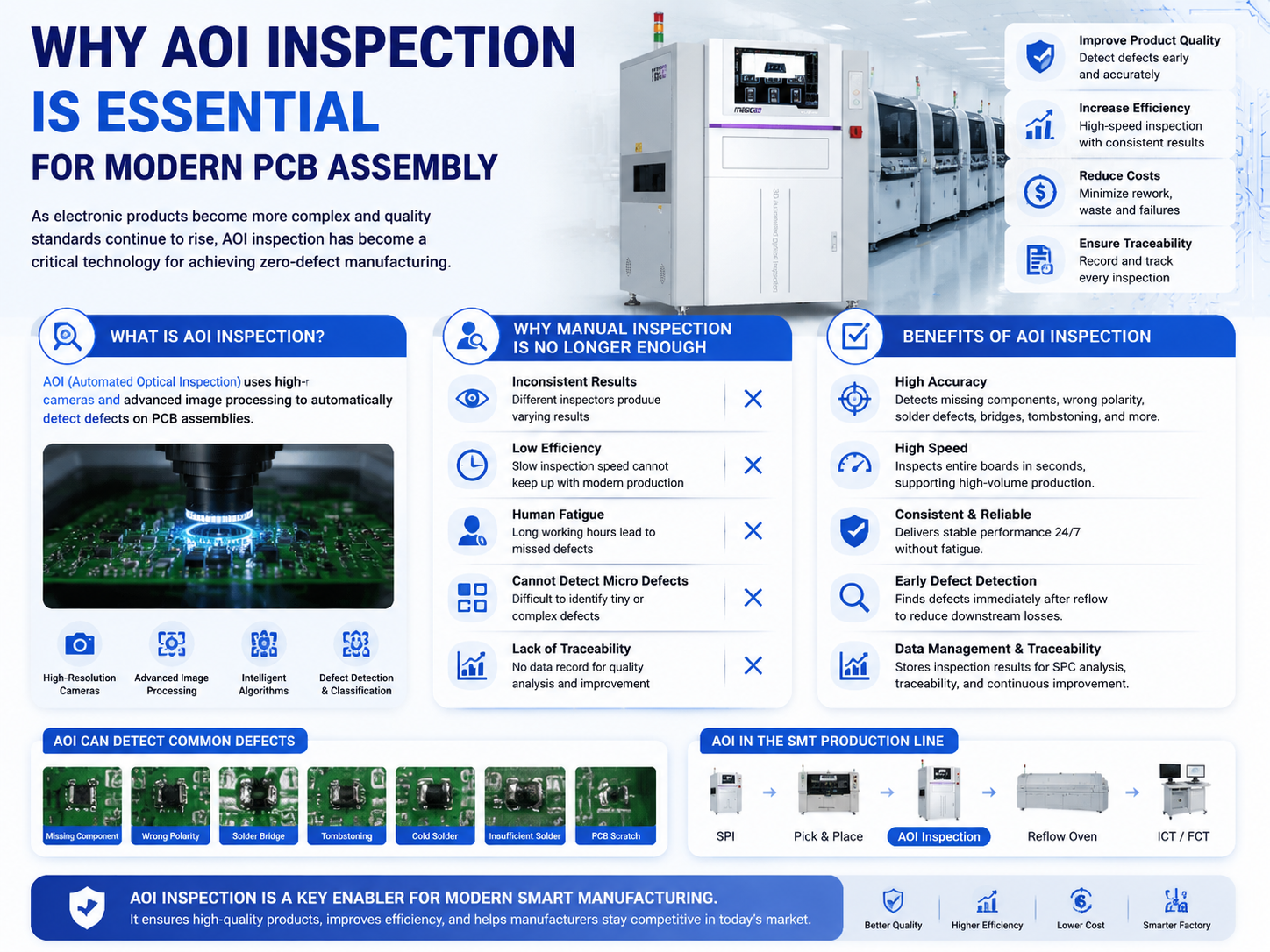
As electronic products become smaller, faster, and more complex, maintaining consistent manufacturing quality has become increasingly challenging. Even minor assembly defects—such as a missing resistor or an incorrectly oriented integrated circuit—can lead to product failures, costly rework, or warranty claims.
To address these challenges, manufacturers rely on AOI inspection (Automated Optical Inspection) as a critical quality control process in modern PCB assembly. By automatically identifying defects during production, AOI helps improve yield, reduce manual inspection, and ensure every assembled PCB meets strict quality standards.
What Is AOI Inspection in PCB Assembly?
In this guide, you’ll learn what AOI inspection in PCB assembly is, how it works, what defects it can detect, and why it has become an essential part of today’s SMT production lines.
What Is AOI Inspection?
AOI (Automated Optical Inspection) is an automated visual inspection process that uses high-resolution cameras, advanced lighting systems, and image-processing software to inspect printed circuit boards for manufacturing defects.
Unlike manual inspection, which depends on operator experience and visual judgment, AOI performs fast, repeatable, and highly accurate inspections without operator fatigue.
AOI is widely used in:
- SMT production lines
- PCB assembly factories
- Electronics manufacturing services (EMS)
- Automotive electronics
- Medical electronics
- Consumer electronics
- Industrial control systems
Why Is AOI Important in PCB Assembly?
Modern PCBs contain hundreds or even thousands of miniature components. Inspecting these assemblies manually is both time-consuming and prone to human error.
AOI inspection provides several important advantages.
Improve Product Quality
Early defect detection prevents defective boards from reaching later production stages or customers.
Reduce Rework Costs
Identifying defects immediately after soldering makes repairs faster and less expensive.
Increase Production Efficiency
Automated inspection operates much faster than manual visual inspection, supporting high-volume manufacturing.
Maintain Consistent Quality
AOI applies the same inspection criteria to every PCB, ensuring repeatable quality regardless of production volume.
How Does AOI Inspection Work?
Although different AOI systems vary in design, the inspection process generally follows the same workflow.
Step 1: Image Capture
High-resolution cameras capture multiple images of the assembled PCB using specially designed lighting.
Different lighting angles improve the visibility of:
- Component edges
- Solder joints
- Surface textures
- Component markings
Step 2: Image Processing
The AOI software compares captured images with reference data, CAD files, or “golden board” images.
Advanced algorithms analyze:
- Component position
- Component orientation
- Solder quality
- Component presence
- Polarity
- Dimensions
Step 3: Defect Detection
If abnormalities exceed predefined tolerances, the system automatically flags the PCB for operator review or repair.
Inspection results are typically displayed immediately, allowing manufacturers to react before additional defective products are produced.
Common Defects Detected by AOI
One of the biggest advantages of AOI inspection in PCB assembly is its ability to detect a wide range of manufacturing defects.
Typical defects include:
- Missing components
- Incorrect component placement
- Component rotation
- Wrong component values
- Reverse polarity
- Lifted leads
- Solder bridges
- Insufficient solder
- Excess solder
- Open solder joints
- Tombstoning
- Skewed components
Detecting these defects early significantly improves production quality and first-pass yield.
Inline AOI vs Offline AOI
Manufacturers generally choose between two AOI configurations.
Inline AOI
Inline AOI systems are integrated directly into the SMT production line.
Advantages include:
- Real-time inspection
- Immediate defect feedback
- Higher automation
- Suitable for mass production
Inline AOI is the preferred choice for high-volume electronics manufacturing.
Offline AOI
Offline AOI systems inspect boards separately from the production line.
Advantages include:
- Lower initial investment
- Flexible inspection scheduling
- Suitable for low-volume production
- Easy implementation
Offline AOI is often used by prototype manufacturers and smaller PCB assembly facilities.
AOI vs SPI: What’s the Difference?
AOI and SPI are complementary technologies rather than competing systems.
SPI (Solder Paste Inspection)
SPI is performed immediately after solder paste printing.
It evaluates:
- Paste volume
- Paste height
- Paste alignment
- Printing quality
Its primary objective is to prevent defects before components are placed.
AOI (Automated Optical Inspection)
AOI is typically performed after reflow soldering.
It evaluates:
- Component placement
- Solder joints
- Component orientation
- Assembly quality
- Missing or incorrect parts
Many manufacturers install both SPI and AOI to achieve comprehensive quality control throughout the SMT process.
Best Practices for AOI Inspection
To maximize inspection performance, manufacturers should follow several best practices.
Optimize Lighting
Proper lighting significantly improves defect detection accuracy.
Maintain Camera Calibration
Regular calibration ensures stable measurement precision.
Update Inspection Programs
Inspection criteria should be adjusted whenever new PCB designs are introduced.
Combine AOI with SPI
Using both inspection systems improves overall production quality and reduces defect escape rates.
Train Operators
Operators should understand inspection results and efficiently distinguish between actual defects and false alarms.
Choosing an AOI Inspection System
Before purchasing an AOI machine, manufacturers should evaluate several factors.
Consider:
- Production volume
- PCB complexity
- Component sizes
- Inspection speed
- Camera resolution
- Software capabilities
- Integration with existing SMT equipment
- Technical support and maintenance
Selecting the appropriate AOI solution ensures long-term production efficiency and consistent product quality.
Why Choose Fuliu Electronics?
Established in 2014, Fuliu Electronics is dedicated to providing customers with high-quality PCBA intelligent manufacturing solutions and comprehensive technical services.
With extensive experience in the SMT industry, Fuliu Electronics supplies complete SMT production line solutions featuring internationally recognized brands such as Fuji, Panasonic, ASM, Yamaha, JUKI, and Hanwha, along with MagicRay SPI/AOI inspection systems, ERSA reflow ovens, automatic solder paste printers, pre-owned SMT equipment, SMT spare parts, equipment leasing, and maintenance services.
Serving customers across India, Vietnam, the Philippines, Indonesia, the Middle East, South Africa, and Europe, Fuliu Electronics helps manufacturers improve PCB quality through advanced inspection technologies and customized production line solutions.
Conclusion
As PCB assemblies become increasingly compact and complex, AOI inspection in PCB assembly has become an indispensable part of modern electronics manufacturing.
By automatically detecting defects such as missing components, solder bridges, polarity errors, and placement inaccuracies, AOI helps manufacturers improve product quality, reduce rework, increase first-pass yield, and support high-speed automated production.
Whether you’re establishing a new SMT production line or upgrading an existing facility, investing in an advanced AOI inspection system can significantly improve both manufacturing efficiency and long-term product reliability.
Frequently Asked Questions
AOI (Automated Optical Inspection) is an automated visual inspection process that uses cameras and image-processing software to detect manufacturing defects on assembled printed circuit boards.
AOI can identify missing components, incorrect placement, polarity errors, solder bridges, tombstoning, lifted leads, insufficient solder, and many other assembly defects.
For most SMT production environments, yes. AOI offers faster inspection, greater consistency, higher accuracy, and supports high-volume manufacturing more effectively than manual inspection.
SPI inspects solder paste immediately after printing, while AOI inspects assembled PCBs after component placement and reflow soldering.
Inline AOI is ideal for high-volume automated production, while offline AOI is more suitable for prototype manufacturing or lower-volume production.
AOI improves product quality by detecting defects early, reducing rework, minimizing production costs, and ensuring consistent inspection standards across every PCB.