
In today’s competitive electronics manufacturing industry, improving SMT line efficiency is no longer just about producing more boards per hour—it’s about reducing downtime, improving product quality, lowering operating costs, and maximizing return on investment.
Whether you operate a small EMS facility or a high-volume PCB assembly factory, even minor improvements in production efficiency can significantly increase profitability over time.
This guide explores practical strategies to increase SMT line efficiency, helping manufacturers optimize equipment performance, streamline production processes, and build a more reliable SMT manufacturing operation.
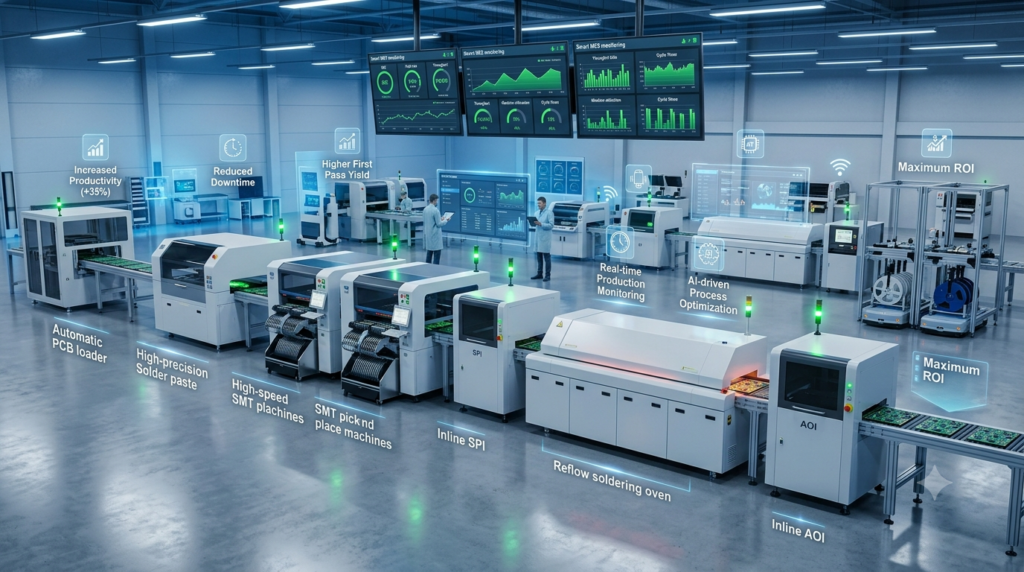
Why SMT Line Efficiency Matters
An efficient SMT production line delivers more than higher output. It also improves:
- First-pass yield (FPY)
- Overall Equipment Effectiveness (OEE)
- Product quality
- Equipment utilization
- Delivery performance
- Production flexibility
Conversely, inefficient production lines often experience:
- Frequent machine stoppages
- High rework rates
- Material waste
- Longer production cycles
- Increased labor costs
Optimizing efficiency allows manufacturers to remain competitive while meeting growing customer expectations.
Identify Production Bottlenecks
The first step in SMT production line optimization is identifying bottlenecks.
Common bottlenecks include:
- Slow solder paste printing
- Frequent feeder changes
- Pick and place machine idle time
- Reflow oven throughput limitations
- Manual inspection delays
- Poor material preparation
Using production monitoring software and machine data helps identify where valuable production time is being lost.
Optimize Solder Paste Printing
Solder paste printing is often considered the foundation of SMT quality.
Poor printing can cause defects that reduce overall efficiency, including:
- Solder bridges
- Insufficient solder
- Component misalignment
- Rework
To improve printing consistency:
- Use high-quality stencils.
- Verify stencil cleaning intervals.
- Monitor solder paste viscosity.
- Perform regular printer calibration.
- Utilize SPI (Solder Paste Inspection) to detect printing defects before component placement.
Stable printing reduces downstream defects and improves first-pass yield.
Improve Pick and Place Machine Performance
The pick and place machine is the core of every SMT production line.
Improving its utilization has a direct impact on productivity.
Recommended practices include:
Optimize Feeder Layout
Organize feeders based on production frequency to reduce unnecessary head movement.
Reduce Changeover Time
Standardized feeder preparation and offline setup minimize machine downtime between product changes.
Update Machine Programs
Regularly optimize placement sequences and vision parameters for improved cycle times.
Schedule Preventive Maintenance
Routine inspection of nozzles, cameras, feeders, and moving components prevents unexpected equipment failures.
Reduce Production Downtime
Unexpected downtime is one of the biggest obstacles to improving SMT production efficiency.
Effective strategies include:
- Preventive maintenance schedules
- Spare parts inventory management
- Equipment health monitoring
- Remote diagnostics
- Operator training
- Standardized troubleshooting procedures
Reducing downtime increases equipment availability and overall production capacity.
Use Automated Inspection Systems
Modern SMT manufacturing relies heavily on automated inspection technologies.
SPI (Solder Paste Inspection)
SPI identifies printing defects before components are placed.
AOI (Automated Optical Inspection)
AOI automatically detects assembly defects such as:
- Missing components
- Incorrect polarity
- Component rotation
- Solder bridges
- Lifted leads
Early defect detection prevents defective boards from moving further down the production line, reducing rework and material waste.
Optimize Reflow Soldering
The reflow oven plays a crucial role in solder joint quality.
Manufacturers should regularly review:
- Temperature profiles
- Conveyor speed
- Heating zone balance
- Cooling performance
Proper reflow optimization minimizes soldering defects while improving long-term product reliability.
Improve Material Management
Production efficiency depends not only on machines but also on material flow.
Best practices include:
- Accurate component inventory management
- Barcode tracking
- FIFO (First-In, First-Out) material handling
- Feeder preparation before production starts
- Organized material storage
Well-managed materials reduce waiting time and minimize production interruptions.
Invest in Operator Training
Even highly automated production lines require skilled personnel.
Well-trained operators can:
- Respond quickly to machine alarms
- Reduce setup errors
- Perform routine maintenance
- Optimize machine utilization
- Maintain consistent production quality
Continuous technical training helps manufacturers maximize the performance of their SMT equipment.
Frequently Asked Questions
Improve solder paste printing, optimize pick and place machine performance, reduce downtime, implement preventive maintenance, use automated inspection systems, and monitor production KPIs.
Common causes include equipment downtime, poor feeder management, solder paste printing defects, inadequate operator training, and inefficient production planning.
Preventive maintenance helps avoid unexpected machine failures, reduces downtime, extends equipment life, and maintains stable production quality.
SPI detects solder paste defects before component placement, while AOI identifies assembly defects after reflow soldering, reducing rework and improving first-pass yield.
Overall Equipment Effectiveness (OEE) measures equipment availability, performance, and quality to evaluate manufacturing productivity.
If aging equipment frequently causes downtime, limits production speed, or increases maintenance costs, upgrading can improve efficiency and reduce long-term operating expenses.