
The electronics manufacturing industry is evolving rapidly. As product life cycles become shorter and electronic devices become smaller and more sophisticated, manufacturers are expected to deliver higher quality products in less time while keeping production costs under control.
Traditional manual processes are no longer sufficient to meet these demands. As a result, more manufacturers are investing in SMT automation to increase production efficiency, improve quality consistency, and build smarter factories capable of supporting future growth.
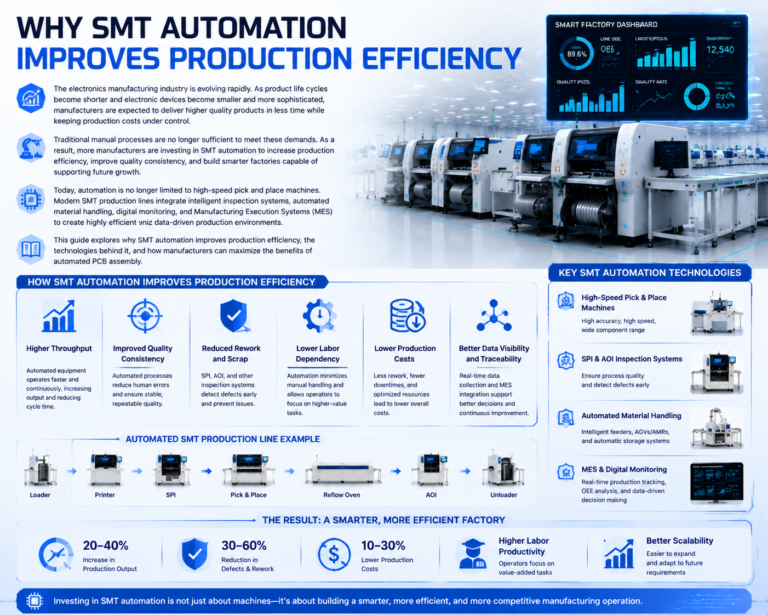
Today, automation is no longer limited to high-speed pick and place machines. Modern SMT production lines integrate intelligent inspection systems, automated material handling, digital monitoring, and Manufacturing Execution Systems (MES) to create highly efficient and data-driven production environments.
This guide explores why SMT automation improves production efficiency, the technologies behind it, and how manufacturers can maximize the benefits of automated PCB assembly.
Why SMT Automation Improves Production Efficiency
What Is SMT Automation?
SMT automation refers to the use of automated equipment, software, and intelligent control systems throughout the Surface Mount Technology (SMT) manufacturing process.
Instead of relying on manual operations, automated SMT lines coordinate multiple machines to perform PCB assembly with high speed, precision, and consistency.
A typical automated SMT production line includes:
- Automatic PCB Loader
- Automatic Solder Paste Printer
- SPI (Solder Paste Inspection)
- High-Speed Pick and Place Machine
- Chip Mounter
- Reflow Oven
- AOI (Automated Optical Inspection)
- PCB Unloader
- Conveyor System
- MES and Production Monitoring Software
Together, these systems create a continuous production flow with minimal human intervention.
Why Is Automation Becoming Essential?
Several industry trends are accelerating the adoption of SMT automation.
Manufacturers face challenges such as:
- Rising labor costs
- Shorter product development cycles
- Increasing product complexity
- Higher quality expectations
- Labor shortages
- Demand for traceability
- Growing competition
Automation helps companies address these challenges while remaining competitive in a rapidly changing market.
Higher Production Throughput
One of the most significant advantages of SMT automation is increased production speed.
Automated equipment operates continuously with consistent cycle times, allowing manufacturers to produce more PCBs without proportionally increasing labor.
Benefits include:
- Faster component placement
- Continuous material transport
- Reduced idle time
- Shorter production cycles
Higher throughput enables manufacturers to meet growing customer demand while maximizing equipment utilization.
Improved Product Quality
Manual assembly introduces natural variation caused by operator experience, fatigue, and inconsistent handling.
Automated SMT systems deliver:
- Accurate solder paste printing
- Precise component placement
- Stable reflow profiles
- Consistent inspection standards
This improves solder joint quality and reduces assembly defects.
Reduced Human Error
Even experienced operators can make mistakes during repetitive production tasks.
Automation minimizes errors such as:
- Incorrect component placement
- Wrong polarity
- Missing components
- Material mix-ups
- Manual handling damage
Reducing human error directly improves first-pass yield and lowers rework costs.
Lower Labor Costs
Automation does not eliminate the need for skilled workers, but it reduces dependence on repetitive manual labor.
Instead of manually performing routine production tasks, operators focus on:
- Equipment monitoring
- Process optimization
- Quality analysis
- Preventive maintenance
- Production planning
This improves workforce productivity while lowering overall operating costs.
Better Production Consistency
Consistency is essential in modern electronics manufacturing.
Automated equipment repeats the same process under controlled conditions, ensuring:
- Uniform solder paste deposition
- Repeatable placement accuracy
- Stable soldering quality
- Consistent inspection criteria
This consistency becomes increasingly important for automotive, medical, aerospace, and industrial electronics.
Real-Time Quality Control
Automation integrates inspection directly into the manufacturing process.
SPI Inspection
SPI detects solder paste defects immediately after printing.
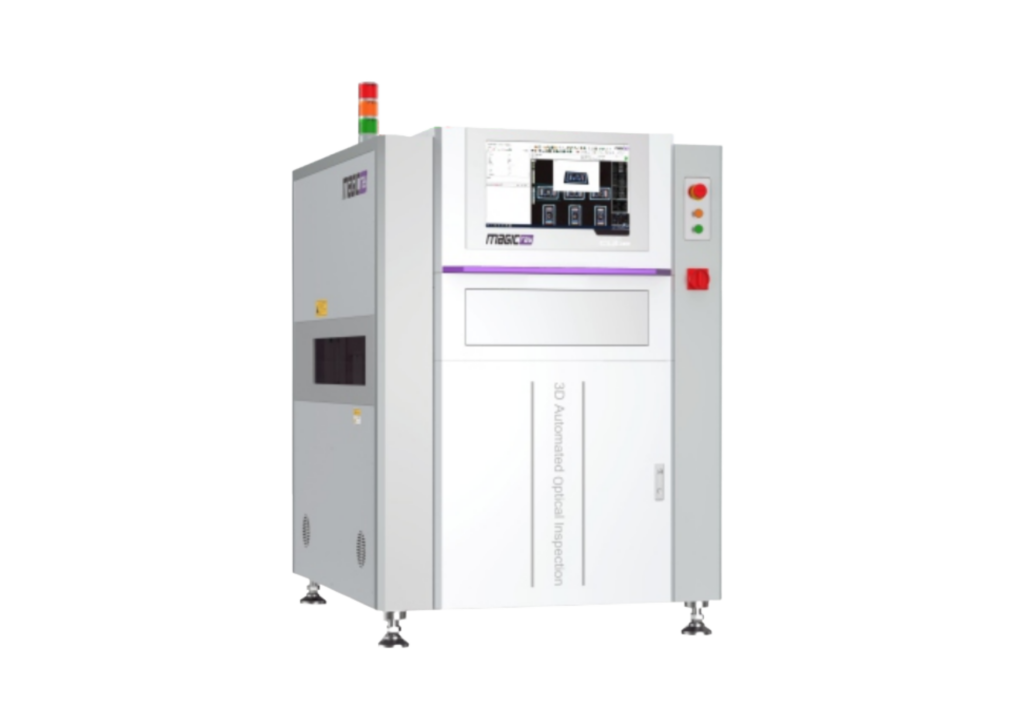
AOI Inspection
AOI automatically identifies:
- Missing components
- Polarity errors
- Component rotation
- Solder bridges
- Lifted leads
Real-time inspection prevents defective boards from progressing through the production line, reducing scrap and rework.
Improved Material Management
Automated SMT factories increasingly use intelligent material management systems.
These systems support:
- Barcode tracking
- Feeder identification
- Inventory control
- Material traceability
- Automatic replenishment
Efficient material handling reduces production interruptions and minimizes inventory errors.
Data-Driven Decision Making
Modern SMT automation generates valuable production data.
Manufacturers can monitor:
- Overall Equipment Effectiveness (OEE)
- First-Pass Yield (FPY)
- Machine utilization
- Downtime
- Production throughput
- Defect trends
Analyzing this data supports continuous improvement and more informed operational decisions.
Easier Integration with Industry 4.0
Automation provides the foundation for smart manufacturing.
Industry 4.0 technologies commonly integrated into SMT production lines include:
- Manufacturing Execution Systems (MES)
- Real-time production dashboards
- Equipment networking
- Cloud data management
- Predictive maintenance
- AI-assisted process optimization
These technologies improve visibility while enabling proactive production management.
Greater Flexibility for Product Changes
Electronics manufacturers increasingly produce a wider variety of products in smaller batch sizes.
Automated SMT lines support rapid changeovers through:
- Digital production recipes
- Automatic program loading
- Offline feeder preparation
- Intelligent production scheduling
This flexibility enables manufacturers to respond more quickly to changing customer demands.
Components of an Automated SMT Production Line
A fully automated SMT production line typically consists of:
- Automatic PCB Loader
- Automatic Solder Paste Printer
- SPI Inspection System
- High-Speed Pick and Place Machine
- Precision Chip Mounter
- Multi-Zone Reflow Oven
- AOI Inspection System
- X-Ray Inspection (optional)
- ICT / Functional Testing (optional)
- PCB Depaneling Machine
- Automatic PCB Unloader
- MES Production Monitoring
- Automated Conveyor System
Each system contributes to a seamless manufacturing workflow while minimizing manual intervention.
Challenges When Implementing SMT Automation
Although automation offers substantial benefits, successful implementation requires careful planning.
Manufacturers should consider:
- Production volume
- Product complexity
- Equipment compatibility
- Factory layout
- Operator training
- Future scalability
- Technical support
Partnering with an experienced SMT solution provider helps ensure smooth implementation and long-term performance.
Why Choose Fuliu Electronics?
Established in 2014, Fuliu Electronics is dedicated to providing customers with high-quality PCBA intelligent manufacturing solutions and comprehensive technical services.
With extensive experience in the SMT industry, Fuliu Electronics supplies complete automated SMT production line solutions featuring internationally recognized brands such as Fuji, Panasonic, ASM, Yamaha, JUKI, and Hanwha, together with ERSA reflow ovens, MagicRay SPI/AOI inspection systems, automatic solder paste printers, refurbished SMT equipment, SMT spare parts, equipment leasing, and maintenance services.
Serving customers across India, Vietnam, the Philippines, Indonesia, the Middle East, South Africa, and Europe, Fuliu Electronics helps manufacturers implement intelligent SMT automation through customized turnkey production lines, advanced inspection technologies, factory planning, installation, commissioning, and ongoing technical support.
Conclusion
As electronics manufacturing continues to evolve, SMT automation has become a key driver of production efficiency, product quality, and long-term competitiveness. By integrating automated equipment, intelligent inspection systems, digital monitoring, and smart factory technologies, manufacturers can significantly increase throughput while reducing labor costs, defects, and operational risks.
Whether building a new PCB assembly facility or upgrading an existing production line, investing in SMT automation enables manufacturers to respond faster to market demands, improve operational performance, and establish a scalable foundation for Industry 4.0 manufacturing.
Frequently Asked Questions
SMT automation refers to the use of automated equipment, inspection systems, software, and intelligent control technologies to perform PCB assembly with minimal manual intervention.
Automation increases production speed, improves quality consistency, reduces downtime, minimizes human error, and enables continuous production.
Typical equipment includes PCB loaders, solder paste printers, SPI systems, pick and place machines, reflow ovens, AOI systems, conveyors, PCB unloaders, and optional testing equipment.
Yes. Many automation solutions are scalable and can be configured to match different production volumes and investment budgets.
Automated SMT lines integrate with MES, production monitoring systems, predictive maintenance tools, and data analytics platforms to enable intelligent manufacturing.
The primary benefits include higher productivity, improved quality, lower labor costs, better traceability, reduced defects, and greater manufacturing flexibility.