
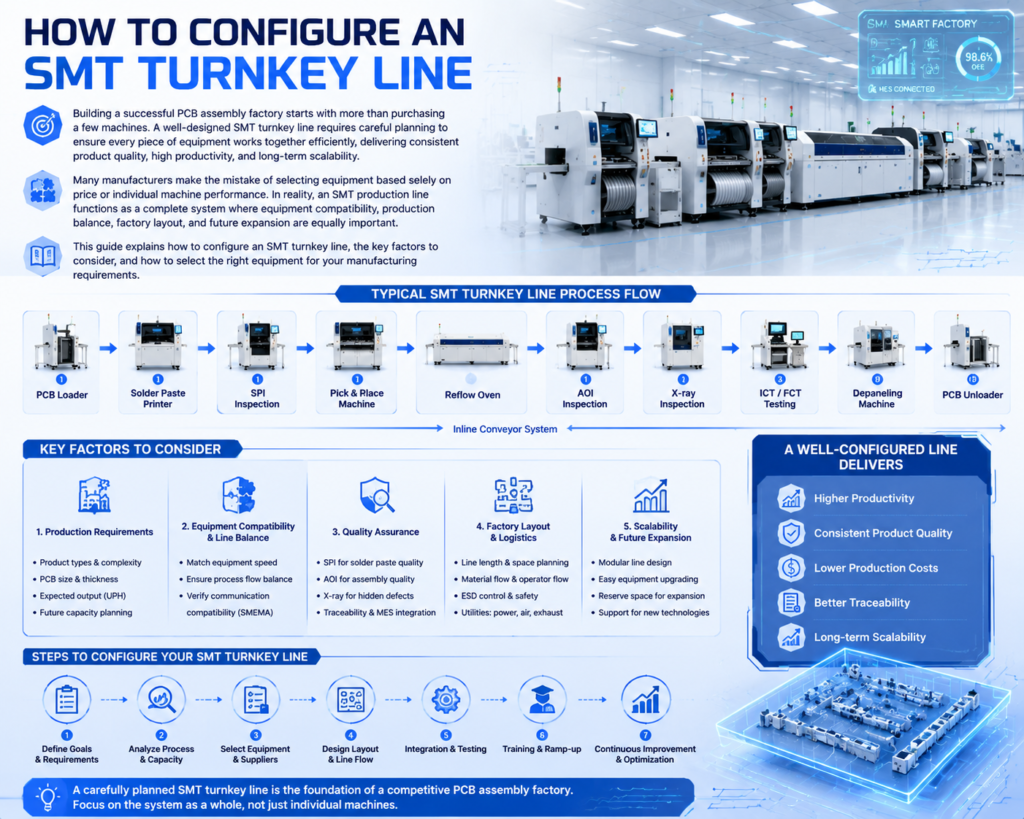
Building a successful PCB assembly factory starts with more than purchasing a few machines. A well-designed SMT turnkey line requires careful planning to ensure every piece of equipment works together efficiently, delivering consistent product quality, high productivity, and long-term scalability.
Many manufacturers make the mistake of selecting equipment based solely on price or individual machine performance. In reality, an SMT production line functions as a complete system where equipment compatibility, production balance, factory layout, and future expansion are equally important.
This guide explains how to configure an SMT turnkey line, the key factors to consider, and how to select the right equipment for your manufacturing requirements.
How to Configure an SMT Turnkey Line
An SMT turnkey line is a complete PCB assembly solution provided by a single supplier, covering every stage of project implementation—from production planning and equipment selection to installation, commissioning, training, and after-sales support.
Rather than sourcing machines from multiple vendors, manufacturers receive an integrated production line that is optimized for efficiency and ready for production.
A typical turnkey project includes:
- Production capacity planning
- Factory layout design
- Equipment selection
- System integration
- Installation and commissioning
- Operator training
- Technical documentation
- Ongoing maintenance and support
Step 1: Define Your Production Requirements
The first step in configuring an SMT turnkey line is understanding your production goals.
Key questions include:
- What is the expected monthly production volume?
- How many PCB models will be manufactured?
- Are production runs high-mix, low-volume or high-volume, low-mix?
- What PCB sizes will be processed?
- What component packages will be used (0402, 0201, BGA, QFN, CSP)?
- Are double-sided assemblies required?
These factors determine the equipment capacity and configuration needed.
Step 2: Evaluate PCB Characteristics
Different PCB designs require different production capabilities.
Important considerations include:
PCB Dimensions
Large PCBs require machines with wider conveyor systems and larger working areas.
Component Density
High-density boards may require:
- Multiple placement machines
- High-resolution vision systems
- More accurate placement heads
Product Complexity
Products such as industrial controllers, automotive electronics, and communication equipment often require additional inspection and testing equipment.
Step 3: Determine Production Capacity
Production capacity directly influences equipment selection.
For example:
Low-Volume Production
Suitable for:
- Prototype manufacturing
- Research and development
- Small EMS companies
Typical configuration:
- One pick and place machine
- Standard reflow oven
- AOI inspection
Medium-Volume Production
Suitable for:
- Industrial electronics
- Consumer electronics
- Contract manufacturing
Typical configuration:
- Two placement machines
- SPI inspection
- AOI inspection
- Automatic board handling
High-Volume Production
Suitable for:
- Automotive electronics
- Consumer electronics manufacturing
- Large EMS factories
Typical configuration:
- Multiple high-speed placement machines
- Advanced inspection systems
- Smart factory integration
- Fully automated material handling
Step 4: Select the Core SMT Equipment
Every turnkey SMT line consists of several essential machines.
PCB Loader
Automatically feeds PCBs into the production line while minimizing manual handling.
Automatic Solder Paste Printer
Applies solder paste accurately to PCB pads, providing the foundation for reliable solder joints.
SPI (Solder Paste Inspection)
Measures solder paste volume, height, and alignment to detect printing defects before component placement.
Pick and Place Machine
The core machine responsible for placing electronic components accurately and efficiently.
Equipment selection depends on:
- Placement speed
- Component range
- PCB size
- Placement accuracy
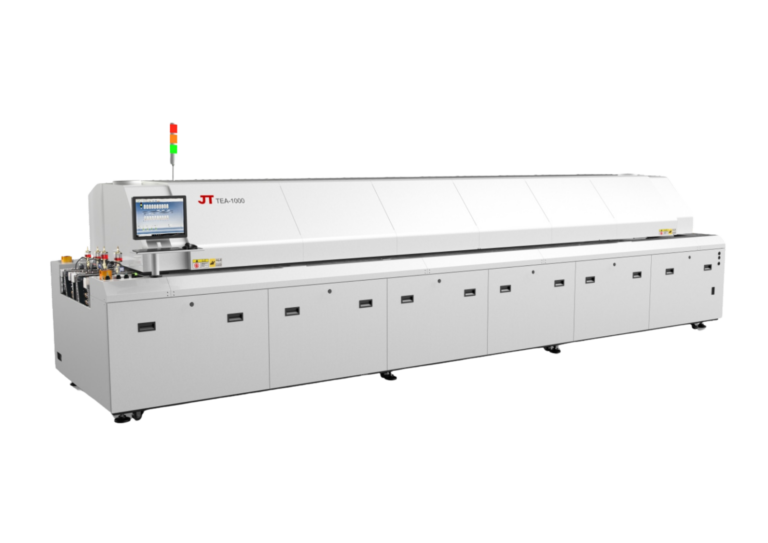
Reflow Oven
Creates reliable solder joints through carefully controlled temperature profiles.
AOI (Automated Optical Inspection)
Inspects assembled PCBs for missing components, polarity errors, solder defects, and placement inaccuracies.
PCB Unloader
Automatically collects finished boards while maintaining continuous production flow.
Step 5: Decide Whether Additional Equipment Is Needed
Depending on product requirements, manufacturers may add:
- X-ray inspection systems
- Selective soldering machines
- Wave soldering equipment
- ICT (In-Circuit Testing)
- Functional testing stations
- PCB depaneling machines
- Automatic cleaning systems
- MES software
- Traceability systems
Adding the right equipment improves product quality without unnecessarily increasing investment.
Step 6: Optimize Factory Layout
A well-designed factory layout improves both productivity and safety.
Layout planning should consider:
- Material flow
- Operator movement
- Equipment maintenance access
- Electrical and compressed air supply
- ESD protection
- Future production expansion
Reducing unnecessary transportation between processes helps improve overall line efficiency.
Step 7: Balance Production Capacity
A production line is only as efficient as its slowest process.
Equipment should be selected so that:
- Printer capacity matches placement speed.
- Placement capacity matches reflow throughput.
- Inspection systems do not become bottlenecks.
- Material supply keeps pace with production.
Balanced production minimizes idle time and maximizes equipment utilization.
Step 8: Plan for Future Expansion
A good SMT turnkey line should support future growth.
Manufacturers should consider:
- Additional pick and place machines
- Higher production capacity
- Smart factory integration
- Additional inspection equipment
- Automated material storage
- Digital production management
Planning ahead reduces future upgrade costs and avoids unnecessary production interruptions.
Common Mistakes When Configuring an SMT Turnkey Line
Avoiding common mistakes can save significant time and investment.
Typical errors include:
- Selecting equipment based only on purchase price
- Ignoring future production expansion
- Underestimating inspection requirements
- Choosing incompatible equipment brands
- Overlooking factory layout optimization
- Failing to train operators adequately
A professional turnkey supplier helps minimize these risks through proper engineering and project management.
Why Choose a Turnkey SMT Solution?
Compared with purchasing equipment individually, a turnkey solution offers several advantages.
Benefits include:
- Faster implementation
- Better equipment compatibility
- Simplified project management
- Professional production line design
- Centralized technical support
- Reduced integration risks
- Easier future expansion
These advantages allow manufacturers to begin production more quickly while improving long-term operational efficiency.
Why Choose Fuliu Electronics?
Established in 2014, Fuliu Electronics is dedicated to providing customers with high-quality PCBA intelligent manufacturing solutions and comprehensive technical services.
With extensive experience in the SMT industry, Fuliu Electronics provides complete SMT turnkey line solutions featuring internationally recognized brands such as Fuji, Panasonic, ASM, Yamaha, JUKI, and Hanwha, together with ERSA reflow ovens, MagicRay SPI/AOI inspection systems, automatic solder paste printers, refurbished SMT equipment, SMT spare parts, machine leasing, and maintenance services.
Serving customers across India, Vietnam, the Philippines, Indonesia, the Middle East, South Africa, and Europe, Fuliu Electronics supports manufacturers from initial factory planning through equipment selection, installation, commissioning, operator training, and long-term technical support, delivering customized turnkey solutions tailored to each customer’s production goals.
Conclusion
Configuring an SMT turnkey line requires more than selecting individual machines—it involves designing a complete manufacturing system that balances production capacity, equipment compatibility, product quality, and future scalability.
By carefully evaluating production requirements, selecting appropriate equipment, optimizing factory layout, and partnering with an experienced turnkey solution provider, manufacturers can build an efficient SMT production line that delivers reliable performance and long-term return on investment.
Whether launching a new PCB assembly factory or upgrading an existing facility, a properly configured turnkey SMT line provides the foundation for sustainable manufacturing success.
Frequently Asked Questions
An SMT turnkey line is a fully integrated PCB assembly production solution that includes equipment selection, factory planning, installation, commissioning, training, and technical support from a single supplier.
A standard configuration typically includes a PCB loader, solder paste printer, SPI system, pick and place machine, reflow oven, AOI inspection system, conveyor system, and PCB unloader. Additional equipment may be added depending on production requirements.
Consider your production volume, PCB size, product complexity, component types, inspection requirements, factory space, automation level, and future expansion plans.
Yes. Most turnkey suppliers customize equipment configurations based on the customer’s products, production targets, factory layout, and budget.
Balanced production prevents bottlenecks, maximizes equipment utilization, improves throughput, and reduces idle time across the SMT production line.
A turnkey supplier provides integrated equipment, professional engineering, simplified project management, centralized technical support, and faster production startup while reducing overall project risk.