
As global demand for electronics continues to grow, manufacturers face increasing pressure to launch production quickly while maintaining high product quality and controlling costs. Building an SMT production line from multiple equipment suppliers can be time-consuming, technically complex, and difficult to manage.
For this reason, more electronics manufacturers are choosing turnkey SMT lines—complete production solutions that include equipment selection, production line planning, installation, commissioning, training, and ongoing technical support.
Rather than purchasing individual machines separately, a turnkey approach enables manufacturers to deploy an optimized SMT production line more efficiently while reducing project risks and simplifying long-term operations.
In this guide, we’ll explain what a turnkey SMT line is, why it has become increasingly popular, and what manufacturers should consider when selecting a turnkey solution provider.
What Is a Turnkey SMT Line?
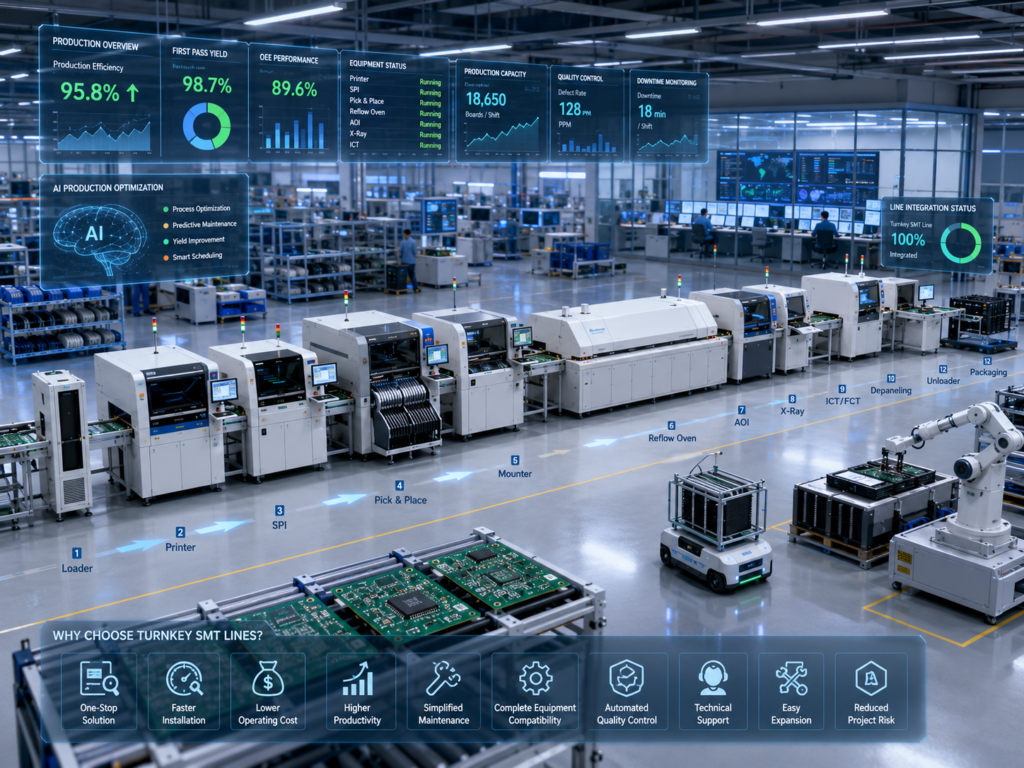
A turnkey SMT line is a complete PCB assembly production solution delivered by a single supplier. Instead of sourcing equipment, software, installation, and support from multiple vendors, manufacturers receive a fully integrated production line that is ready for operation.
A turnkey SMT solution typically includes:
- Production line planning
- Factory layout design
- Equipment selection
- SMT machine integration
- Installation and commissioning
- Operator training
- Technical documentation
- After-sales support
The objective is to provide a production line that can begin manufacturing with minimal additional coordination from the customer.
What Equipment Is Included in a Turnkey SMT Line?
Although configurations vary depending on production requirements, a complete turnkey SMT line generally includes:
- PCB Loader
- Automatic Solder Paste Printer
- SPI (Solder Paste Inspection) System
- SMT Pick and Place Machine(s)
- PCB Conveyor System
- Reflow Oven
- AOI (Automated Optical Inspection) System
- PCB Unloader
- Supporting software and production management tools
Additional equipment such as X-ray inspection, selective soldering, wave soldering, or functional testing systems may also be integrated when required.
Why Are More Factories Choosing Turnkey SMT Lines?
Several industry trends are driving the growing demand for turnkey solutions.
Faster Project Implementation
Coordinating multiple equipment suppliers often results in longer delivery schedules and installation delays.
With a turnkey provider:
- Equipment compatibility is planned in advance.
- Installation is coordinated by one project team.
- Production startup is faster.
- Commissioning is more efficient.
Manufacturers can begin production sooner and reduce time-to-market.
Better Equipment Integration
An SMT production line functions as one integrated system rather than a collection of individual machines.
A turnkey supplier ensures:
- Communication compatibility
- Conveyor synchronization
- Software integration
- Production data consistency
- Optimized material flow
Proper integration minimizes production interruptions while improving efficiency.
Lower Project Risk
Purchasing equipment from different vendors often creates uncertainty regarding responsibility when technical issues occur.
With a turnkey solution:
- One supplier manages the complete project.
- Technical support is centralized.
- Troubleshooting becomes faster.
- Communication is simplified.
This significantly reduces project management complexity.
Optimized Factory Layout
An experienced turnkey supplier evaluates:
- Available floor space
- Material flow
- Operator movement
- Maintenance access
- Future expansion requirements
An optimized layout improves productivity while reducing unnecessary transportation and handling.
Simplified Procurement Process
Instead of negotiating separately with multiple machine manufacturers, buyers communicate with one experienced supplier.
Benefits include:
- Fewer purchase orders
- Simplified logistics
- Unified documentation
- Easier warranty management
- More efficient project coordination
This reduces administrative workload throughout the project.
Comprehensive Technical Support
A turnkey SMT solution extends beyond equipment delivery.
Professional suppliers provide:
- Installation
- Commissioning
- Operator training
- Process optimization
- Preventive maintenance
- Spare parts support
- Software updates
- Remote technical assistance
Long-term support helps manufacturers maintain stable production and maximize equipment utilization.
Easier Future Expansion
As production demand increases, many factories need additional equipment.
Turnkey suppliers understand the original production line design, making future expansion easier through:
- Additional placement machines
- Inspection equipment upgrades
- Automation improvements
- Smart factory integration
Scalable solutions help protect long-term investments.
Who Benefits Most from Turnkey SMT Lines?
Turnkey SMT production lines are particularly suitable for:
Electronics Manufacturing Services (EMS)
Companies serving multiple customers benefit from flexible and fully integrated production lines.
New PCB Assembly Factories
Manufacturers establishing their first SMT production facility often lack in-house integration experience.
A turnkey solution reduces implementation risks and accelerates production startup.
Existing Manufacturers Expanding Capacity
Factories increasing production can integrate new equipment more efficiently through a unified solution provider.
International Manufacturers
Companies building overseas production facilities often prefer turnkey partners capable of delivering equipment, installation, and technical support under one contract.
How to Choose a Turnkey SMT Line Supplier
Selecting the right supplier is just as important as choosing the equipment itself.
Consider the following factors.
Industry Experience
Look for suppliers with extensive experience in SMT manufacturing and PCB assembly projects.
Equipment Portfolio
A qualified supplier should offer:
- Pick and place machines
- Solder paste printers
- SPI systems
- AOI systems
- Reflow ovens
- Supporting automation equipment
A comprehensive product portfolio allows the supplier to recommend the most suitable configuration rather than promoting a single machine.
Engineering Capability
Evaluate whether the supplier can provide:
- Factory layout planning
- Process optimization
- Production line integration
- Capacity analysis
Engineering expertise is a key advantage of turnkey solutions.
After-Sales Service
Reliable suppliers should provide:
- Technical training
- Preventive maintenance
- Spare parts inventory
- Software support
- Remote diagnostics
Long-term support ensures consistent production performance.
Common Misconceptions About Turnkey SMT Lines
“Turnkey Solutions Are More Expensive”
While the initial quotation may appear higher, turnkey projects often reduce hidden costs associated with equipment incompatibility, delayed implementation, and project management.
“One Supplier Means Less Flexibility”
In reality, experienced turnkey providers typically configure production lines using equipment from multiple internationally recognized brands based on customer requirements.
“Turnkey Lines Are Only for Large Factories”
Small and medium-sized manufacturers also benefit from turnkey solutions because they simplify project execution and reduce technical complexity.
Why Choose Fuliu Electronics?
Established in 2014, Fuliu Electronics is dedicated to providing customers with high-quality PCBA intelligent manufacturing solutions and comprehensive technical services.
With extensive experience in the SMT industry, Fuliu Electronics provides complete turnkey SMT line solutions featuring internationally recognized brands such as Fuji, Panasonic, ASM, Yamaha, JUKI, and Hanwha, together with ERSA reflow ovens, MagicRay SPI/AOI inspection systems, automatic solder paste printers, refurbished SMT equipment, SMT spare parts, equipment leasing, and maintenance services.
Serving customers across India, Vietnam, the Philippines, Indonesia, the Middle East, South Africa, and Europe, Fuliu Electronics supports manufacturers throughout every stage of the project—from factory planning and equipment selection to installation, commissioning, operator training, and long-term technical support.
Conclusion
As electronics manufacturing becomes more competitive, companies need production solutions that are efficient, scalable, and reliable. A turnkey SMT line offers a practical way to simplify project implementation while reducing technical risk and accelerating production.
By working with a single experienced supplier, manufacturers benefit from integrated equipment, optimized factory layouts, professional engineering support, and comprehensive after-sales service. Whether establishing a new PCB assembly factory or expanding an existing operation, turnkey solutions help manufacturers achieve faster deployment, higher productivity, and better long-term returns on investment.
Frequently Asked Questions
A turnkey SMT line is a complete PCB assembly production solution that includes equipment, installation, commissioning, training, and technical support from a single supplier.
A standard turnkey line typically includes a PCB loader, solder paste printer, SPI system, pick and place machine, conveyor system, reflow oven, AOI inspection system, and PCB unloader.
Turnkey solutions simplify project management, improve equipment compatibility, reduce implementation risks, shorten startup time, and provide centralized technical support.
Yes. Small and medium-sized manufacturers often benefit because turnkey suppliers handle engineering, installation, and training, reducing the need for extensive in-house expertise.
Yes. Most turnkey solutions are designed with scalability in mind, allowing manufacturers to add equipment and increase production capacity as business grows.
Evaluate the supplier’s industry experience, equipment portfolio, engineering capability, technical support, after-sales service, and ability to customize solutions for your production requirements.