
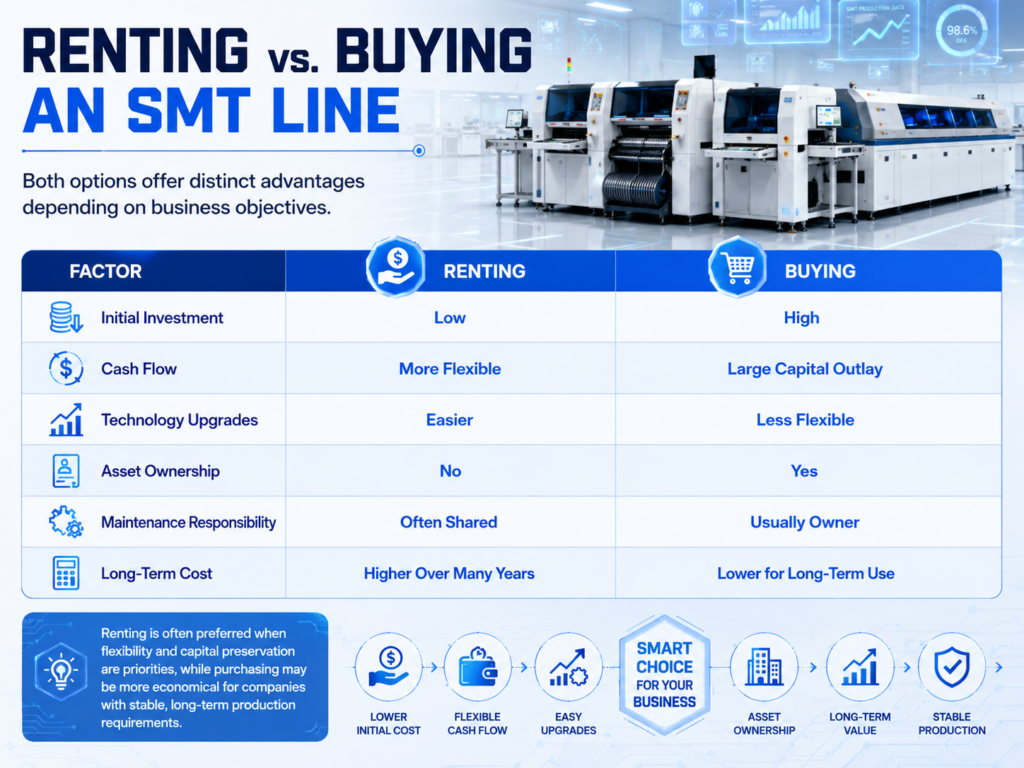
As a result, more companies are exploring the option to rent a complete SMT line instead of purchasing one outright. SMT equipment leasing allows manufacturers to start production with significantly lower initial capital while maintaining operational flexibility.
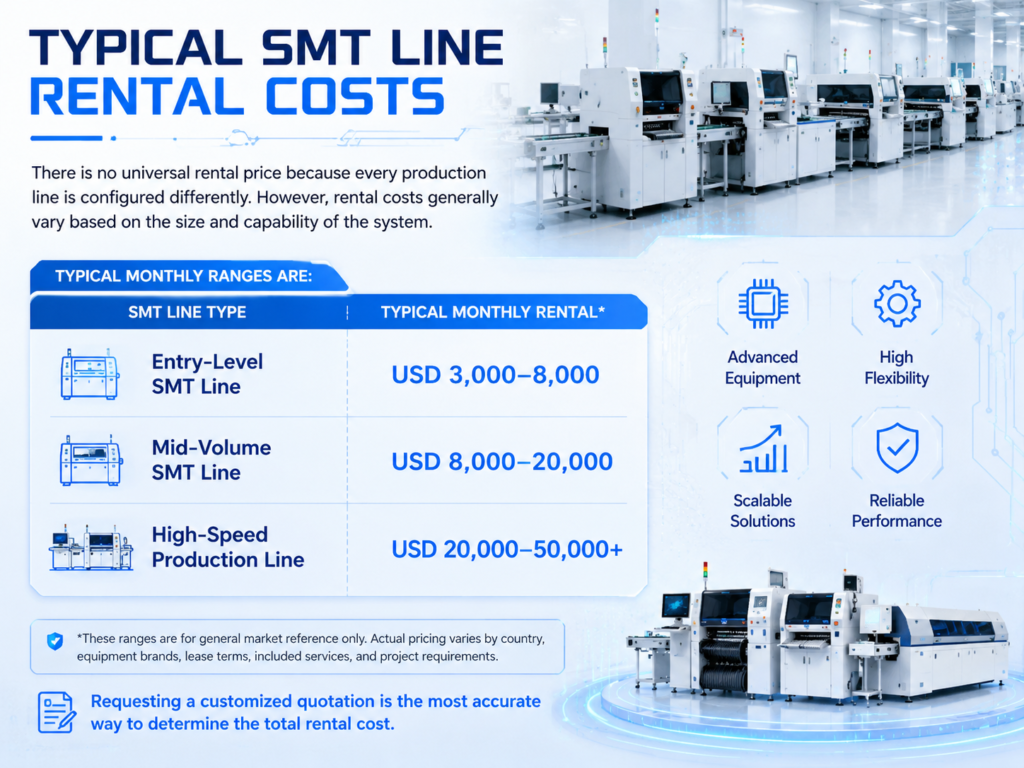
But how much does it cost to rent a complete SMT line? The answer depends on several factors, including equipment configuration, production capacity, lease duration, equipment condition, and the level of technical support included.
This guide explains the major cost drivers, compares renting versus buying, and helps you determine whether SMT line leasing is the right solution for your business.
What Is an SMT Line Rental?
An SMT line rental (or SMT equipment leasing) allows manufacturers to use a complete SMT production line for a fixed monthly or annual fee instead of purchasing the equipment.
Depending on the agreement, the rental package may include:
- PCB Loader
- Automatic Solder Paste Printer
- SPI (Solder Paste Inspection)
- Pick and Place Machine(s)
- Conveyor System
- Reflow Oven
- AOI Inspection System
- PCB Unloader
- Installation and commissioning
- Operator training
- Technical support
- Preventive maintenance
Some suppliers also offer lease-to-own programs or flexible upgrade options as production needs change.
What Factors Affect SMT Line Rental Costs?
Several variables influence the total cost of leasing a complete SMT production line.
Equipment Configuration
The largest cost factor is the equipment included in the line.
For example:
- Number of pick and place machines
- Automatic or semi-automatic printer
- SPI system
- AOI inspection
- X-ray inspection
- Conveyor automation
- Smart factory software
The more sophisticated the configuration, the higher the rental cost.
Production Capacity
Higher-speed production lines generally require:
- Faster placement machines
- Larger reflow ovens
- Additional inspection equipment
- More advanced automation
Lines producing hundreds of thousands of components per hour naturally cost more than entry-level systems.
Equipment Brand
International brands such as Fuji, Panasonic, ASM, Yamaha, JUKI, and Hanwha typically command higher rental rates due to their performance, reliability, and global service networks.
However, refurbished equipment from these manufacturers can provide excellent value while reducing monthly costs.
New vs. Refurbished Equipment
Many manufacturers choose refurbished SMT equipment because it offers:
- Lower monthly payments
- Proven reliability
- Faster delivery
- Excellent return on investment
Professionally refurbished machines can provide performance comparable to new equipment when properly maintained.
Lease Duration
Longer rental agreements often result in lower monthly payments.
For example:
Short-term projects may carry higher monthly rates.
Multi-year leases often include discounted pricing.
Lease-to-own options may further improve long-term value.
Included Services
Rental packages vary considerably.
Some agreements include only equipment, while others also cover:
- Installation
- Commissioning
- Operator training
- Preventive maintenance
- Spare parts
- Remote diagnostics
- Software updates
A lower rental fee may not represent the lowest total cost if essential services must be purchased separately.
Who Should Consider Renting an SMT Line?
SMT line rental is particularly suitable for several types of manufacturers.
Startups
New electronics companies can begin production without committing significant capital to equipment purchases.
EMS Providers
Contract manufacturers handling fluctuating customer demand benefit from scalable production capacity.
Short-Term Projects
Companies producing limited product runs may avoid unnecessary equipment ownership costs.
Factory Expansion
Existing manufacturers can temporarily increase production capacity while evaluating future demand.
Overseas Manufacturing
Businesses establishing production facilities in new markets often prefer leasing equipment before making long-term investment decisions.
Advantages of Renting a Complete SMT Line
Leasing offers several practical benefits beyond reducing upfront investment.
Preserve Cash Flow
Capital can be allocated to:
- Product development
- Inventory
- Marketing
- Business expansion
instead of being tied up in equipment purchases.
Faster Production Startup
Rental suppliers frequently provide complete turnkey installation, reducing project implementation time.
Access to Modern Technology
Leasing enables manufacturers to upgrade equipment more easily as production requirements evolve.
Reduced Technical Risk
Many rental agreements include maintenance and technical support, minimizing unexpected repair expenses and production downtime.
What to Ask Before Signing an SMT Equipment Lease
Before choosing a rental provider, clarify the following:
- What equipment is included?
- Are installation and commissioning covered?
- Is operator training provided?
- What maintenance services are included?
- Are spare parts readily available?
- How quickly is technical support provided?
- Can equipment be upgraded during the lease?
- Is there a lease-to-own option?
Understanding these details helps avoid unexpected costs later.
Why Choose Fuliu Electronics?
Established in 2014, Fuliu Electronics is dedicated to providing customers with high-quality PCBA intelligent manufacturing solutions and comprehensive technical services.
With extensive experience in the SMT industry, Fuliu Electronics offers complete SMT production line solutions featuring internationally recognized brands such as Fuji, Panasonic, ASM, Yamaha, JUKI, and Hanwha, together with ERSA reflow ovens, MagicRay SPI/AOI inspection systems, automatic solder paste printers, refurbished SMT equipment, SMT spare parts, equipment leasing, and maintenance services.
Serving customers across India, Vietnam, the Philippines, Indonesia, the Middle East, South Africa, and Europe, Fuliu Electronics helps manufacturers reduce investment risk through flexible SMT equipment leasing, customized turnkey solutions, professional installation, and long-term technical support.
Conclusion
For many manufacturers, choosing to rent a complete SMT line offers an effective way to balance production capability with financial flexibility. Instead of making a substantial upfront investment, companies can launch production more quickly, preserve working capital, and gain access to advanced SMT technology with lower initial risk.
While rental costs vary depending on equipment configuration, lease duration, and included services, evaluating the total value—not just the monthly payment—is essential. By partnering with an experienced SMT solution provider, manufacturers can secure a production line that supports both immediate operational needs and future business growth.
Frequently Asked Questions
Rental costs vary depending on the equipment configuration, production capacity, lease duration, and included services. Entry-level systems generally cost less than high-speed, fully automated production lines.
Renting typically requires a much lower upfront investment and offers greater flexibility, while purchasing may result in lower overall costs for long-term production.
Most complete rental packages include a solder paste printer, pick and place machine, reflow oven, AOI system, conveyors, PCB loader/unloader, and related support equipment.
Many suppliers include maintenance and technical support, although service coverage varies by lease agreement.
Yes. Refurbished SMT machines are widely available and can provide excellent performance at a lower monthly cost when professionally serviced.
Startups, EMS companies, expanding manufacturers, and businesses with short-term or uncertain production requirements often benefit most from SMT equipment leasing.