
In modern electronics manufacturing, efficiency is achieved not only through automated component placement and soldering but also through optimized handling of finished circuit boards. One often-overlooked yet essential process is PCB depaneling—the step that separates individual printed circuit boards from a larger manufacturing panel.
Although depaneling occurs at the end of the assembly process, it has a direct impact on product quality, production efficiency, and long-term reliability. Improper separation can introduce mechanical stress, damage solder joints, crack components, or even cause hidden defects that reduce product lifespan.
In this guide, we’ll explain what PCB depaneling is, why it’s important, explore the most common depaneling methods, and help you choose the right solution for your PCB assembly production.
What Is PCB Depaneling?
PCB depaneling is the process of separating individual printed circuit boards (PCBs) from a larger manufacturing panel after the PCB assembly process has been completed.
Instead of manufacturing one board at a time, PCB fabricators combine multiple identical or different boards into a single panel. This panelized design improves production efficiency during:
- Solder paste printing
- SMT component placement
- Reflow soldering
- Automated Optical Inspection (AOI)
- Functional testing
Once assembly is complete, each PCB must be carefully separated without damaging the board or electronic components.
Why Are PCBs Manufactured in Panels?
Panelization offers several manufacturing advantages.
Higher Production Efficiency
Processing multiple boards simultaneously reduces machine setup time and increases equipment utilization.
Better Equipment Compatibility
Large panels move more reliably through automated SMT equipment than individual small PCBs.
Lower Manufacturing Costs
Panelized production minimizes handling and improves throughput, reducing labor and operating costs.
Improved Production Consistency
Keeping multiple boards together during assembly ensures more stable positioning throughout the SMT production process.
Why Is PCB Depaneling Important?
Although depaneling is the final manufacturing step, its impact on product quality is significant.
Improper depaneling may result in:
- Cracked ceramic capacitors
- Broken solder joints
- PCB edge damage
- Copper trace fractures
- Component displacement
- Hidden mechanical stress
For high-reliability industries such as automotive, medical, aerospace, and industrial automation, selecting the correct depaneling method is essential.
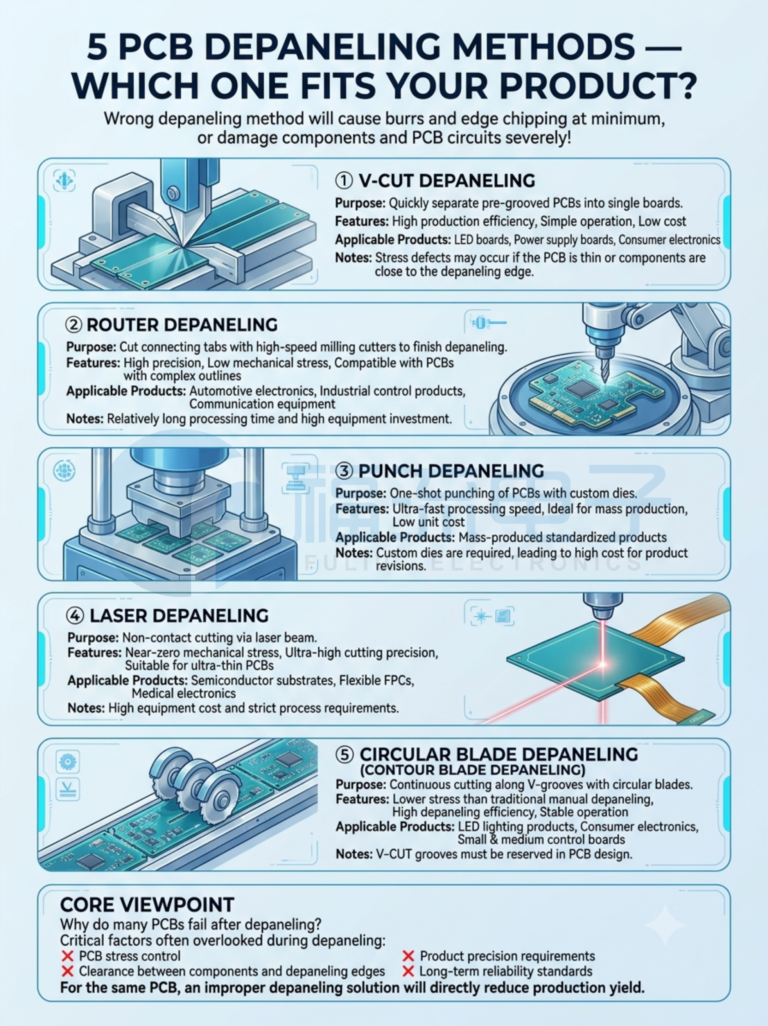
Common PCB Depaneling Methods
Several depaneling technologies are widely used in PCB manufacturing.
The best choice depends on PCB design, production volume, component placement, and quality requirements.
V-Cut (V-Groove) Depaneling
V-cut depaneling uses pre-scored grooves manufactured into the PCB panel.
After assembly, a depaneling machine applies controlled force to separate the boards along these grooves.
Advantages
- Fast processing speed
- Low operating cost
- Simple equipment
- Suitable for high-volume production
Limitations
- Mechanical stress during separation
- Limited flexibility for irregular PCB shapes
- Components cannot be placed too close to panel edges
Typical applications include:
- Consumer electronics
- LED products
- Standard PCB assemblies
Router (Milling) Depaneling
A PCB router machine uses a high-speed rotating cutting tool to mill the board profile from the panel.
Unlike V-cut separation, router depaneling removes material gradually, significantly reducing mechanical stress.
Advantages
- High cutting precision
- Minimal stress on components
- Supports complex PCB outlines
- Excellent edge quality
Limitations
- Slower than V-cut methods
- Higher equipment cost
- Requires routine cutter replacement
Router depaneling is widely used for:
- Medical electronics
- Automotive PCBs
- Industrial control boards
- High-density PCB assemblies
Punch Depaneling
Punch depaneling uses custom-designed dies to separate PCBs in a single pressing operation.
Advantages
- Extremely fast
- Consistent separation
- Suitable for mass production
Limitations
- Custom tooling required
- Less flexible for product changes
- Higher initial tooling investment
This method is commonly used for products with stable, high-volume production.
Laser Depaneling
Laser depaneling uses focused laser energy to separate PCBs without physical contact.
Advantages
- Virtually no mechanical stress
- Exceptional precision
- Suitable for ultra-thin PCBs
- Ideal for fragile components
Limitations
- Higher equipment investment
- Slower for certain applications
- Requires specialized programming
Laser depaneling is increasingly used in:
- Smartphones
- Wearable electronics
- Medical devices
- Flexible PCBs (FPC)
How to Choose the Right PCB Depaneling Method
Several factors should be considered before selecting a depaneling solution.
PCB Design
Evaluate:
- Board thickness
- Board shape
- Panel layout
- Edge clearance
- Component placement
Boards with components close to the edge generally require low-stress separation methods.
Production Volume
High-volume manufacturing may prioritize speed and automation, while low-volume production often emphasizes flexibility.
Product Reliability
Applications requiring high reliability should minimize mechanical stress during depaneling.
Examples include:
- Automotive electronics
- Medical equipment
- Aerospace electronics
- Industrial control systems
Investment Budget
Manufacturers should compare not only equipment cost but also:
- Tooling costs
- Maintenance expenses
- Production efficiency
- Product yield
- Long-term operating costs
Best Practices for PCB Depaneling
To achieve consistent product quality, manufacturers should:
- Select the appropriate depaneling method during PCB design.
- Maintain adequate clearance between components and board edges.
- Perform routine equipment maintenance.
- Replace worn cutting tools promptly.
- Train operators on proper machine setup.
- Verify separation quality through visual inspection and functional testing.
These practices help reduce defects while extending equipment life.
Why High-Quality SMT Equipment Supports Better Depaneling
Depaneling quality depends not only on the separation machine but also on the consistency of upstream SMT processes.
Accurate solder paste printing, precise component placement, stable reflow soldering, and effective AOI inspection all contribute to stronger solder joints and more reliable PCB assemblies that better withstand the depaneling process.
A well-integrated SMT production line improves overall manufacturing quality from the first process to the final board separation.
Why Choose Fuliu Electronics?
Established in 2014, Fuliu Electronics is dedicated to providing customers with high-quality PCBA intelligent manufacturing solutions and comprehensive technical services.
With extensive experience in the SMT industry, Fuliu Electronics supplies complete SMT production line solutions featuring internationally recognized brands such as Fuji, Panasonic, ASM, Yamaha, JUKI, and Hanwha, together with ERSA reflow ovens, MagicRay SPI/AOI inspection systems, automatic solder paste printers, pre-owned SMT equipment, SMT spare parts, machine leasing, and maintenance services.
Serving customers across India, Vietnam, the Philippines, Indonesia, the Middle East, South Africa, and Europe, Fuliu Electronics helps manufacturers optimize every stage of PCB assembly—from solder paste printing and component placement to inspection and final production line integration.
Conclusion
PCB depaneling is a critical final step in the PCB assembly process that directly influences product quality and long-term reliability. While it may appear simple, improper board separation can introduce mechanical stress that compromises otherwise well-manufactured electronic assemblies.
Selecting the appropriate depaneling method—whether V-cut, router, punch, or laser—depends on factors such as PCB design, production volume, product reliability, and budget. By integrating the right depaneling solution into a well-designed SMT production line, manufacturers can improve yield, reduce defects, and ensure consistent product performance.
Frequently Asked Questions
PCB depaneling is the process of separating individual printed circuit boards from a larger manufacturing panel after PCB assembly is completed.
Panelization improves production efficiency, reduces handling, increases equipment utilization, and lowers manufacturing costs during SMT assembly.
There is no universal solution. V-cut is ideal for high-volume standard products, while router and laser depaneling are better suited for complex or high-reliability PCB assemblies.
V-cut separates boards along pre-scored grooves using controlled force, whereas router depaneling uses a rotating cutting tool to mill the board profile with significantly less mechanical stress.
Yes. Improper depaneling may crack components, damage solder joints, or introduce hidden mechanical stress, making the correct depaneling method essential.
Automotive, medical, aerospace, industrial automation, and high-reliability electronics manufacturers commonly use low-stress depaneling methods to protect sensitive components.