
As electronic products become more compact and are expected to operate reliably in increasingly demanding environments, protecting PCB assemblies from moisture, dust, corrosion, and chemical contamination has become an important manufacturing consideration.
For manufacturers producing automotive electronics, industrial controls, telecommunications equipment, Battery Management Systems (BMS), energy electronics, and other reliability-sensitive products, conformal coating can provide an additional layer of environmental protection.
However, achieving consistent coating quality requires more than purchasing a conformal coating machine.
A professional conformal coating production line must coordinate PCB handling, surface preparation, selective coating, inspection, curing, ventilation, material management, and production traceability.
So, how should you set up a conformal coating production line?
This guide explains the complete process, the equipment required, key configuration factors, and how to design an automated PCBA coating line that matches your production requirements.
What Is a Conformal Coating Production Line?
A conformal coating production line is an integrated manufacturing system used to apply, cure, inspect, and handle protective coatings on assembled printed circuit boards.
A typical automated line may follow this process:
PCB Loading → Surface Preparation/Cleaning → Selective Coating → Inspection → UV/Hot-Air Curing → Final Inspection → PCB Unloading
Depending on the product and coating material, additional equipment may include:
- Conveyors
- PCB buffers
- Barcode readers
- Exhaust systems
- Material feeding systems
- Coating inspection systems
- MES connectivity
- Automatic board handling
The goal is to create a stable, repeatable, and traceable coating process.
Step 1: Define Your PCB and Production Requirements
Before choosing equipment, start by defining the products the line will process.
Important parameters include:
- Maximum PCB dimensions
- Minimum PCB dimensions
- PCB thickness
- Component height
- PCB weight
- Production volume
- Required takt time
- Number of product models
- Coating areas
- Keep-out areas
For example, a factory producing several PCB models in small batches may prioritize flexibility and fast program changeover.
A high-volume automotive electronics factory may prioritize automation, traceability, process control, and throughput.

Step 2: Determine the Conformal Coating Material
Coating chemistry has a major influence on production line configuration.
Common materials include:
Acrylic Coatings
Often selected for ease of application, relatively fast processing, and repairability.
Silicone Coatings
Frequently used where wider temperature resistance and flexibility are required.
Polyurethane Coatings
Can provide strong chemical and abrasion resistance for demanding applications.
UV-Curable Coatings
Suitable for automated high-volume manufacturing because UV exposure can significantly accelerate the curing process for appropriately formulated materials.
Hybrid and Dual-Cure Coatings
May combine UV curing with secondary curing mechanisms to address shadowed areas.
Before selecting equipment, always confirm the coating manufacturer’s recommended application and curing conditions.
Step 3: Evaluate PCB Cleaning Requirement
One of the most overlooked stages of conformal coating is surface preparation.
PCB surfaces may contain:
- Flux residues
- Dust
- Fingerprints
- Oils
- Ionic contamination
- Manufacturing residues
Applying coating over contamination can negatively affect adhesion and long-term reliability.
Depending on your assembly process and reliability requirements, the production line may therefore require a PCB cleaning process before coating.
Manufacturers should evaluate cleanliness requirements rather than assuming every PCB can be coated directly after SMT or DIP assembly.
Step 4: Select a PCB Loading and Conveyor System
Automation begins with reliable PCB handling.
A coating line may use:
- Automatic PCB loader
- Inline conveyor
- Inspection conveyor
- Buffer conveyor
- PCB unloader
The conveyor system should be compatible with:
- PCB dimensions
- Product weight
- Production speed
- Equipment communication protocols
A well-designed conveyor system maintains consistent material flow between coating, curing, and inspection processes.
Step 5: Choose the Selective Conformal Coating Machine
The selective coating machine is the core equipment in an automated PCBA coating line.
Unlike manual spraying, selective coating machines follow programmed paths and apply coating only where required.
Important selection criteria include:
- Maximum PCB size
- Coating speed
- Positioning accuracy
- Number of coating valves
- Supported coating materials
- Valve types
- Programming method
- Conveyor compatibility
- Automatic width adjustment
- Recipe storage
- MES connectivity
The correct machine should match both current products and future production requirements.
Step 6: Choose the Right Coating Valve
Different coating patterns may require different dispensing technologies.
Common options can include:
- Spray valves
- Film coating valves
- Needle dispensing valves
- Jetting solutions
For example, broad PCB areas may require efficient film application, while narrow areas around connectors may require more precise dispensing.
Some advanced coating machines support multiple valve configurations on the same platform, providing greater flexibility for complex PCB designs.
Step 7: Define Coating and Keep-Out Areas
Not every part of a PCB should necessarily be coated.
Typical keep-out areas may include:
- Connectors
- Test points
- Switches
- Adjustment components
- Contact surfaces
- Certain sensors
- Heat-transfer surfaces
Before programming the machine, engineers should clearly define:
Coating Area → Keep-Out Area → Coating Path → Material Volume → Process Speed
This helps prevent coating from interfering with electrical connections, testing, or downstream assembly.
Step 8: Configure the Curing Process
After coating application, the material must be cured correctly.
Common curing methods include:
UV Curing
A UV curing oven exposes compatible coating material to controlled ultraviolet energy.
Advantages can include:
- Fast curing
- High production efficiency
- Inline automation
- Reduced work-in-process time
Hot-Air or Thermal Curing
Some coating chemistries require controlled heat to accelerate curing.
Ambient Curing
Certain materials can cure under normal environmental conditions but may require longer processing time.
Dual-Cure Systems
Some UV-curable materials use a secondary curing mechanism for areas that UV light cannot directly reach.
The curing system should always be selected according to the coating manufacturer’s specifications.
Step 9: Add Conformal Coating Inspection
Inspection is essential because simply applying coating does not guarantee complete protection.
The inspection process should evaluate:
- Coating coverage
- Missing coating
- Excessive coating
- Keep-out area contamination
- Bubbles
- Voids
- Coating consistency
Many conformal coatings contain fluorescent indicators that become visible under UV illumination, making coverage easier to inspect.
Depending on production requirements, inspection may be:
- Manual
- Semi-automatic
- Automated
High-volume production may benefit from automated coating inspection systems.
Step 10: Plan Exhaust and Ventilation
Coating processes may involve volatile substances or fumes depending on the material chemistry.
A professional production line should therefore evaluate:
- Local exhaust ventilation
- Factory air exchange
- Filtration
- Material handling
- Storage requirements
- Applicable environmental and workplace safety requirements
The exact ventilation solution depends on the coating material and its safety documentation.
Always refer to the material manufacturer’s Safety Data Sheet (SDS) when designing the system.
Step 11: Integrate Traceability and MES
For automotive, industrial, medical, telecommunications, and other high-reliability applications, process traceability can be particularly valuable.
A smart coating line may record:
- PCB serial number
- Product recipe
- Coating parameters
- Production time
- Operator information
- Equipment status
- Inspection results
- Curing parameters
Barcode readers and MES integration can automatically associate this information with each PCB.
This creates a digital production record that supports quality management and root-cause analysis.

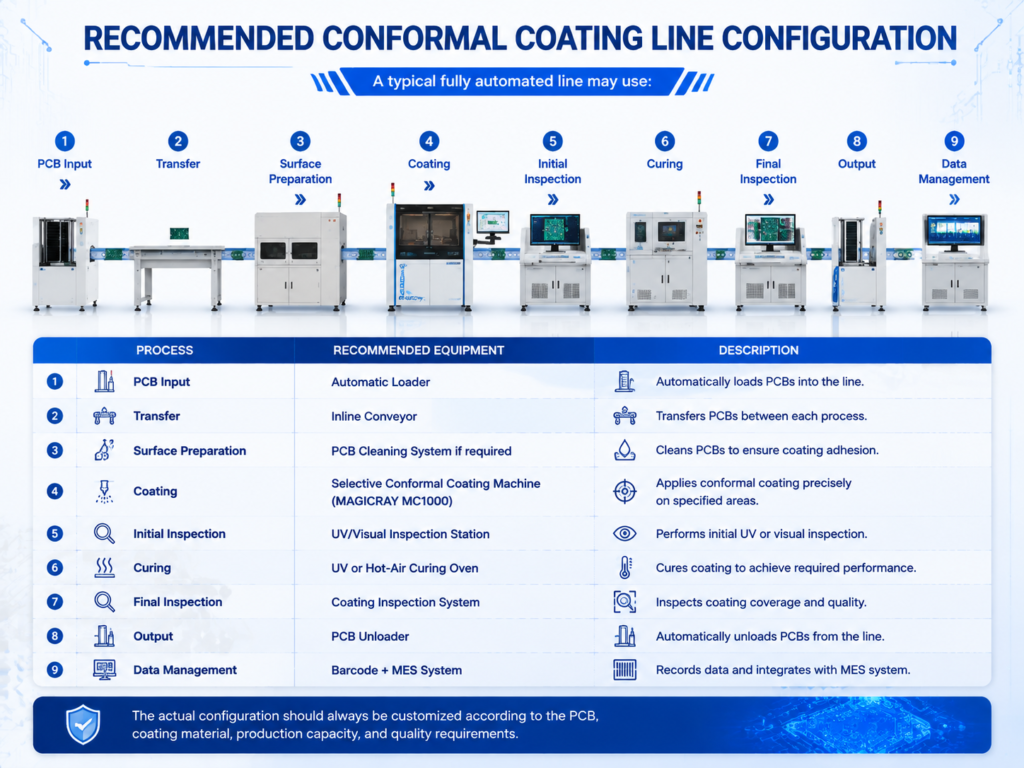
Recommended Conformal Coating Line Configuration
The actual configuration should always be customized according to the PCB, coating material, production capacity, and quality requirements.
How to Calculate Required Production Capacity
The coating machine should not become a bottleneck in the PCBA manufacturing process.
Manufacturers should evaluate:
- PCB cycle time
- Coating path length
- Number of coating areas
- Required coating thickness
- Curing time
- Inspection time
- Conveyor transfer time
For example, a PCB with a large and complex selective coating path may require significantly more processing time than a small PCB with simple coverage.
Therefore, coating line capacity should be calculated using actual product data rather than machine maximum speed alone.
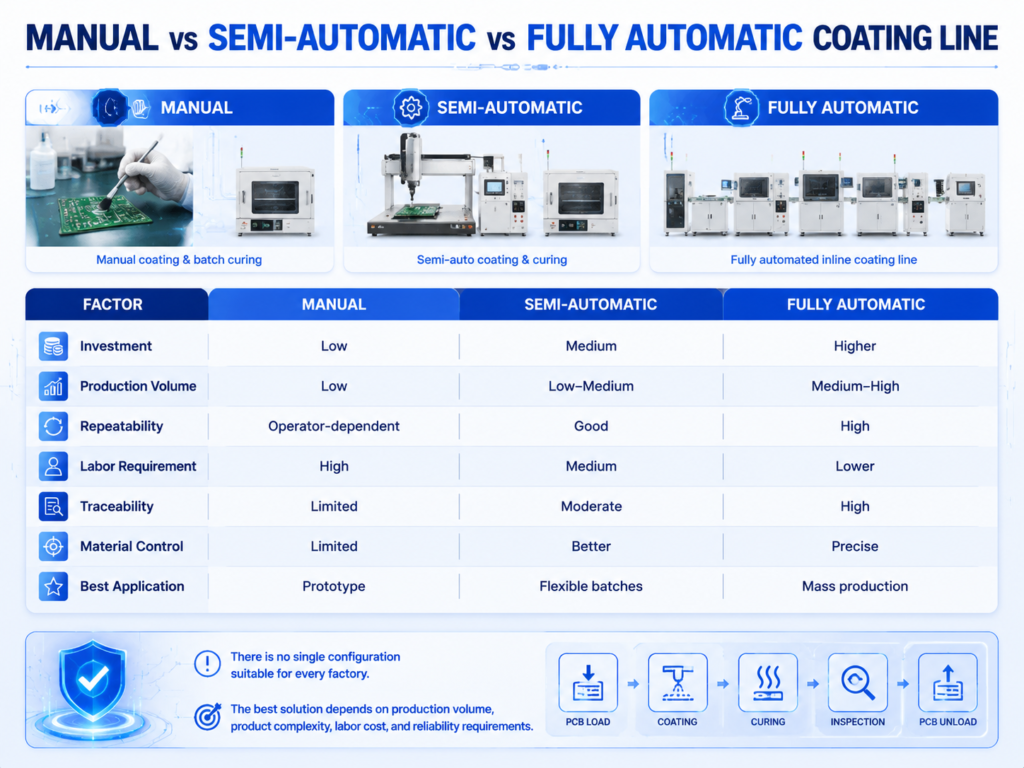
Manual vs Semi-Automatic vs Fully Automatic Coating Line
There is no single configuration suitable for every factory.
The best solution depends on production volume, product complexity, labor cost, and reliability requirements.
How Much Does a Conformal Coating Production Line Cost?
The cost depends heavily on configuration.
Major cost factors include:
- PCB size
- Coating machine configuration
- Number and type of valves
- Conveyor automation
- Curing technology
- Inspection requirements
- Exhaust system
- MES integration
- Production capacity
- Installation and commissioning
Instead of comparing only machine prices, manufacturers should evaluate total project cost and total cost of ownership (TCO).
A lower-cost coating machine may not provide the required speed, repeatability, or automation capability.
Common Mistakes When Setting Up a Coating Line
Choosing Equipment Before Selecting the Coating Material
Material chemistry determines dispensing and curing requirements.
Better approach: Confirm material and process requirements before finalizing equipment.
Ignoring PCB Cleaning
Contamination can affect coating adhesion and reliability.
Better approach: Evaluate cleanliness before coating.
Underestimating Curing Time
A fast coating machine provides little benefit if curing becomes the production bottleneck.
Better approach: Balance coating and curing capacity.
Ignoring Keep-Out Areas
Coating connectors or test points can create serious downstream problems.
Better approach: Define selective coating zones during process development.
Buying Based Only on Machine Price
The lowest-cost solution may result in higher labor, maintenance, and material costs.
Better approach: Evaluate TCO, production efficiency, and supplier support.
How to Choose a Conformal Coating Line Supplier
When selecting a supplier, consider whether they can provide:
- Process requirement analysis
- Equipment selection
- Line balancing
- Factory layout planning
- Selective coating equipment
- Curing equipment
- Inspection solutions
- Conveyor integration
- Installation
- Commissioning
- Operator training
- Maintenance
- Spare parts
- Long-term technical support
For manufacturers without extensive in-house coating experience, choosing a supplier capable of complete line integration can significantly simplify project implementation.
Why Choose Fuliu Electronics?
Established in 2014, Fuliu Electronics is dedicated to providing customers with high-quality PCBA intelligent manufacturing solutions and professional technical services.
With extensive experience in electronics manufacturing equipment and SMT production line integration, we provide solutions covering SMT, DIP/THT, inspection, and PCBA conformal coating processes.
Our broader product portfolio includes SMT pick and place machines from renowned brands such as Fuji, Panasonic, ASM, Yamaha, JUKI, and Hanwha, together with ERSA reflow ovens from Germany, MagicRay SPI/AOI inspection systems, automatic solder paste printers, pre-owned SMT equipment, SMT spare parts, equipment leasing, and maintenance services.
For conformal coating applications, Fuliu Electronics can support customers with:
- Selective conformal coating machines
- UV and hot-air curing ovens
- PCB conveyors and handling systems
- Coating inspection solutions
- Automation integration
- Factory layout planning
- Installation and commissioning
- Operator training
- Process and technical support
Based on the customer’s PCB dimensions, coating material, production capacity, factory space, automation requirements, and budget, our engineering team can configure a customized PCBA conformal coating production line.
Fuliu Electronics is actively serving and expanding across India, Vietnam, the Philippines, Indonesia, the Middle East, South Africa, and Europe, helping electronics manufacturers establish more efficient and reliable PCBA production capabilities.
Conclusion
Setting up a conformal coating production line requires much more than choosing a coating machine.
Manufacturers must consider the entire process:
PCB cleanliness → Board handling → Selective coating → Inspection → Curing → Final inspection → Traceability
Each stage affects production efficiency and coating reliability.
For low-volume manufacturing, manual or semi-automatic coating may provide sufficient flexibility. For medium- and high-volume production, an automated selective conformal coating line can improve repeatability, reduce labor requirements, optimize coating material usage, and provide better process traceability.
Most importantly, the production line should be configured around your actual PCB products and coating chemistry—not around generic equipment specifications.
Working with an experienced PCBA production line integrator can help ensure that the coating machine, curing system, conveyors, inspection equipment, and software operate together as one efficient manufacturing system.
Frequently Asked Questions
A typical automated line includes PCB handling conveyors, a selective conformal coating machine, inspection equipment, a UV or hot-air curing oven, and a PCB unloader. Cleaning, exhaust, barcode, and MES systems can be added according to production requirements.
It depends on PCB cleanliness, flux chemistry, product requirements, and applicable reliability standards. Manufacturers should evaluate surface contamination before determining whether a cleaning process is necessary.
The best machine depends on PCB size, coating material, production volume, keep-out areas, required precision, automation level, and future product requirements.
Neither method is universally better. The correct curing technology depends on the coating chemistry and material manufacturer’s recommended process.
Capacity should be calculated based on actual PCB cycle time, coating path complexity, curing time, inspection time, and material transfer—not simply the maximum speed of the coating machine.
Yes. Suitable automated equipment can integrate barcode identification, recipe management, production records, inspection data, and MES connectivity for improved traceability.