
Choosing the right PCB assembly process is an important decision for electronics manufacturers. Two of the most widely used methods are Surface Mount Technology (SMT) and Through-Hole Technology (THT).
But when comparing SMT vs THT, which process is better for your product?
The answer depends on your PCB design, component types, production volume, reliability requirements, automation goals, and application. For many modern electronics manufacturers, the most effective solution is not choosing one over the other, but combining SMT and THT within an integrated PCBA production process.
This guide explains the difference between SMT and THT, compares their advantages and limitations, and helps PCB assembly factories determine which manufacturing process is more suitable for their production requirements.
What Is SMT PCB Assembly?
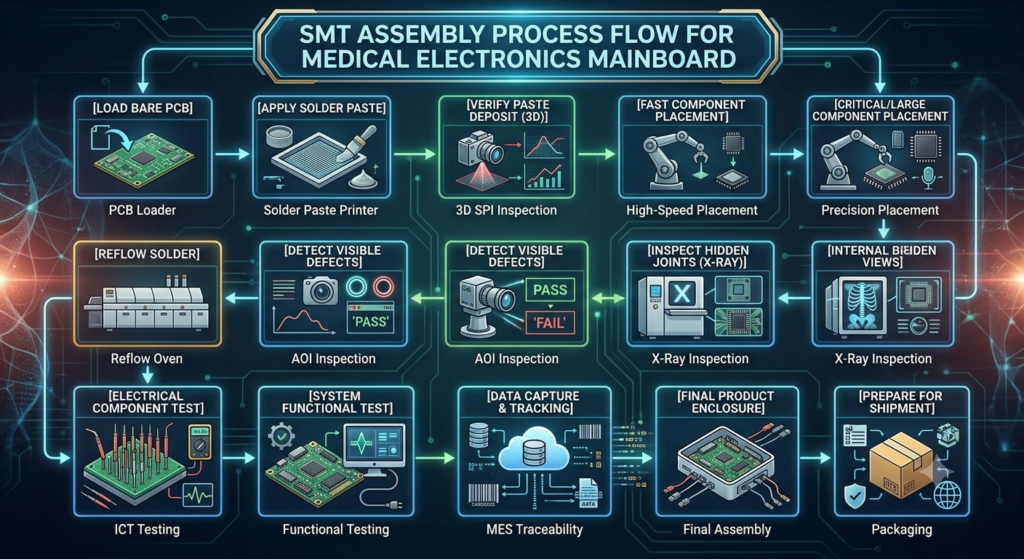
Surface Mount Technology (SMT) is a PCB assembly process in which electronic components are mounted directly onto pads on the surface of a printed circuit board.
A typical SMT production line may include:
PCB Loader → Solder Paste Printer → SPI → Pick and Place Machine → Reflow Oven → AOI → PCB Unloader
During production, solder paste is printed onto PCB pads before high-speed pick and place machines accurately position surface-mount devices (SMDs). The assembled PCB then passes through a reflow oven, where controlled heating forms the solder joints.
SPI and AOI systems can be integrated into the production line to monitor solder paste printing and component assembly quality.
Because of its high automation capability, SMT is widely used in smartphones, computers, consumer electronics, automotive electronics, industrial controls, communication products, and many other applications.
What Is THT PCB Assembly?
Through-Hole Technology (THT) involves inserting component leads through drilled holes in the PCB. The leads are then soldered on the opposite side of the board.
In the PCB assembly industry, this process is also commonly associated with DIP assembly.
A typical THT or DIP production line may include:
PCB Loading → Component Preparation → Manual/Automatic Insertion → DIP Conveyor → Fluxing → Preheating → Wave Soldering → Cooling → Inspection → Rework → Testing
THT is particularly useful for larger components or applications requiring strong mechanical connections.
Typical through-hole components include:
- Connectors
- Transformers
- Relays
- Large capacitors
- Terminals
- Switches
- Coils and inductors
- Certain power components
Although THT generally requires more PCB space than SMT, it continues to play an important role in industrial, automotive, power electronics, and other demanding applications.
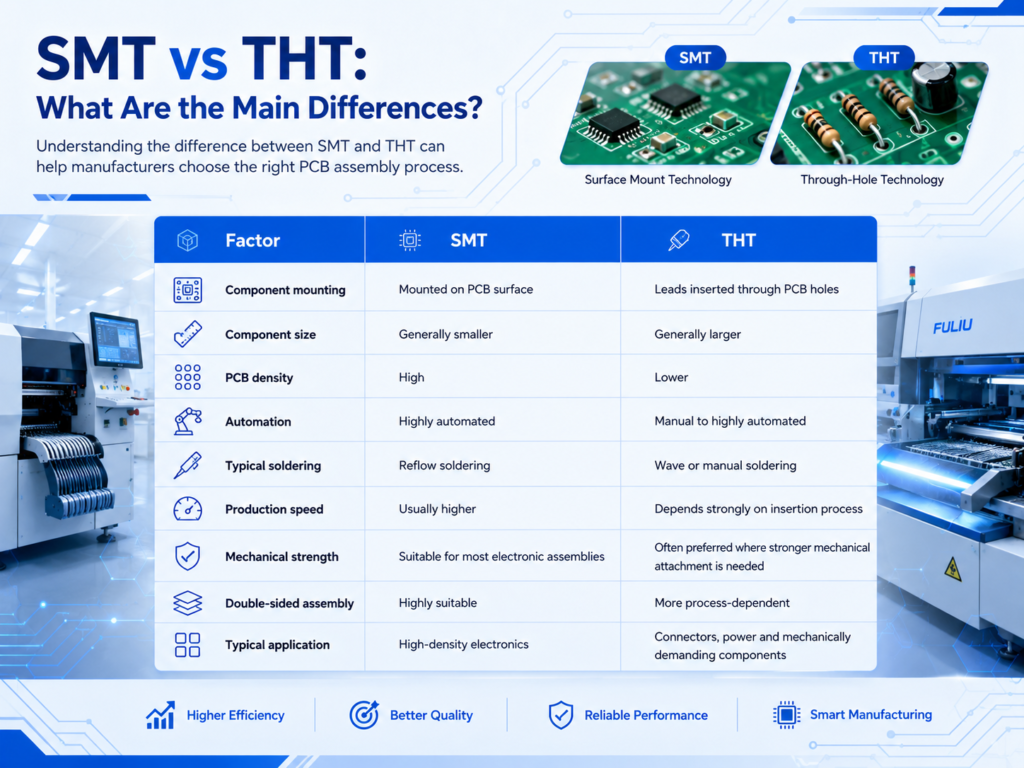
SMT vs THT: What Are the Main Differences?
Understanding the difference between SMT and THT can help manufacturers choose the right PCB assembly process.
Advantages of SMT Assembly
Higher Component Density
SMT components are generally smaller and can be placed closer together, allowing engineers to design compact and high-density electronic products.
Components can also be mounted on both sides of a PCB when the design and manufacturing process support it.
High Production Efficiency
Modern pick and place machines can automate component placement at high speeds.
For medium- and high-volume manufacturing, this can significantly improve production efficiency compared with processes requiring extensive manual insertion.
Strong Automation Capability
From automatic solder paste printing and SPI to component placement, reflow soldering, AOI, and PCB handling, almost the entire SMT process can be automated.
This makes SMT suitable for manufacturers pursuing scalable intelligent PCBA manufacturing.
Suitable for Miniaturized Electronics
As electronic products become smaller and more complex, SMT enables manufacturers to assemble compact components and fine-pitch devices on increasingly dense PCBs.
Advantages of THT Assembly
Despite the widespread adoption of SMT, THT assembly remains necessary for many products.
Strong Mechanical Connection
Because component leads pass through the PCB, through-hole mounting can provide additional mechanical support.
This is particularly useful for connectors, switches, terminals, and components exposed to repeated physical forces.
Suitable for Certain Large Components
Some transformers, relays, large capacitors, and power components are commonly available in through-hole packages and may not be suitable for conventional SMT processes.
Flexible for Specialized Production
Manual or semi-automatic THT lines can provide flexibility for factories producing multiple PCB models, lower volumes, or products with frequently changing through-hole component requirements.
Useful for Demanding Applications
THT continues to be used in industrial equipment, automotive electronics, power supplies, control systems, and other applications where particular components or mechanical requirements favor through-hole mounting.
SMT vs THT: Which Is More Cost-Effective?
When comparing SMT vs THT PCB assembly, cost should be evaluated across the complete manufacturing process.
SMT requires investment in equipment such as:
- Automatic solder paste printers
- SPI systems
- Pick and place machines
- Reflow ovens
- AOI systems
- PCB handling equipment
However, once production volume reaches an appropriate level, automation can reduce manual operations and increase throughput.
THT may require less automation for a basic production setup, but manual component preparation and insertion can increase labor requirements as production volume grows.
Therefore, manufacturers should evaluate total production cost, including equipment investment, labor, throughput, maintenance, factory space, product changeover, and expected production volume.
When Should You Choose SMT?
SMT is generally suitable when your products require:
- High component density
- Compact PCB designs
- High production volumes
- Fast automated component placement
- Large quantities of SMD components
- Double-sided PCB assembly
- Scalable automated production
For factories producing modern consumer electronics, communication equipment, automotive modules, and many industrial electronic products, an SMT production line for PCB assembly is usually a fundamental manufacturing process.
When Should You Choose THT?
THT may be more suitable when the PCB contains:
- Large connectors
- Transformers or relays
- High-power components
- Components requiring strong mechanical mounting
- Components unavailable in suitable SMD packages
The ideal THT production line for PCB assembly should be configured according to PCB dimensions, component types, production capacity, soldering requirements, labor conditions, and quality control needs.
Do You Have to Choose Between SMT and THT?
Not necessarily.
Many PCB assemblies use a mixed-technology process, combining SMT and THT components on the same board.
A complete process might look like:
Solder Paste Printing → SPI → SMT Placement → Reflow Soldering → AOI → THT/DIP Insertion → Wave Soldering → Inspection → Functional Testing
For example, a control board may contain hundreds of small surface-mount resistors, capacitors, and ICs while also requiring through-hole connectors, relays, or transformers
In this situation, combining the two technologies allows manufacturers to take advantage of the high density and automation of SMT while retaining THT where the product design requires it.
How to Choose the Right PCB Assembly Process
Before deciding between SMT or THT for PCB assembly, consider the complete product and production requirements.
PCB Design
Evaluate PCB dimensions, component density, board layers, available space, and whether components need to be assembled on one or both sides.
Component Types
Analyze the bill of materials (BOM) to determine the percentage of SMD and through-hole components.
Production Capacity
High-volume manufacturing can make automation more attractive, while high-mix, low-volume production may require greater flexibility.
Quality Requirements
Consider where SPI, AOI, visual inspection, ICT, functional testing, and traceability systems should be integrated into the process.
Factory Layout
Production planning should account for machine dimensions, operators, material flow, maintenance access, utilities, exhaust requirements, and future expansion.
Future Production Plans
Instead of purchasing machines only for today’s orders, consider whether the line can support expected product changes and future capacity growth.
Complete SMT and THT Production Line Solutions from Fuliu Electronics
Established in 2014, Fuliu Electronics is dedicated to providing customers with high-quality PCBA intelligent manufacturing solutions and services.
With extensive experience in the SMT industry, we specialize in dependable equipment, professional technical support, and complete SMT and PCBA production line solutions.
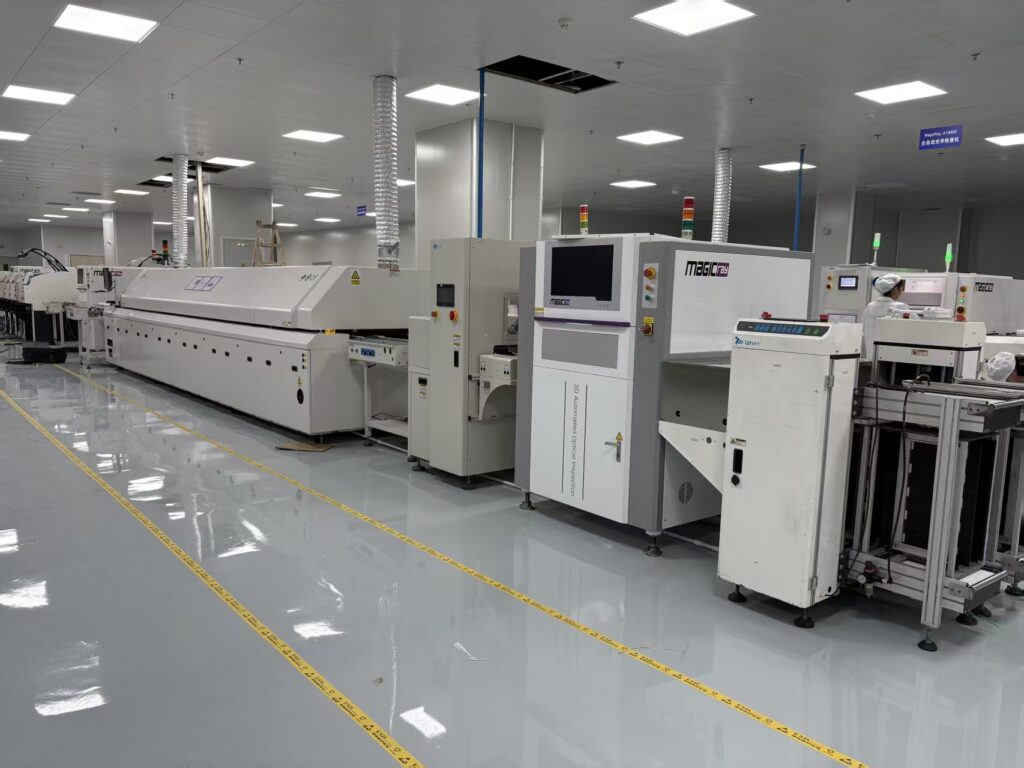
Our product portfolio includes SMT pick and place machines from Fuji, Panasonic, ASM, Yamaha, JUKI, and Hanwha, along with ERSA reflow ovens from Germany, MagicRay SPI/AOI inspection systems, automatic solder paste printers, supporting production equipment, pre-owned SMT machines, SMT spare parts, machine leasing, and maintenance services.
For manufacturers requiring both surface-mount and through-hole processes, Fuliu Electronics can support the planning of an integrated SMT and THT production line solution according to product specifications, production capacity, automation requirements, and factory layout.
As part of our global growth strategy, we are actively expanding into international markets, with key focus areas including India, Vietnam, the Philippines, Indonesia, the Middle East, South Africa, and Europe.
SMT or THT? Build the Process Around Your Product
The SMT vs THT decision should not be based on which technology is newer. It should be based on what your PCB and manufacturing process actually require.
SMT provides excellent component density, automation, and production efficiency, while THT remains valuable for specific components and applications requiring through-hole mounting and mechanical support. For many electronics manufacturers, combining both technologies provides the most practical solution.
If you are planning a new PCB assembly factory, upgrading an existing line, or looking for a complete PCBA production line solution, Fuliu Electronics can help you evaluate your production requirements.
Provide us with your PCB dimensions, BOM, component information, target capacity, factory layout, and required automation level, and our team can help configure an appropriate SMT, THT, or integrated PCB assembly production line.
Frequently Asked Questions
The main difference is how components are mounted. SMT components are mounted directly onto PCB surface pads, while THT components have leads that pass through holes in the PCB before soldering.
Not in every application. SMT is generally better suited to high-density, highly automated assembly, while THT is useful for components requiring through-hole mounting or additional mechanical support. Many PCBs use both technologies.
It depends on production volume, equipment investment, component selection, labor costs, and product complexity. SMT automation can become highly cost-effective for volume production, while manual or semi-automatic THT can remain practical for certain lower-volume or specialized products.
Yes. Mixed-technology PCBs are common. SMT components can first be assembled using solder paste, pick and place, and reflow soldering, followed by THT component insertion and wave or manual soldering.
A typical line includes a PCB loader, automatic solder paste printer, SPI, pick and place machines, reflow oven, AOI, conveyors, and an unloader. The exact configuration depends on capacity, PCB specifications, component range, and quality requirements.
A THT or DIP line may include component preparation equipment, insertion workstations or automatic insertion machines, conveyors, fluxing and preheating systems, wave soldering, cooling, inspection, rework, testing, and PCB handling equipment.