
Building a modern SMT production line is one of the most important investments an electronics manufacturer can make. Whether you’re establishing a new PCB assembly factory, expanding production capacity, or upgrading aging equipment, a complete SMT line can significantly improve productivity, product quality, and long-term competitiveness.
However, purchasing SMT equipment also requires substantial capital. Many manufacturers—especially small and medium-sized enterprises (SMEs)—must balance growth opportunities with cash flow, working capital, and investment risk.
Fortunately, buying equipment outright is no longer the only option. Today, manufacturers can choose from a variety of financing solutions, including equipment leasing, bank loans, supplier financing, government incentive programs, and strategic investment partnerships.
How to Finance an SMT Production Line
In this guide, we’ll explain how to finance an SMT production line, compare common financing methods, and provide practical recommendations for selecting the right funding strategy.
Why Financing Matters
A complete SMT production line includes much more than a pick and place machine.
Typical investments include:
- Automatic PCB Loader
- Automatic Solder Paste Printer
- SPI (Solder Paste Inspection)
- High-Speed Pick and Place Machine
- Precision Chip Mounter
- Multi-Zone Reflow Oven
- AOI Inspection System
- X-Ray Inspection (optional)
- ICT/FCT Testing Equipment
- PCB Cleaning Equipment (optional)
- PCB Unloader
- Conveyor Systems
- MES Software
- Air Compressors
- Nitrogen Systems
- Factory Installation and Commissioning
For many manufacturers, financing allows these investments to be made without placing excessive pressure on day-to-day business operations.
Benefits of Financing SMT Equipment
Financing is often viewed as a growth strategy rather than simply a way to delay payment.
Potential advantages include:
- Preserve working capital
- Improve cash flow
- Accelerate factory expansion
- Upgrade technology sooner
- Reduce opportunity costs
- Match payments with production revenue
- Increase return on invested capital
Instead of waiting years to accumulate sufficient capital, manufacturers can begin production earlier and generate revenue sooner.
Common Financing Options
Several financing methods are available depending on company size, location, and business objectives.
Equipment Leasing
Equipment leasing is one of the most popular financing solutions in the electronics manufacturing industry.
Instead of purchasing equipment outright, manufacturers pay regular lease payments over an agreed period.
Advantages include:
- Lower upfront investment
- Predictable monthly payments
- Easier budgeting
- Faster equipment upgrades
- Improved cash flow
Leasing is particularly attractive for companies expecting rapid technological changes.
Bank Loans
Traditional commercial bank loans remain a common financing option.
Suitable for manufacturers with:
- Strong financial statements
- Stable operating history
- Good credit records
- Long-term expansion plans
Benefits include:
- Equipment ownership
- Fixed repayment schedules
- Potentially competitive interest rates
However, approval may require collateral and extensive documentation.
Supplier Financing
Many SMT equipment suppliers now offer flexible financing programs through financial partners.
These programs may include:
- Deferred payments
- Installment plans
- Equipment leasing
- Customized financing packages
Supplier financing can simplify project implementation because equipment procurement and financing are coordinated together.
Government Incentives
Many countries encourage advanced manufacturing through various support programs.
Potential incentives include:
- Investment grants
- Manufacturing subsidies
- Tax credits
- Low-interest loans
- Export incentives
- Technology innovation funds
Eligibility varies depending on local regulations and industry policies.
Private Investment
Some manufacturers finance expansion through:
- Strategic investors
- Venture capital
- Private equity
- Joint ventures
This option is more common for rapidly growing businesses planning significant capacity expansion.
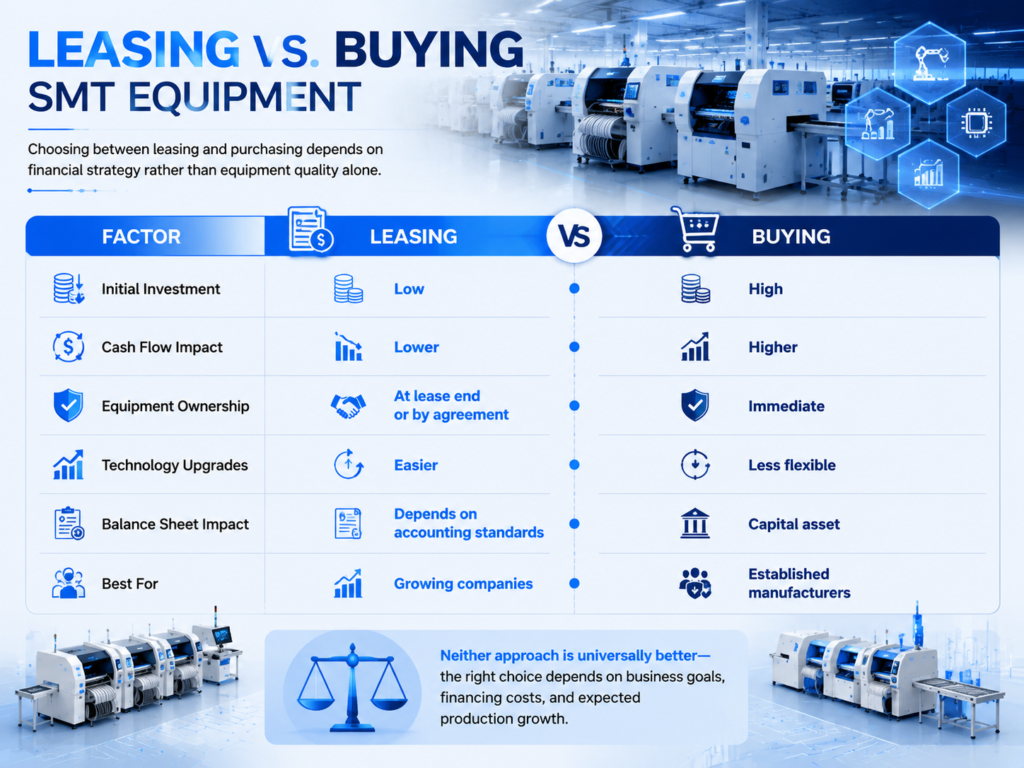
Leasing vs. Buying SMT Equipment
Choosing between leasing and purchasing depends on financial strategy rather than equipment quality alone.
Neither approach is universally better—the right choice depends on business goals, financing costs, and expected production growth.
Financing a Turnkey SMT Production Line
Many manufacturers prefer financing an entire turnkey solution rather than purchasing machines individually.
A turnkey project may include:
- Factory layout design
- Equipment selection
- Production line integration
- Installation
- Commissioning
- Operator training
- Process optimization
- Technical support
Bundling these services into a single financing arrangement often simplifies budgeting and project management.

Factors Lenders Consider
Financial institutions typically evaluate several factors before approving equipment financing.
These include:
- Company financial performance
- Credit history
- Business experience
- Production forecasts
- Industry outlook
- Equipment resale value
- Cash flow stability
Preparing detailed financial documentation can improve financing approval and negotiation outcomes.
Calculating Return on Investment (ROI)
Before financing an SMT production line, manufacturers should estimate the expected financial return.
Key performance indicators include:
- Increased production capacity
- Higher first-pass yield (FPY)
- Reduced labor costs
- Lower defect rates
- Improved equipment utilization
- Shorter production cycles
- Reduced maintenance costs
- Faster order fulfillment
Evaluating total lifecycle value often provides a more accurate picture than comparing equipment purchase prices alone.
Managing Financial Risk
Financing should support business growth—not create unnecessary financial pressure.
Manufacturers can reduce risk by:
- Matching loan terms to equipment lifespan
- Maintaining healthy cash reserves
- Avoiding excessive leverage
- Planning for future maintenance costs
- Investing according to actual production demand
- Selecting scalable production lines
Careful financial planning helps ensure sustainable long-term growth.
Why Refurbished Equipment Can Improve Financing
Professionally refurbished SMT equipment has become increasingly popular because it reduces total capital requirements.
Benefits include:
- Lower acquisition costs
- Faster return on investment
- Shorter delivery times
- Proven manufacturing performance
- Easier financing approval due to lower loan amounts
For many SMEs, refurbished equipment provides an effective balance between performance and affordability.
Choosing the Right Financing Partner
A financing partner should understand both manufacturing operations and capital investment planning.
When evaluating providers, consider:
- Industry experience
- Financing flexibility
- Global support capabilities
- Equipment expertise
- Transparent pricing
- Technical service availability
- Upgrade options
- Long-term partnership potential
Working with experienced suppliers and financial institutions can significantly reduce implementation risk.
Why Choose Fuliu Electronics?
Established in 2014, Fuliu Electronics is dedicated to providing customers with high-quality PCBA intelligent manufacturing solutions and comprehensive technical services.
With extensive experience in the SMT industry, Fuliu Electronics supplies complete SMT production line solutions featuring internationally recognized brands such as Fuji, Panasonic, ASM, Yamaha, JUKI, and Hanwha, together with ERSA reflow ovens, MagicRay SPI/AOI inspection systems, automatic solder paste printers, refurbished SMT equipment, SMT spare parts, equipment leasing, and maintenance services.
Serving customers across India, Vietnam, the Philippines, Indonesia, the Middle East, South Africa, and Europe, Fuliu Electronics helps manufacturers plan and implement turnkey SMT projects by providing equipment selection, factory layout design, installation, commissioning, technical training, and flexible equipment acquisition options that support long-term business growth.
Best Practices Before Financing an SMT Production Line
Before committing to any financing agreement, manufacturers should:
- Define production capacity requirements clearly.
- Compare multiple financing options.
- Calculate total ownership costs instead of purchase price alone.
- Evaluate projected return on investment.
- Plan for maintenance and spare parts.
- Select equipment that can support future expansion.
- Work with suppliers offering long-term technical support.
- Review financing terms carefully, including interest rates, payment schedules, and upgrade options.
A structured evaluation process helps ensure that financing decisions align with long-term operational and financial objectives.
Conclusion
Financing an SMT production line is not simply about acquiring equipment—it is about enabling sustainable business growth while preserving financial flexibility. Whether through leasing, bank financing, supplier-supported programs, or government incentives, manufacturers now have multiple ways to invest in advanced PCB assembly technology without committing all available capital upfront.
The most effective financing strategy balances cash flow, production capacity, technology requirements, and future expansion plans. By partnering with experienced SMT solution providers and selecting financing options that align with business goals, manufacturers can accelerate factory development, improve production efficiency, and strengthen their long-term competitiveness in the electronics manufacturing industry.
Frequently Asked Questions
The best financing option depends on your company’s cash flow, credit profile, production goals, and long-term investment strategy. Common choices include equipment leasing, bank loans, supplier financing, and government incentive programs.
Leasing typically requires a lower upfront investment and preserves working capital, while purchasing provides immediate ownership. The right choice depends on financial priorities and expected equipment utilization.
Yes. Many suppliers offer financing solutions that cover complete turnkey projects, including equipment, installation, commissioning, and technical support.
In many cases, yes. Professionally refurbished equipment is often eligible for financing and can reduce the total amount borrowed due to its lower purchase price.
Requirements vary by lender but commonly include financial statements, business registration documents, production plans, cash flow forecasts, and credit information.
Financing allows manufacturers to begin production sooner, generate revenue earlier, preserve working capital for operations, and spread equipment costs over time, potentially improving overall capital efficiency.