
Outdoor LED displays, architectural lighting, industrial control systems, telecommunications equipment, smart sensors, and other electronic products are increasingly expected to operate reliably in environments with high humidity, condensation, dust, and large temperature fluctuations.
These conditions create significant challenges for printed circuit board assemblies (PCBAs).
Even when a PCB passes functional testing at the factory, long-term exposure to moisture can gradually lead to corrosion, insulation degradation, electrochemical migration, leakage current, and premature product failure.
For this reason, many manufacturers use conformal coating to add an additional protective barrier around sensitive PCB circuitry.
A properly designed conformal coating solution for outdoor LED and high-humidity electronics can improve environmental resistance, extend product service life, and reduce field failures.
In this guide, we’ll explain why outdoor LED and humid-environment electronics require additional protection, how conformal coating helps, what production equipment is needed, and how to configure an automated PCBA coating line.
Why Outdoor LED Electronics Face Higher Reliability Risks
Outdoor LED products frequently operate in difficult environmental conditions.
Typical challenges include:
- High humidity
- Rain exposure
- Condensation
- Dust
- Salt mist in coastal environments
- Temperature cycling
- Airborne pollutants
- UV exposure
- Long operating hours
Although the PCB may be installed inside an enclosure, moisture can still enter through:
- Ventilation openings
- Cable interfaces
- Incomplete sealing
- Temperature-driven condensation
- Maintenance access points
Once moisture reaches the PCB surface, reliability risks increase significantly.

Why High Humidity Is Dangerous for PCBs
Humidity can affect electronic assemblies in several ways.
Corrosion
Moisture combined with ionic contamination can accelerate corrosion on:
- Copper traces
- Solder joints
- Component leads
- Exposed metal surfaces
Leakage Current
Moisture films on PCB surfaces can reduce insulation resistance and create unintended current paths.
Electrochemical Migration
Under electrical bias and moisture, conductive materials may migrate across the PCB surface and form dendritic growth.
This can eventually cause short circuits.
Coating and Adhesion Problems
If a PCB contains contamination before coating, trapped residues can still affect long-term performance.
This is why cleanliness and coating process control are both important.
Why Conformal Coating Is Important for Outdoor LED
Outdoor LED products often contain dense PCB assemblies that control:
- LED driving
- Power conversion
- Communication
- Brightness control
- Temperature monitoring
- Signal processing
A conformal coating forms a thin protective film over these circuits and can help reduce exposure to moisture and contamination.
Benefits may include:
- Improved humidity resistance
- Better corrosion protection
- Reduced surface leakage
- Longer product lifespan
- Better reliability during temperature cycling
- Reduced field maintenance
For outdoor lighting manufacturers, these advantages can translate into fewer warranty claims and more stable long-term performance.
Common Outdoor LED Applications
Conformal coating is commonly considered for:
Outdoor LED Displays
Including:
- Advertising screens
- Stadium displays
- Transportation displays
- Building façades
Architectural Lighting
Including:
- Building illumination
- Landscape lighting
- Bridge lighting
- Decorative outdoor systems
Street and Road Lighting
Including:
- LED streetlights
- Tunnel lighting
- Smart road lighting
Industrial LED Equipment
Including:
- Factory lighting
- Warehouse lighting
- Harsh-environment illumination
These products may operate continuously under changing weather conditions.
High-Humidity Electronics Beyond LED
The same protection strategy applies to many other products.
Common applications include:
- Industrial control systems
- Solar inverters
- Energy storage systems
- Battery Management Systems (BMS)
- Telecom equipment
- Smart meters
- IoT devices
- Agricultural electronics
- Marine-adjacent equipment
- Charging systems
In these applications, environmental reliability is often as important as electrical performance.
Which Conformal Coating Materials Are Commonly Used?
Different applications require different coating chemistries.
Common options include:
Acrylic
Advantages may include:
- Easy application
- Fast processing
- Good repairability
- Broad availability
Silicone
Often selected for:
- Wide temperature ranges
- High flexibility
- Humid environments
Polyurethane
Can provide:
- Strong chemical resistance
- Good abrasion resistance
- Durable environmental protection
UV-Curable Coatings
Suitable for:
- High-volume production
- Fast curing
- Automated inline manufacturing
Hybrid / Dual-Cure Coatings
Can combine fast UV curing with a secondary mechanism for shadowed areas.
The best material depends on the operating environment, service life, rework requirements, and production process.
Coating Material Selection for Outdoor LED
Outdoor LED manufacturers should evaluate:
- Humidity exposure
- Operating temperature
- Thermal cycling
- UV exposure
- Chemical contamination
- Salt mist risk
- Required repairability
- Product lifetime
- Curing requirements
No single conformal coating material is ideal for every LED product.
The correct material should be selected together with the coating process.
Why Selective Conformal Coating Is Useful for LED PCBs
Outdoor LED boards often contain areas that should remain uncoated.
These may include:
- Connectors
- Test points
- Switches
- Contact surfaces
- Sensors
- Heat-transfer areas
A selective conformal coating machine applies material only to programmed zones.
This provides several advantages:
- Better keep-out control
- Reduced masking
- More consistent coating
- Lower material waste
- Improved automation
- Better traceability
For medium- and high-volume LED production, selective coating can significantly improve process efficiency.
Typical Outdoor LED Conformal Coating Process
A production line may follow this workflow:
PCB Assembly → Cleaning if Required → Selective Coating → Inspection → UV/Hot-Air Curing → Final Inspection → Testing → Unloading
The exact configuration depends on the coating material and product requirements.
Step 1: Evaluate PCB Cleanliness
Before coating, check for:
- Flux residues
- Dust
- Oils
- Fingerprints
- Ionic contamination
Applying coating directly over contamination can reduce adhesion and compromise reliability.
For outdoor and high-humidity products, PCB cleaning can be especially important.
Step 2: Define Coating and Keep-Out Zones
Before programming the coating machine, engineers should define:
- Areas requiring protection
- Connectors
- Test points
- Heat dissipation surfaces
- LED optical areas
- Electrical contact zones
These boundaries help ensure the coating protects the PCB without interfering with downstream function.
Step 3: Apply Conformal Coating
A selective coating machine applies material according to a programmed recipe.
Typical process parameters include:
- Coating path
- Application speed
- Valve type
- Material flow
- Spray width
- Dispensing height
Maintaining consistent process parameters improves repeatability.
Step 4: Inspect Coating Coverage
Inspection should verify:
- Complete coverage
- No missing areas
- No coating in keep-out zones
- No excessive pooling
- No visible bubbles
- No major voids
Some coatings include UV-fluorescent indicators, making coverage easier to inspect.
Step 5: Cure the Coating
Curing depends on coating chemistry.
Common methods include:
- UV curing
- Hot-air curing
- Ambient curing
- Moisture curing
- Dual-cure systems
For high-volume LED production, inline UV or thermal curing can significantly improve throughput.
Step 6: Final Quality Verification
After curing, manufacturers may perform:
- Visual inspection
- Electrical testing
- Functional testing
- Coating coverage verification
- Adhesion checks
- Thickness/process checks
For high-reliability products, process records can also be linked to the PCB serial number.
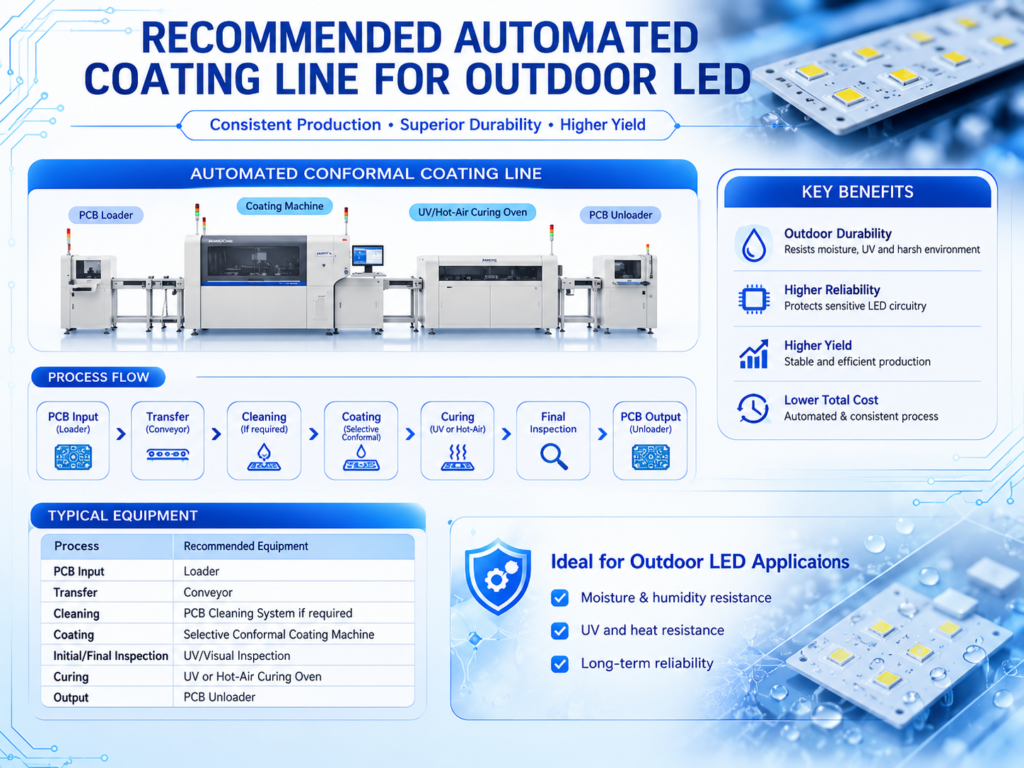
Recommended Automated Coating Line for Outdoor LED
This type of automated line supports consistent production while reducing manual handling.
How to Improve Moisture Protection Beyond Coating
Conformal coating should be considered one part of a broader reliability strategy.
Outdoor electronics may also require:
- Sealed enclosures
- Waterproof connectors
- Proper drainage
- Potting or encapsulation in selected areas
- Ventilation design
- PCB cleaning
- Corrosion-resistant materials
The best solution combines mechanical protection and PCB-level protection.
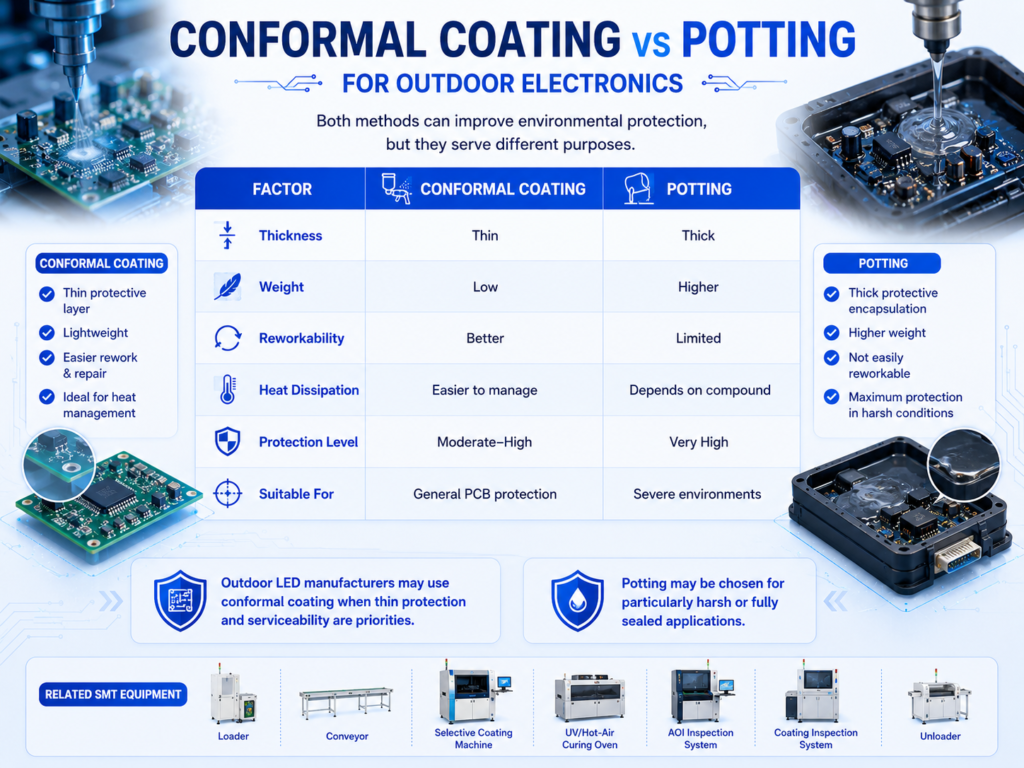
Conformal Coating vs Potting for Outdoor Electronics
Both methods can improve environmental protection, but they serve different purposes.
Outdoor LED manufacturers may use conformal coating when thin protection and serviceability are priorities.
Potting may be chosen for particularly harsh or fully sealed applications.
Common Coating Defects in LED Manufacturing
Missing Coverage
Caused by incorrect path programming or poor material flow.
Excessive Coating
May increase curing time or interfere with components.
Bubbles
Can result from material handling or process conditions.
Coating on Connectors
Usually caused by inadequate keep-out control.
Poor Adhesion
Often linked to PCB contamination or incompatible materials.
Incomplete Curing
May occur when curing parameters do not match coating chemistry.
Proper process validation helps prevent these issues.
How to Choose a Coating Line for Outdoor LED
Before purchasing equipment, provide the supplier with:
- PCB dimensions
- PCB photos
- LED/component layout
- Coating areas
- Keep-out zones
- Coating material
- Required capacity
- Curing requirements
- Factory layout
- Traceability needs
This allows the supplier to configure the correct equipment rather than offering a generic coating machine.
How Much Does an Outdoor LED Coating Line Cost?
Cost depends on:
- PCB dimensions
- Coating machine size
- Number of coating valves
- Production speed
- Curing technology
- Inspection requirements
- PCB cleaning
- Automation level
- MES integration
A simple standalone coating setup requires a lower investment than a fully automatic coating line with cleaning, selective coating, curing, inspection, and traceability.
Manufacturers should evaluate total cost of ownership rather than equipment purchase price alone.
Why Choose Fuliu Electronics?
Established in 2014, Fuliu Electronics is dedicated to providing customers with high-quality PCBA intelligent manufacturing solutions and professional technical services.
With extensive industry experience, we provide equipment and complete production solutions covering SMT, DIP/THT, inspection, PCB cleaning, and conformal coating processes.
Our broader equipment portfolio includes SMT pick and place machines from leading brands such as Fuji, Panasonic, ASM, Yamaha, JUKI, and Hanwha, together with ERSA reflow ovens from Germany, MagicRay SPI/AOI inspection systems, automatic solder paste printers, high-quality pre-owned SMT equipment, spare parts, leasing, and maintenance services.
For outdoor LED and high-humidity electronics, Fuliu Electronics can provide:
- Selective conformal coating machines
- UV curing ovens
- Hot-air curing systems
- PCB cleaning equipment
- PCB conveyors
- Coating inspection solutions
- Barcode/MES integration
- Factory layout planning
- Installation and commissioning
- Operator training
- Long-term technical support
Based on your PCB size, coating material, production capacity, environmental reliability requirements, factory layout, and budget, our engineering team can configure a customized coating solution.
Fuliu Electronics serves customers across India, Vietnam, the Philippines, Indonesia, the Middle East, South Africa, and Europe, supporting electronics manufacturers with flexible and scalable PCBA production solutions.
Conclusion
Outdoor LED and high-humidity electronics face much greater environmental reliability challenges than products used in controlled indoor environments.
Moisture, condensation, dust, temperature cycling, and contamination can gradually damage PCB assemblies even when they initially pass all production tests.
A properly designed conformal coating solution can help protect critical PCB circuitry, improve humidity resistance, reduce corrosion risk, and extend product service life.
However, reliable coating performance depends on the entire process:
PCB Cleanliness → Material Selection → Selective Application → Inspection → Curing → Final Verification
For medium- and high-volume manufacturers, an automated selective conformal coating line can provide better repeatability, traceability, and process control while reducing manual masking and material waste.
The best solution should always be configured around the actual product, operating environment, coating chemistry, and required production capacity.
Frequently Asked Questions
Outdoor LED PCBs are exposed to humidity, condensation, dust, and temperature changes. Conformal coating adds a protective barrier that helps improve corrosion resistance and long-term reliability.
The best coating depends on temperature, humidity, UV exposure, chemical exposure, repairability, and production requirements. Acrylic, silicone, polyurethane, and UV-curable materials are commonly considered.
PCB cleanliness should always be evaluated. Flux residues, dust, oils, and ionic contamination can affect coating adhesion and reliability, particularly in high-humidity applications.
Yes. Selective coating is particularly useful when the PCB contains connectors, test points, optical areas, sensors, or other keep-out zones.
No. Conformal coating improves moisture and environmental resistance, but it should not automatically be treated as complete waterproofing. Enclosure design and sealing remain important.
A typical line may include PCB conveyors, cleaning equipment if required, a selective coating machine, inspection equipment, UV or hot-air curing equipment, and PCB handling systems.