
For a medium-volume PCB assembly factory, the reflow oven is one of the most important process machines in the SMT production line.
After solder paste printing and component placement, the assembled PCB passes through the reflow oven, where the thermal process forms the solder joints.
A typical SMT production line is:
PCB Loader → Solder Paste Printer → SPI → Pick and Place Machine(s) → Reflow Oven → AOI → PCB Unloader
So what is the best reflow oven for medium-volume production?
There is no universal model that is best for every factory.
The correct reflow oven depends on:
PCB Size + Thermal Mass + Solder Paste + Component Mix + Target Capacity + Product Mix + Process Window + Factory Utilities + Budget
For medium-volume production, the objective is usually not to purchase the largest oven available.
It is to select an oven that provides sufficient thermal-process capability, production capacity, flexibility, and maintainability without unnecessary capital or operating cost.
What Is Medium-Volume SMT Production?
There is no single universal boards-per-hour definition of medium-volume production.
A factory may be considered medium-volume based on a combination of:
- Daily PCB output
- Number of product models
- Batch size
- Number of shifts
- Placement quantity
- PCB complexity
- Changeover frequency
For example, two factories may both produce 1,000 PCBAs per day.
One produces one PCB model continuously.
Another produces ten models in smaller batches.
Their reflow requirements may be different even though their daily output is similar.
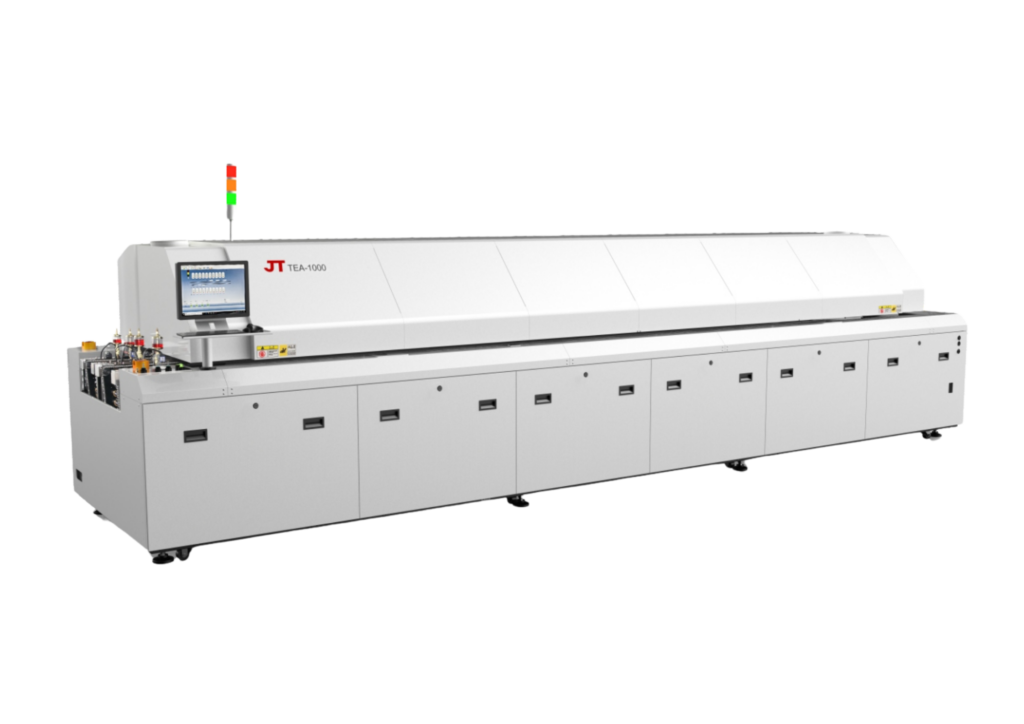
What Does a Reflow Oven Do?
A reflow oven applies a controlled thermal process to a PCB after solder paste printing and SMT placement.
A simplified thermal sequence includes:
Preheating → Thermal Equalization → Reflow → Cooling
However, the actual thermal profile depends on:
- Solder paste
- PCB construction
- Component requirements
- Copper distribution
- Thermal mass
- Product design
There is no universal temperature profile suitable for every PCB.
Why Reflow Oven Selection Matters
An unsuitable oven can make process control more difficult.
Potential production problems can include:
- Insufficient process window
- Uneven heating
- Excessive temperature differences
- Poor cooling control
- Limited PCB width
- Insufficient throughput
- Difficult maintenance
- Excessive energy consumption
The reflow oven should therefore be selected as a process system—not simply as a conveyor with heaters.
Key Factors When Choosing a Medium-Volume Reflow Oven
A practical comparison should include:
- Heating zones
- Effective heating length
- Temperature control
- Thermal uniformity
- Conveyor width
- PCB size
- PCB thermal mass
- Conveyor speed
- Cooling capacity
- Flux management
- Nitrogen capability
- Exhaust
- Recipe management
- Changeover
- Maintenance
- Energy consumption
- Spare-parts availability
- Technical support
- Line compatibility
- Total cost of ownership
How Many Heating Zones Do You Need?
One of the most common questions is:
How many heating zones should a reflow oven have?
There is no universal answer.
More heating zones can provide greater flexibility for shaping the thermal profile, but the required configuration depends on the actual PCB.
Medium-volume professional SMT lines often use multi-zone inline reflow systems rather than compact benchtop ovens.
When comparing ovens, evaluate both:
- Number of zones
- Effective process length
A larger number of short zones does not automatically make one oven better than another.
Why Effective Heating Length Matters
The PCB requires time inside the controlled thermal environment.
A simplified relationship is:
Process Time ≈ Effective Process Length ÷ Conveyor Speed
For example, if the effective heated process length is: 4.0 meters
and conveyor speed is: 0.8 meters/minute
the theoretical heated residence time is approximately: 4.0 ÷ 0.8 = 5 minutes
This is only a simplified illustration.
Actual profile development should be performed using the real PCB, solder paste, components, and oven.
PCB Thermal Mass
PCB thermal mass has a major effect on reflow behavior.
Factors can include:
- PCB thickness
- Copper weight
- Large copper areas
- Ground planes
- Large components
- Shields
- Connectors
- Power components
A small control PCB may heat differently from a thick power-electronics PCBA.
Therefore, two factories with the same boards-per-hour requirement may need different oven configurations.
Medium-Volume Power Electronics Production
Products such as:
- Power supplies
- Solar inverter electronics
- EV charger electronics
- Industrial power control
- Battery management electronics
may contain PCB designs with significant thermal mass.
Where applicable, the oven should provide enough process flexibility to heat these assemblies while maintaining an appropriate thermal profile for temperature-sensitive components.
Temperature Control
Evaluate how the oven controls:
- Zone temperatures
- Conveyor speed
- Cooling
- Nitrogen where applicable
- Recipe settings
For high-mix production, recipe storage can be particularly useful.
Operators can load validated settings for different PCB models rather than manually rebuilding the process each time.
Thermal Uniformity
Uniform heating helps reduce temperature differences across the PCB and between boards.
Thermal performance can be affected by:
- Airflow
- Heater design
- Zone design
- PCB loading
- Conveyor configuration
- Board dimensions
When evaluating equipment, request process information relevant to the actual PCB rather than relying only on maximum temperature specifications.
Reflow Profile Development
A thermal profiler with thermocouples can be used to measure the temperature experienced at selected locations on the actual PCB.
Measurements may be taken at:
- Small components
- Large components
- High thermal mass regions
- Sensitive components
- Different PCB areas
The profile should be evaluated against the requirements of the solder paste, components, PCB, and validated manufacturing process.
Why Oven Set Temperature Is Not PCB Temperature
If a heating zone is set to a particular temperature, that does not mean every component immediately reaches that temperature.
Actual PCB temperature depends on:
- Heat transfer
- Conveyor speed
- PCB mass
- Component mass
- Copper distribution
- Airflow
This is why thermal profiling is important.
Conveyor Width
Before selecting a reflow oven, confirm:
- Maximum PCB width
- Minimum PCB width
- Panel dimensions
- Edge clearance
- Conveyor support requirements
If future products may use larger panels, consider reasonable expansion capacity.
However, purchasing an unnecessarily wide oven can increase equipment size and potentially operating cost.
Center Support
Large, thin, or heavy PCB panels may benefit from center support during transport.
This can help reduce potential sagging or instability during the thermal process.
Whether center support is required depends on:
- PCB dimensions
- Thickness
- Weight
- Panel design
- Temperature behavior
Check this before finalizing the oven configuration.
Conveyor Speed and Production Capacity
Reflow capacity is influenced by:
- Conveyor speed
- PCB length
- PCB spacing
- Thermal profile
- Loading method
Suppose:
- PCB length in conveyor direction = 250 mm
- Required PCB spacing = 50 mm
- Effective pitch = 300 mm
- Conveyor speed = 900 mm/min
A simplified theoretical loading rate is:
900 ÷ 300 = 3 boards/minute or: 180 boards/hour
But this does not automatically mean the line will produce 180 finished boards per hour.
Upstream and downstream processes must also support that rate.
Line Balance
Consider this example:
Finished output is approximately limited to: 70 boards/hour
Buying a larger oven capable of 220 boards/hour would not solve the production bottleneck.
For medium-volume production, equipment should be balanced around the required finished output.
Cooling Performance
Cooling is an important part of the reflow process.
Evaluate:
- Number of cooling zones
- Cooling method
- Cooling capacity
- Accessibility for maintenance
- Flux accumulation
The required cooling behavior depends on the solder process and PCB.
Cooling should be considered during profiling rather than treated only as a machine-exit function.
Flux Management
During reflow, volatile materials from solder paste can enter the oven atmosphere.
Over time, residues may accumulate in:
- Exhaust paths
- Cooling systems
- Filters
- Internal surfaces
Flux management can help control residue and reduce maintenance burden.
When comparing reflow ovens, ask:
- How is flux collected?
- Which parts require regular cleaning?
- Are collection units removable?
- How often are filters serviced?
- How easy is internal access?
Maintenance design can significantly affect long-term production availability.
Air vs Nitrogen Reflow
A common purchasing question is whether to choose:
Air Reflow or Nitrogen Reflow
There is no universal answer.
Air Reflow
Air operation can offer:
- Simpler factory infrastructure
- No continuous nitrogen consumption
- Lower utility complexity
- It may be sufficient for many SMT processes.
Nitrogen Reflow
Nitrogen can be considered where the process benefits from a reduced-oxygen environment.
Whether it is required depends on:
- Solder paste
- PCB finish
- Component structure
- Product requirements
- Process window
Nitrogen adds:
- Equipment configuration
- Nitrogen generation or supply
- Piping
- Operating cost
Do not specify nitrogen simply because it is considered a higher-end feature.
Oxygen Control
For nitrogen-capable systems, manufacturers should understand:
- Oxygen monitoring
- Nitrogen consumption
- Control method
- Process requirements
Lower oxygen concentration is not automatically better for every product.
The target should follow the validated soldering process.
High-Mix Medium-Volume Production
For high-mix manufacturing, important oven features can include:
- Recipe storage
- Fast recipe change
- Stable temperature recovery
- Adjustable conveyor width
- Flexible conveyor speed
- Easy profiling
- Good maintenance access
Applications may include:
- Industrial control
- Medical electronics
- Power electronics
- Automotive electronics
- EMS manufacturing
In this environment, flexibility can be more valuable than maximum throughput.
Product Changeover
Changing from one PCB model to another may require changes to:
- Zone temperatures
- Conveyor speed
- Conveyor width
- Nitrogen settings
- Cooling settings
A well-designed recipe system can help control changeover.
For high-mix factories, frequent unnecessary thermal stabilization periods can reduce effective production time.
Reflow Oven and Fine-Pitch Assembly
Fine-pitch components and dense PCBAs require a controlled upstream and thermal process.
However, reflow quality does not depend on the oven alone.
It also depends on:
Stencil + Solder Paste + Printing + Placement + PCB Design + Reflow Profile
A premium oven cannot compensate for severe solder paste printing problems.
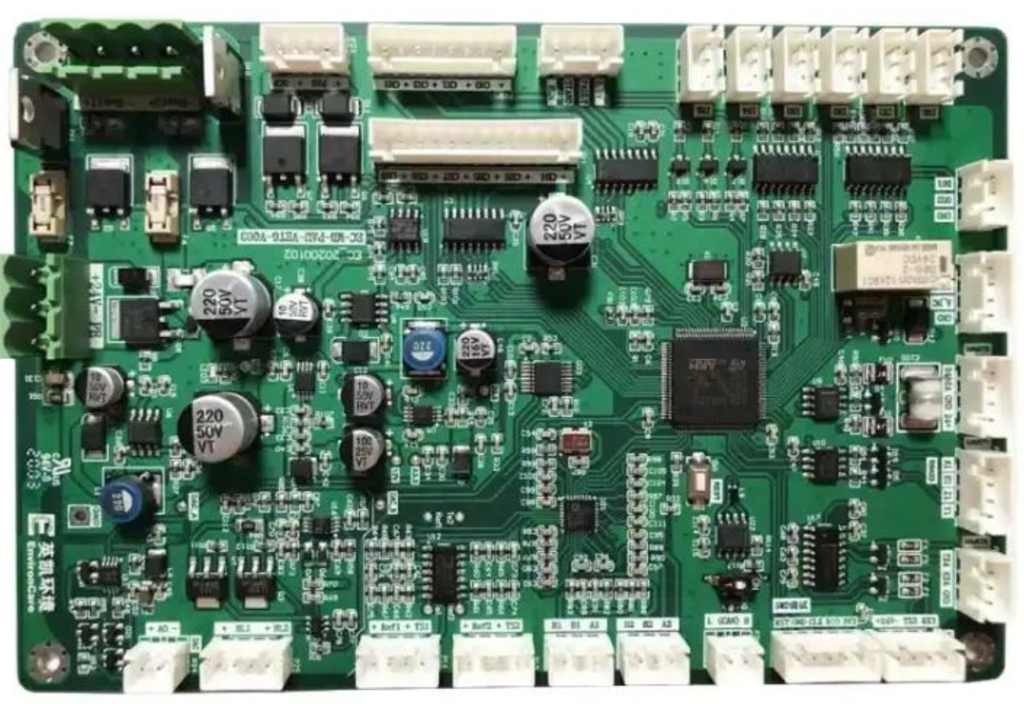
Reflow Oven for BGA and QFN Assembly
BGAs and QFNs can have hidden solder joints.
Reflow profile development should consider:
- Package thermal behavior
- PCB thermal mass
- Solder paste
- Component requirements
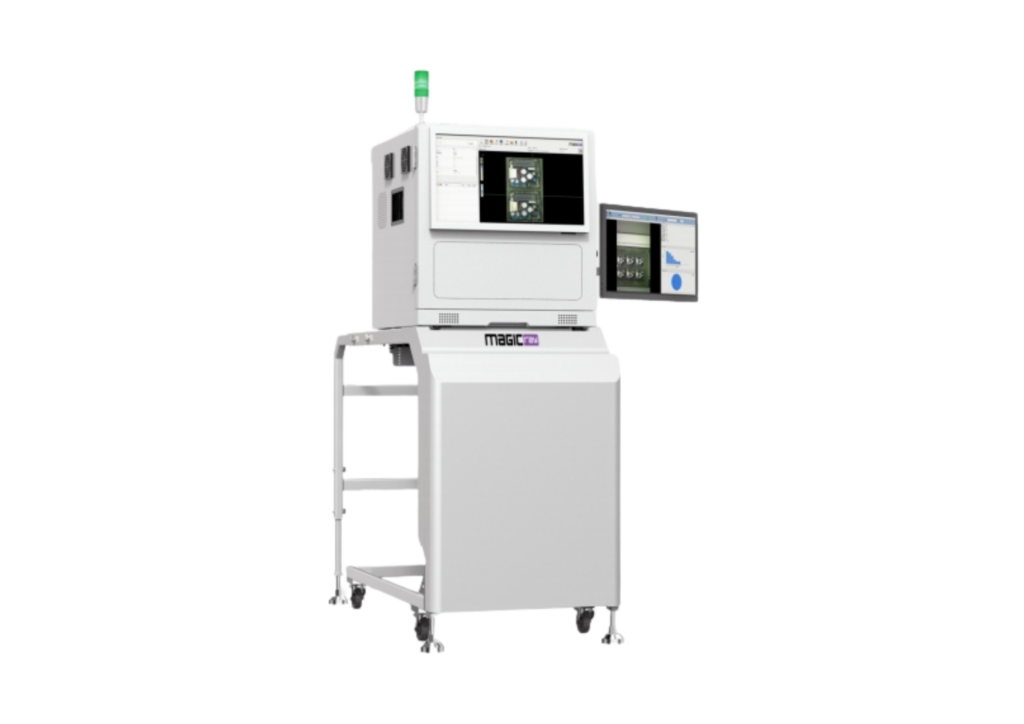
Post-reflow inspection may use X-ray where appropriate because AOI cannot directly inspect every hidden joint.
Reflow Oven for Double-Sided SMT
Double-sided SMT assembly commonly involves two reflow passes.
A simplified process may be:
Side A Printing → Placement → Reflow → Flip → Side B Printing → Placement → Reflow
The process should consider:
- Component selection
- PCB support
- First-side components
- Second reflow exposure
- Thermal profile
The oven should support the validated process for both sides.
Reflow Oven for Lead-Free Production
Lead-free soldering processes can require different thermal conditions from some traditional solder processes.
The oven should provide sufficient:
- Heating capability
- Profile control
- Cooling
- Process flexibility
Do not choose the oven based only on a “lead-free compatible” label.
Profile the actual assembly.
Energy Consumption
Reflow ovens can be significant energy users in an SMT factory.
Operating cost can include:
- Electrical heating
- Cooling
- Exhaust
- Nitrogen where applicable
- Factory HVAC load
For medium-volume factories, the oven may not operate at full production continuously.
Therefore, evaluate:
- Warm-up behavior
- Standby modes
- Energy management
- Production scheduling
Initial machine price is only part of the cost.
Maintenance Cost
Routine maintenance can involve:
- Flux collection systems
- Filters
- Exhaust
- Fans
- Motors
- Heaters
- Conveyor
- Chain/mesh
- Cooling system
- Sensors
Before purchasing, ask:
- Which parts require daily maintenance?
- Which require weekly or monthly maintenance?
- How long does cleaning take?
- What consumables are required?
- Which spare parts should be stocked?
Easy maintenance can improve equipment availability.
Downtime Risk
Suppose a medium-volume SMT line produces: 70 PCBAs/hour
The reflow oven stops for: 6 production hours
Planned output affected: 70 × 6 = 420 PCBAs
This illustrates why maintenance access, spare parts, and technical support should be considered during equipment selection.
New vs Pre-Owned Reflow Oven
Medium-volume factories can consider both new and suitable pre-owned equipment.
New Reflow Oven
Potential advantages include:
- New-machine condition
- Current controls
- Current energy-management features
- Manufacturer support
- Warranty depending on supplier
Pre-Owned Reflow Oven
Potential advantages can include:
- Lower initial investment
- Access to established international-brand equipment
- Suitable capacity for factories with limited capital budgets
However, condition should be carefully inspected.
ERSA Reflow Ovens for Professional SMT Production
ERSA provides professional reflow soldering systems for electronics manufacturing.
Depending on the specific machine and configuration, ERSA reflow solutions can support requirements involving:
- Controlled thermal processing
- Multi-zone heating
- Cooling
- Process monitoring
- Nitrogen operation where configured
- Flux management
- Inline SMT manufacturing
For medium-volume production, the appropriate ERSA configuration should be selected according to PCB dimensions, thermal mass, required capacity, soldering process, factory utilities, and budget.
The brand alone does not determine the correct oven size.
What Is the Best Reflow Oven Configuration for Medium-Volume Production?
A typical medium-volume SMT line may use:
Automatic Loader → Automatic Printer → SPI → Pick and Place Machine(s) → Multi-Zone Inline Reflow Oven → AOI → Unloader
The reflow oven should provide sufficient capacity for the placement section without being unnecessarily oversized.
For high-mix production, prioritize:
- Flexible recipes
- Adjustable conveyor
- Process stability
- Maintenance access
For more stable medium-volume production, prioritize:
- Required throughput
- Thermal process window
- Uptime
- Energy efficiency
- Process repeatability
Compact Oven vs Full-Size Inline Reflow Oven
A compact oven may suit:
- Prototyping
- R&D
- Small batches
- Very limited production
A full-size inline system may be more appropriate when:
- Continuous production is required
- Multiple shifts are used
- Larger PCBs are processed
- More thermal flexibility is needed
Production is integrated with automatic SMT equipment
Medium-volume professional production often benefits from an inline system that can be balanced with printing, placement, and inspection equipment.
Total Cost of Ownership
Do not compare only purchase price.
A simplified model is:
Reflow Oven TCO = Equipment + Installation + Exhaust + Nitrogen Infrastructure + Energy + Maintenance + Spare Parts + Cleaning + Downtime
For a medium-volume factory, operating cost can become significant over several years.
SMT Reflow Solutions from Fuliu Electronics
Established in 2014, Fuliu Electronics is dedicated to providing customers with high-quality PCBA intelligent manufacturing solutions and services.
With extensive experience in the SMT industry, we specialize in dependable equipment, professional technical support, and complete SMT production line solutions.
Our equipment portfolio includes SMT pick and place machines from Fuji, Panasonic, ASM, Yamaha, JUKI, and Hanwha, together with ERSA reflow ovens from Germany, MagicRay SPI/AOI inspection systems, automatic solder paste printers, PCB handling equipment, pre-owned SMT equipment, SMT spare parts, machine leasing, and maintenance services.
For manufacturers selecting a reflow oven, Fuliu Electronics can evaluate:
- PCB dimensions
- PCB thermal characteristics
- Component layout
- Solder paste
- Target capacity
- Product mix
- Existing placement capacity
- Air vs nitrogen requirements
- Cooling requirements
- Factory exhaust
- Factory layout
- New vs pre-owned equipment
- Investment budget
The objective is to configure:
Printing → SPI → Placement → Reflow → AOI
as one balanced SMT manufacturing process.
As part of our global growth strategy, Fuliu Electronics is actively expanding into international markets, with key focus areas including India, Vietnam, the Philippines, Indonesia, the Middle East, South Africa, and Europe.
Frequently Asked Questions
There is no universal best model. The correct oven depends on PCB dimensions, thermal mass, solder paste, target capacity, product mix, factory utilities, and budget.
There is no universal number. Evaluate the required thermal profile, effective heating length, PCB thermal mass, conveyor speed, and production requirements.
No. An oversized oven may increase capital, floor-space, and operating requirements without increasing finished-line output if another process is the bottleneck.
Not always. Nitrogen should be selected where the soldering process benefits from a reduced-oxygen environment and the additional infrastructure and operating cost are justified.
Yes. Professional inline ovens typically support recipe changes, but each PCB process should be developed and validated appropriately.
Capacity depends on conveyor speed, PCB dimensions, board spacing, and the required thermal profile. It should also be balanced with printing, placement, and inspection capacity.