
High-volume PCB manufacturing requires more than simply increasing the speed of individual machines.
For PCBAs containing through-hole components, manufacturers must coordinate:
- Component preparation
- Material feeding
- THT insertion
- Manual insertion of non-automatable parts
- Pre-solder inspection
- Wave or selective soldering
- Cooling
- Post-solder inspection
- Testing
- PCB handling
When these processes are not properly balanced, a high-speed soldering machine or automatic insertion machine can spend significant time waiting for upstream or downstream processes.
A successful automatic THT assembly line should therefore be designed around complete-line output rather than the rated speed of one machine.
A typical process may be:
PCB Loading → Component Preparation → Automatic THT Insertion → Manual/Semi-Automatic Insertion → Pre-Solder Inspection → Wave/Selective Soldering → Cooling → Inspection → Testing → PCB Unloading
Automatic THT Assembly Line Solution for High-Volume PCB Production
This guide explains how to configure an automated through-hole assembly solution for high-volume PCB production.
What Is an Automatic THT Assembly Line?
An automatic THT assembly line integrates equipment and material handling to reduce manual operations during through-hole PCB assembly.
THT stands for Through-Hole Technology, where component leads pass through holes in the PCB before soldering.
Depending on the product, automation may cover:
- PCB loading
- Component preparation
- Component feeding
- THT insertion
- PCB transfer
- Inspection
- Fluxing
- Preheating
- Soldering
- Cooling
- PCB unloading
- Barcode identification
- Production-data collection
However, an automatic THT line does not necessarily mean that every component is inserted automatically.
For many real products, a hybrid automatic + manual insertion strategy is more practical.
THT vs DIP in High-Volume PCB Production
The terms THT and DIP are often used together, but they are not technically identical.
THT describes the mounting technology.
DIP means Dual In-line Package, which is one particular component package.
A through-hole production line may process:
- Connectors
- Capacitors
- Relays
- Transformers
- Inductors
- Terminals
- Switches
- Power components
- that are not DIP packages.
Nevertheless, the terms automatic DIP line and DIP production line are commonly used in electronics manufacturing to describe broader THT assembly operations.
Why Automate THT Assembly?
High-volume production can involve thousands of repetitive component insertions.
Manual assembly may create challenges such as:
- High labor requirements
- Variable cycle times
- Operator fatigue
- Insertion mistakes
- Difficult line balancing
- Increasing WIP
- Capacity limitations
Automation can be considered where the product structure is stable enough to support it.
Potential objectives include:
- Increasing repeatable production capacity
- Reducing repetitive manual work
- Improving line balance
- Supporting continuous PCB flow
- Improving process consistency
- Supporting production-data collection
However, automation should solve a measurable production problem.
Start with the BOM, Not the Machine
Before selecting an automatic insertion machine, analyze the actual THT BOM.
For every component, collect:
- Component type
- Package
- Dimensions
- Lead structure
- Lead spacing
- Orientation
- Polarity
- Packaging method
- Quantity per PCB
- Required insertion method
Then divide the components into groups.
Group 1: Components Suitable for Automatic Insertion
Some standardized THT components may support automated insertion when their:
- Geometry is compatible
- Leads are suitable
- Packaging supports automatic feeding
- Orientation is controlled
- Production quantity justifies automation
These components should be prioritized when evaluating automatic insertion.
Group 2: Components Suitable for Semi-Automatic Processing
Some parts may benefit from:
- Automatic component presentation
- Guided workstations
- Fixtures
- PCB positioning
- Visual work instructions
without requiring a fully automatic insertion machine.
Group 3: Components Better Suited to Manual Insertion
Manual insertion may remain practical for:
- Large transformers
- Irregular connectors
- Heavy components
- Low-quantity parts
- Components with difficult packaging
- Frequently changing components
Trying to automate every component can increase tooling, feeding, programming, and changeover complexity.
Component Packaging Matters
Two components with similar electrical functions may require different automation strategies because of their packaging.
THT components can arrive in:
- Tape
- Tube
- Tray
- Reel
- Bulk packaging
- Custom packaging
Automatic feeding becomes much easier when the component packaging supports consistent orientation and presentation.
Therefore, automation planning should include the component supply format—not just the component drawing.
Component Preparation for High-Volume Production
Before insertion, some THT components require:
- Lead cutting
- Lead forming
- Bending
- Straightening
- Sorting
If these operations remain fully manual while insertion is automated, component preparation can become the bottleneck.
For high-volume production, manufacturers should evaluate whether repetitive preparation operations can be:
- Automated
- Semi-automated
- Integrated with feeding
The objective is continuous material supply to the insertion process.
Typical Automatic THT Production Flow
A higher-automation line may use:
Automatic PCB Loader → Automatic THT Insertion → Assisted/Manual Insertion → Pre-Solder Inspection → Automatic PCB Transfer → Wave Soldering → Cooling → Post-Solder Inspection → Testing → Automatic Unloader
Optional functions include:
- Barcode scanning
- Automatic width adjustment
- Buffers
- Recipe management
- Traceability
- Production-data collection
The exact configuration should follow the actual product.
Automatic PCB Loading
Automatic loaders can feed boards into the production line without continuous manual loading.
When selecting PCB handling equipment, consider:
- PCB dimensions
- Panel dimensions
- PCB thickness
- Board weight
- Magazine dimensions
- Conveyor height
- Conveyor direction
For heavy PCBAs, board support and transfer stability may require additional consideration.
Automatic THT Insertion
Automatic insertion equipment can reduce repetitive manual placement of compatible components.
When evaluating a machine, review:
- Supported component types
- Feeding method
- PCB dimensions
- Insertion accuracy
- Insertion force
- PCB support
- Changeover
- Programming
- Maintenance
- Spare parts
Actual component compatibility
Nominal machine speed should not be the only selection criterion.
Rated Speed vs Actual Output
An insertion machine may have a high nominal insertion rate.
However, actual output can be affected by:
- Component mix
- Feeder arrangement
- PCB transfer
- Component quantity
- Insertion sequence
- Changeover
- Machine utilization
- Replenishment
- Manual operations
Therefore:
Machine Rated Speed ≠ Finished Line Output
Use actual PCB and BOM data to estimate cycle time.
Manual Insertion Can Still Be Part of an Automatic Line
A high-volume automatic THT line can still contain manual workstations.
For example:
Automatic Insertion → Manual Large-Component Insertion → Soldering
This may be more economical than developing automation for a small number of irregular components.
The key is to balance manual operations with the required takt time.
How to Calculate Manual Insertion Stations
Suppose the remaining manual THT components require a total of:
120 seconds of operator work per PCB
The required line takt is:
30 seconds per PCB
A simplified calculation is:
120 ÷ 30 = 4 operator-equivalent stations
Therefore, approximately four balanced workstations may be required before considering efficiency allowances, replenishment, changeover, and product variation.
This is more useful than simply adding operators after production starts.
Pre-Solder Inspection
Before soldering, inspect for:
- Missing components
- Wrong components
- Incorrect orientation
- Polarity errors
- Bent leads
- Incorrect seating
- Insertion depth problems
High-volume production can generate large quantities of defects quickly if an upstream assembly error is not detected.
Therefore, pre-solder inspection can help prevent repeated downstream rework.
Wave Soldering for High-Volume THT Production
Wave soldering is often an efficient option when:
- The PCB contains many THT joints
- The underside supports wave contact
- Production volume is high
- Continuous conveyorized production is required
A typical process includes:
Fluxing → Preheating → Wave Soldering → Cooling
Machine selection should consider:
- PCB width
- Conveyor capacity
- Fluxing system
- Preheat configuration
- Solder pot
- Wave configuration
- Cooling
- Controls
- Exhaust
Nitrogen where required by the process
Selective Soldering for High-Volume Production
Selective soldering can also be automated.
It may be useful when:
- THT joints are localized
- Bottom-side SMT limits wave contact
- Specific areas require controlled soldering
- Product design does not suit conventional wave soldering
However, selective soldering cycle time depends heavily on:
- Number of joints
- Soldering path
- Nozzle size
- Joint grouping
- Preheating
- Movement
- Number of soldering modules
For high-volume production, cycle-time calculation is especially important.
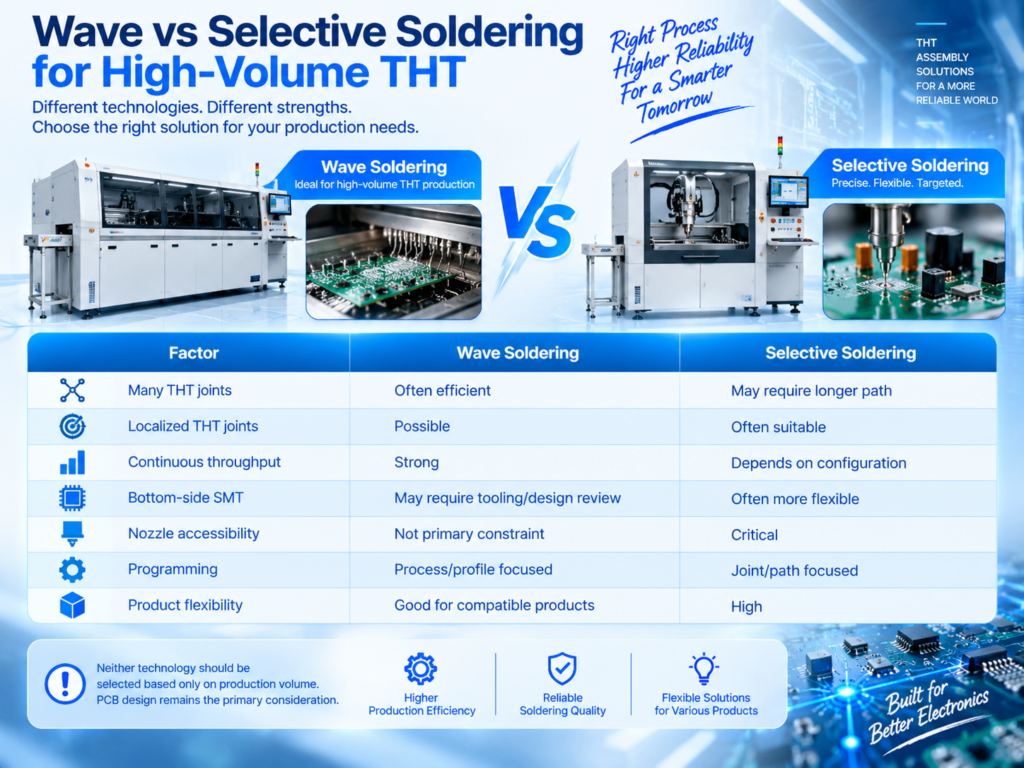
Wave vs Selective Soldering for High-Volume THT
Neither technology should be selected based only on production volume.
PCB design remains the primary consideration.
Preheating for THT Soldering
Preheating is important for stable soldering.
Its role can include:
- Flux activation
- Gradual PCB heating
- Reducing thermal differences
- Supporting wetting
However, there is no universal preheat setting.
The process depends on:
- PCB construction
- Copper distribution
- Component thermal mass
- Flux
- Solder alloy
- Equipment
High-volume production requires a validated process that remains stable over continuous operation.
Cooling and PCB Handling
After soldering, the PCB should cool sufficiently before downstream processing.
Cooling may be integrated into:
- Wave soldering equipment
- Selective soldering equipment
- Separate cooling conveyors
PCB handling should also consider:
- Large components
- Board weight
- Board warpage
- Component stability
For high-volume production, transport reliability is critical because even a simple conveyor fault can stop the complete line.
Post-Solder Inspection
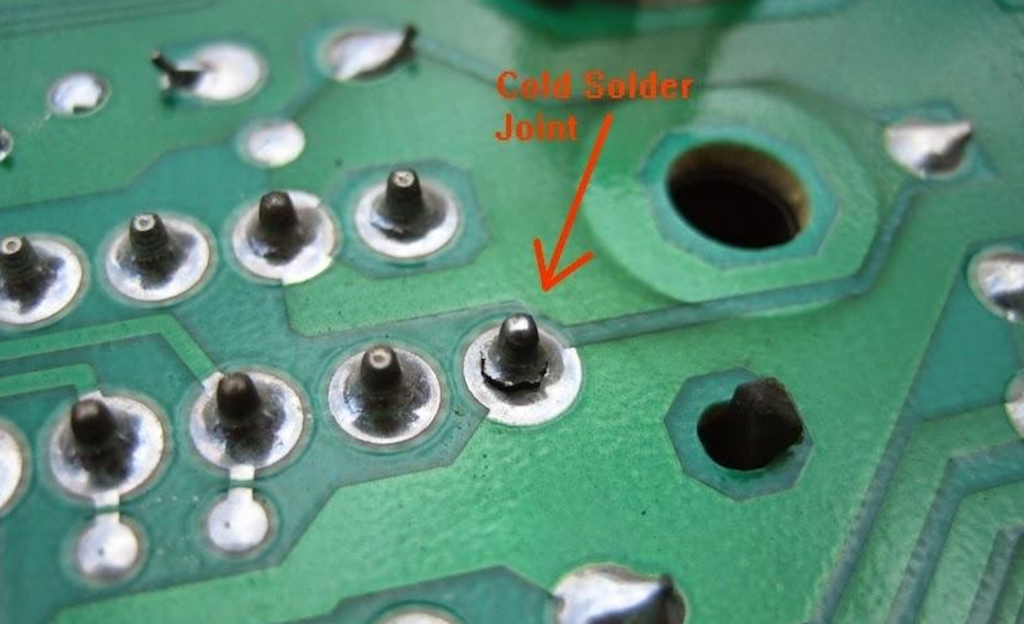
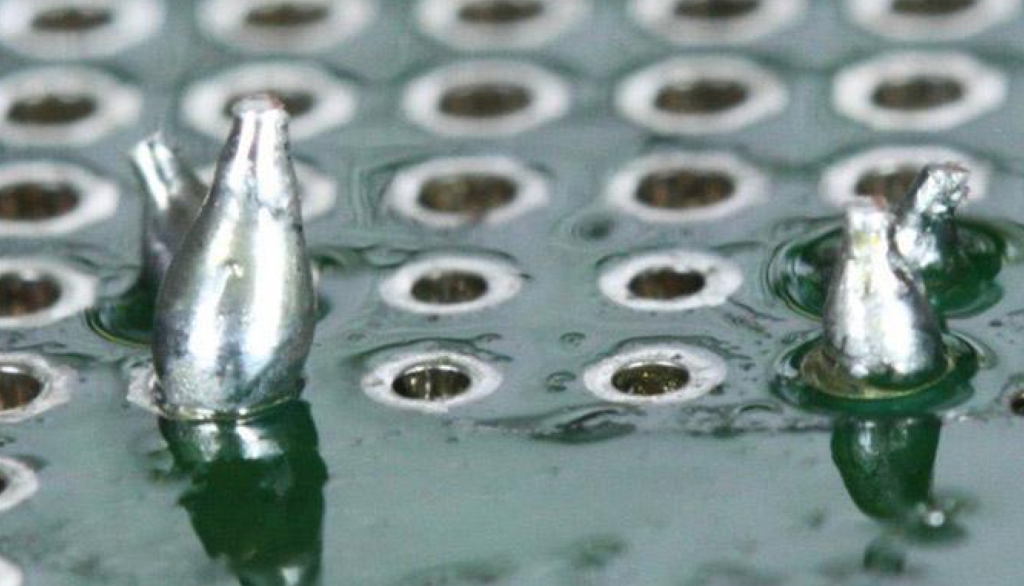
Common THT soldering defects include:
- Solder bridges
- Poor wetting
- Insufficient solder
- Incomplete hole fill
- Excessive solder
- Icicles
- Solder balls
- Potential causes may include:
- Flux coverage
- Preheat
- Solderability
- Solder temperature
- PCB design
- Lead condition
- Conveyor parameters
- Wave stability
- Selective soldering settings
Inspection can include manual visual inspection, AOI where applicable, and other methods according to the product.
Testing Must Be Part of the Automatic Line Strategy
One of the most common mistakes in high-volume line planning is focusing on assembly automation while underestimating testing.
Depending on the product, downstream testing can include:
- ICT
- Programming
- Functional testing
- Communication testing
- Product-specific electrical testing
Testing cycle time must be included when calculating finished production capacity.
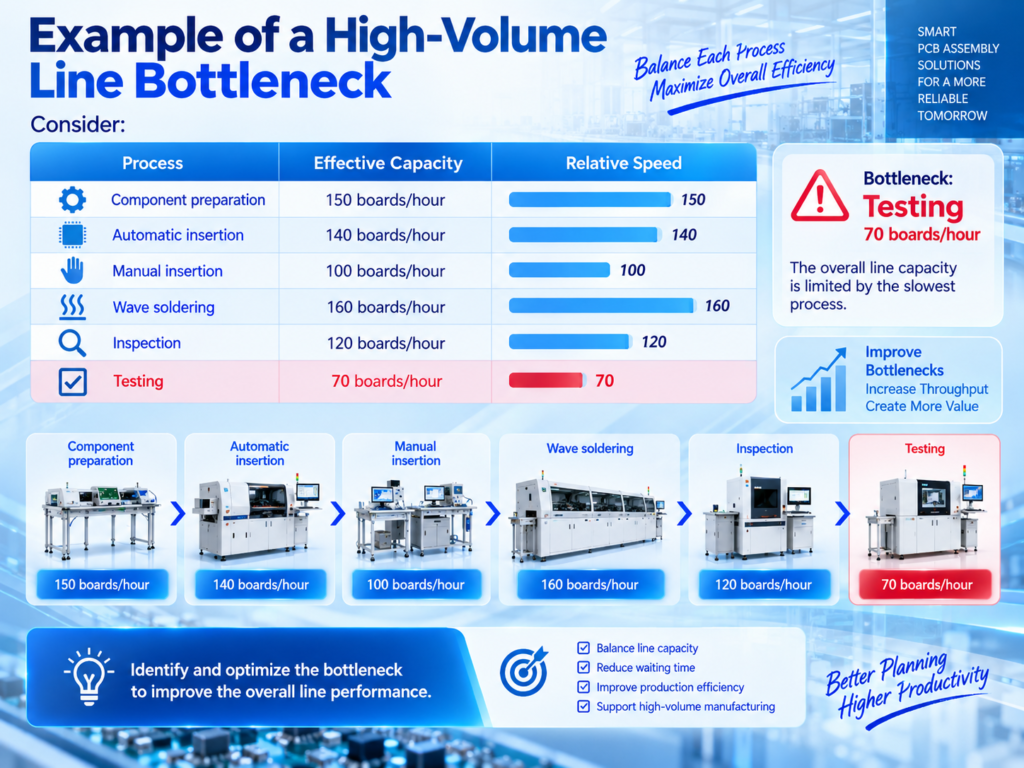
Example of a High-Volume Line Bottleneck
Consider:
Even though the automatic insertion machine can process 140 boards per hour and wave soldering can process 160, the finished line is approximately limited by testing at 70 boards per hour.
Purchasing a faster insertion machine would not solve the actual capacity problem.
Parallel Testing for High-Volume Production
If one test fixture requires 50 seconds per board and the target takt is 20 seconds, one station cannot support the required flow.
Manufacturers may need:
- Multiple test stations
- Parallel fixtures
- Automated routing
- Test buffers
Testing capacity should be calculated during initial line design rather than added after mass production begins.
Line Balancing Is the Core of High-Volume Automation
A high-volume THT line should balance:
Preparation → Automatic Insertion → Manual Insertion → Inspection → Soldering → Inspection → Testing
Useful metrics include:
- Takt time
- Cycle time
- WIP
- First-pass yield
- Downtime
- Changeover
- Rework
- Equipment utilization
The objective is maximum good finished output, not maximum machine speed.
Using Buffers in an Automatic THT Line
Buffers can help decouple processes with small cycle-time differences.
They may be useful between:
- Insertion and soldering
- Soldering and inspection
- Inspection and testing
However, buffers should not be used to hide a major bottleneck.
If testing produces 50 boards/hour while assembly produces 120, increasing buffer capacity only delays the accumulation problem.
High-Volume Does Not Always Mean Low-Mix
A factory can produce high overall volume while still manufacturing multiple PCB models.
In this environment, automation must also consider:
- Product changeover
- Feeder change
- Conveyor width adjustment
- Program selection
- Material verification
- Soldering recipe
- Test fixture change
Changeover time can have a major effect on effective daily capacity.
Automatic Width Adjustment
For lines processing different PCB widths, automatic width adjustment can reduce manual setup.
It may be integrated into:
- Conveyors
- Inspection systems
- Soldering equipment
- Handling systems
However, the feature provides the greatest value when product changeovers occur frequently.
Barcode and Recipe Management
Barcode identification can be used to connect a PCB with:
- Product model
- Insertion program
- Soldering recipe
- Inspection program
- Test program
Depending on the factory system, barcode integration can support automatic recipe selection and production-data recording.
This can reduce manual program-selection errors during changeover.
Traceability in Automated THT Production
Depending on product and customer requirements, traceability may record:
- PCB ID
- Production time
- Machine
- Program
- Material lot
- Operator
- Soldering process information
- Inspection results
- Test results
Traceability requirements should be defined before equipment procurement because they can affect software and integration requirements.
Material Logistics for High-Volume THT Production
A highly automated line cannot maintain output without reliable material supply.
Plan:
- Incoming component storage
- Kitting
- Line-side inventory
- Feeder replenishment
- Empty packaging removal
- Component preparation
- Material verification
If operators frequently stop automatic equipment because components are unavailable, theoretical machine speed becomes irrelevant.
WIP Control
Excessive work-in-process can:
- Occupy floor space
- Increase handling
- Hide defects
- Make production tracking difficult
- Extend lead time
High-volume line design should aim for controlled flow between processes.
Buffers should be intentional rather than uncontrolled PCB accumulation.
Factory Layout for an Automatic THT Line
A practical layout should include:
- Component storage
- Preparation
- Automatic insertion
- Manual insertion
- Inspection
- Soldering
- Cooling
- Testing
- Rework
- Maintenance access
Material flow should minimize:
- Backtracking
- Long transport distances
- Cross-traffic
- Unnecessary handling
Factory layout can affect productivity almost as much as individual machine selection.
Utilities and Exhaust
Depending on equipment configuration, an automatic THT line may require:
- Electrical power
- Compressed air
- Exhaust
- Ventilation
- Nitrogen where required
- Network connections
Utility planning should be completed before machine installation.
Maintenance access should also be reserved around major equipment.
Preventive Maintenance for High-Volume Lines
High-utilization equipment requires planned maintenance.
Maintenance areas may include:
- Feeders
- Insertion heads
- Sensors
- Conveyors
- Fluxing systems
- Preheaters
- Solder pots
- Pumps/nozzles
- Cooling systems
- Exhaust
- Control systems
A machine running multiple shifts can have different maintenance requirements from the same model operating at low utilization.
Maintenance schedules should follow equipment requirements and actual operating conditions.
Spare Parts Strategy
For high-volume production, downtime can be more costly than the replacement part itself.
Factories should identify:
- Routine consumables
- Common wear parts
- Critical spare parts
- Long-lead-time parts
A useful approach is to consider:
Failure Risk × Downtime Impact × Procurement Lead Time
This can help determine which parts should be stocked locally.
New vs Pre-Owned THT Equipment
High-volume manufacturers can evaluate both new and suitable pre-owned equipment.
For pre-owned automatic insertion equipment, inspect:
- Mechanical condition
- Insertion system
- Feeding system
- Sensors
- Controls
- Software
- PCB transport
- Maintenance history
- Spare parts availability
For soldering equipment, inspect:
- Conveyor
- Fluxing
- Preheating
- Solder pot
- Pump/wave/nozzle
- Cooling
- Controls
- Exhaust interfaces
Purchase price should be evaluated together with maintenance, support, and downtime risk.
How to Evaluate the ROI of THT Automation
Automation ROI should consider more than labor reduction.
Potential factors include:
Equipment Investment + Installation + Tooling + Training + Maintenance + Spare Parts
compared with:
Labor Impact + Capacity Increase + Utilization + Process Stability + Reduced Bottlenecks + Expected Equipment Life
Avoid assuming that every manual insertion operation automatically has a strong automation ROI.
Automation is most attractive when:
- The operation is repetitive
- Product volume is sufficient
- Component structure is stable
- Equipment utilization will be high
- Manual work is a genuine bottleneck
Common Mistakes When Building an Automatic THT Line
Buying Based on Machine Speed
Rated speed does not represent finished-line output.
Automating Every Component
Irregular low-quantity components may be more practical to insert manually.
Ignoring Component Packaging
Automatic insertion depends on reliable component feeding.
Ignoring Testing
Testing can become the bottleneck after assembly is automated.
Ignoring Changeover
High-volume multi-model production can lose significant capacity during setup.
Ignoring Maintenance
A high-speed machine that frequently stops does not create high effective output.
Overusing Buffers
Buffers help manage short process variations but do not solve major capacity imbalance.
Automatic THT Assembly Solutions from Fuliu Electronics
Established in 2014, Fuliu Electronics is dedicated to providing customers with high-quality PCBA intelligent manufacturing solutions and services.
With extensive experience in the SMT industry, we specialize in dependable equipment, professional technical support, and complete SMT and PCBA production line solutions.
Our product portfolio includes SMT pick and place machines from Fuji, Panasonic, ASM, Yamaha, JUKI, and Hanwha, together with ERSA reflow ovens from Germany, MagicRay SPI/AOI inspection systems, automatic solder paste printers, supporting PCBA equipment, pre-owned SMT equipment, SMT spare parts, machine leasing, and maintenance services.
Instead of selecting an automatic insertion machine independently, the complete manufacturing process can be evaluated:
SMT Assembly → THT Component Preparation → Automatic/Manual Insertion → Soldering → Inspection → Testing
As part of our global growth strategy, Fuliu Electronics is actively expanding into international markets, with key focus areas including India, Vietnam, the Philippines, Indonesia, the Middle East, South Africa, and Europe.
Conclusion
An automatic THT assembly line for high-volume PCB production should not be designed around one high-speed insertion machine.
For many high-volume manufacturers, the most practical solution is not 100% automation. It is a carefully balanced combination of automatic component preparation and insertion for suitable parts, efficient manual or semi-automatic stations for irregular components, automated soldering, inspection, and sufficient testing capacity.
Most importantly, evaluate automation based on good finished PCBA output and total production economics, not nominal machine speed alone.
If you are planning a new automatic THT/DIP assembly line, increasing the capacity of an existing through-hole production process, or integrating THT automation with an SMT production line, Fuliu Electronics can help evaluate your PCB dimensions, BOM, component packaging, target takt time, production volume, soldering requirements, testing capacity, existing equipment, factory layout, automation target, and investment budget to develop a suitable high-volume PCBA production solution.
Frequently Asked Questions
It is a production system that automates suitable processes such as PCB loading, component feeding, through-hole insertion, PCB transfer, soldering, inspection, and unloading.
No. Automatic insertion depends on component geometry, leads, packaging, orientation, production quantity, and equipment compatibility. Large or irregular components may still require manual insertion.
It can be highly useful when repetitive insertion operations, stable component structures, and sufficient production volume justify the investment.
Wave soldering can be efficient for boards containing many compatible THT joints, but PCB design should determine whether wave or selective soldering is more suitable.
Yes. Capacity depends on joint quantity, nozzle configuration, soldering path, preheat, and the number of soldering modules.
Some irregular, heavy, low-quantity, or difficult-to-feed components may be more practical to insert manually. Operators may also support material replenishment, inspection, and maintenance.