
Industrial control electronics can operate in environments that differ significantly from ordinary indoor consumer electronics.
Depending on the application and enclosure, PCB assemblies may be exposed to conditions such as:
- Humidity
- Condensation
- Dust
- Airborne contaminants
- Temperature variation
- Industrial environments
For products requiring additional environmental protection, conformal coating can be incorporated into the PCBA manufacturing process.
However, building a conformal coating line for industrial control PCB manufacturing involves much more than purchasing an automatic coating machine.
Manufacturers need to evaluate the complete process:
PCBA Testing → Cleaning/Surface Preparation → Masking Where Required → Selective Coating → Coating Inspection → Flash-Off → Curing → Final Inspection
The correct line configuration depends on the PCB design, coating material, keep-out areas, component height, required capacity, curing chemistry, inspection criteria, factory layout, and automation level.
Conformal Coating Line for Industrial Control PCB Manufacturing
This guide explains how to configure a practical conformal coating solution for industrial control PCB manufacturing.
Why Use Conformal Coating on Industrial Control PCBAs?
Industrial control PCBAs can be used in products such as:
- PLC-related electronics
- Industrial power control systems
- Motor control equipment
- Factory automation equipment
- Sensor and I/O modules
- Industrial communication devices
- Process control equipment
- Monitoring systems
Depending on where the electronics are installed, conformal coating may help protect PCB surfaces from certain environmental influences.
Potential functions include protection against:
- Moisture
- Humidity
- Condensation
- Dust
- Certain contaminants
- Corrosive environments
Actual protection depends on the coating chemistry, thickness, coverage, curing, PCB design, and operating environment.
Conformal coating should therefore be treated as part of a validated product-protection strategy rather than a universal solution.
Does Every Industrial Control PCB Need Conformal Coating?
No.
Not every industrial control PCBA requires coating.
The decision should consider:
- Product operating environment
- Enclosure design
- Expected contamination
- Humidity exposure
- Customer specification
- PCB design
- Repair requirements
- Coating compatibility
For some products, enclosure protection may already provide the required environmental control.
For others, conformal coating can provide an additional protective layer.
The requirement should be defined at the product-design and manufacturing-process level.
What Is a Conformal Coating Line?
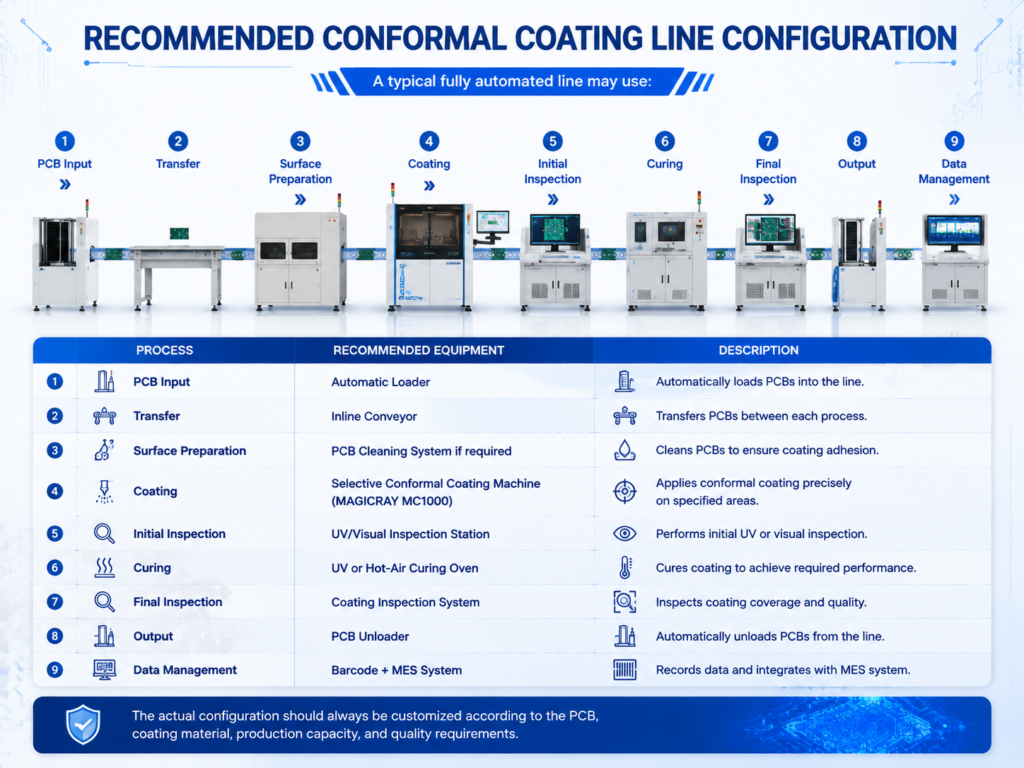
A conformal coating line is a group of equipment and processes used to apply, inspect, flash off, and cure protective coating on PCB assemblies.
A typical automated line may include:
PCB Loader → Preparation/Inspection → Selective Coating Machine → Coating Inspection → Flash-Off Conveyor → Curing System → Final Inspection → PCB Unloader
Optional equipment can include:
- PCB conveyors
- Buffers
- Barcode scanners
- Automatic width adjustment
- Board-flipping systems
- Material supply systems
- Traceability systems
- Exhaust equipment
The complete line should be configured around the actual PCBA and coating chemistry.
Industrial Control PCB Design Can Be Complex
Industrial control boards can contain a mixture of:
- Small SMT components
- ICs
- Connectors
- Relays
- Transformers
- Terminal blocks
- Electrolytic capacitors
- Heat sinks
- THT components
This creates challenges for selective coating.
Tall components can:
- Restrict valve movement
- Create spray shadows
- Limit nozzle access
- Affect inspection
- Affect UV exposure during curing
For this reason, machine working area alone is not enough to determine whether a coating machine can process an industrial PCB.
Step 1: Define the Coating Areas
The first step is to identify exactly where coating is required.
A coating drawing should ideally define:
- Areas requiring coating
- Acceptable transition areas
- Areas that must remain uncoated
- This information determines:
- Valve selection
- Machine programming
- Masking
- Cycle time
- Inspection criteria
Avoid starting equipment selection before the coating requirement is defined.
Step 2: Identify All Keep-Out Areas
Industrial control PCBAs can contain many areas that should remain free from coating.
Depending on product design, keep-outs may include:
- Connectors
- Terminal contacts
- Test points
- Programming interfaces
- Switches
- Electrical contacts
- Selected sensors
- Mechanical connection areas
Keep-out geometry is one of the most important factors when choosing selective coating equipment.
Can Selective Coating Eliminate Masking?
Selective coating can reduce masking in many applications, but it does not always eliminate it.
Masking may still be necessary when:
- Keep-outs are extremely close to coating regions
- Material can flow into restricted areas
- Tall components limit valve access
- Very sharp coating boundaries are required
- Sensitive contacts require additional protection
The best approach is to evaluate the actual PCB with the intended coating material.
Step 3: Evaluate PCB Dimensions and Component Height
Before selecting equipment, provide:
- PCB length
- PCB width
- PCB thickness
- Panel dimensions
- Maximum component height
- Board weight where relevant
- Component spacing
- Top-side and bottom-side layout
Component height is especially important for industrial control boards.
The coating valve must be able to travel around:
- Relays
- Transformers
- Large capacitors
- Terminal blocks
- Connectors
- Heat sinkswithout collision.
Step 4: Select the Conformal Coating Material
Common coating material families include:
- Acrylic
- Silicone
- Polyurethane
- Epoxy
- UV-curable coatings
- Specialized chemistries
Material selection should be based on product requirements.
Different materials can have different:
- Viscosity
- Flow behavior
- Solids content
- Pot life
- Curing method
- Storage requirements
- Chemical compatibility
The coating material should be selected before the machine configuration is finalized.
Material Viscosity Affects Application
Viscosity influences:
- Spray behavior
- Coating width
- Edge definition
- Flow
- Pressure
- Valve selection
- Application speed
The same machine can produce different coating results when different materials are used.
Therefore, coating trials should use the intended production material where practical.
Step 5: Choose the Correct Coating Valve
Different PCB regions may require different application methods.
Selective Spray Valve
Spray application can be useful for:
- Larger coating regions
- General PCB coverage
- Open component layouts
However, overspray should be considered near keep-out areas.
Film Coating Valve
Film application can be useful for:
- Long coating paths
- Larger selected regions
- Controlled coating bands
- Efficient surface coverage
Needle Dispensing Valve
Needle dispensing can be useful for:
- Narrow areas
- Localized coating
- Difficult geometry
- Areas between components
Using a needle for the entire board may increase cycle time.
Multi-Valve Configuration
Complex industrial PCBAs may benefit from a combination such as:
Film Valve + Needle Valve
The larger application tool processes broad regions while the needle handles localized areas.
More valves are not automatically better. Each valve should solve a defined process requirement.
Step 6: Surface Preparation and Cleaning
Surface condition can strongly affect coating behavior.
Potential contamination may include:
- Flux residues
- Handling contamination
- Dust
- Oils
- Other manufacturing residues
Whether cleaning is required depends on:
- Flux chemistry
- PCB cleanliness
- Coating material
- Product specification
- Customer requirements
- Validated process
Some validated manufacturing processes may coat over suitable no-clean residues, while others require cleaning.
There is no universal rule that every industrial PCB must be cleaned before coating.
Step 7: Consider Testing Before Coating
Testing before conformal coating is often practical because repair and component replacement can become more difficult after coating.
A possible process is:
SMT/THT Assembly → Inspection → Electrical/Functional Testing → Cleaning/Preparation → Conformal Coating → Curing → Final Inspection
For industrial control PCBAs, testing can vary widely depending on product function.
It may include:
- ICT
- Programming
- Functional testing
- Communication testing
- I/O testing
- Product-specific electrical testing
The actual sequence should follow the product manufacturing plan.
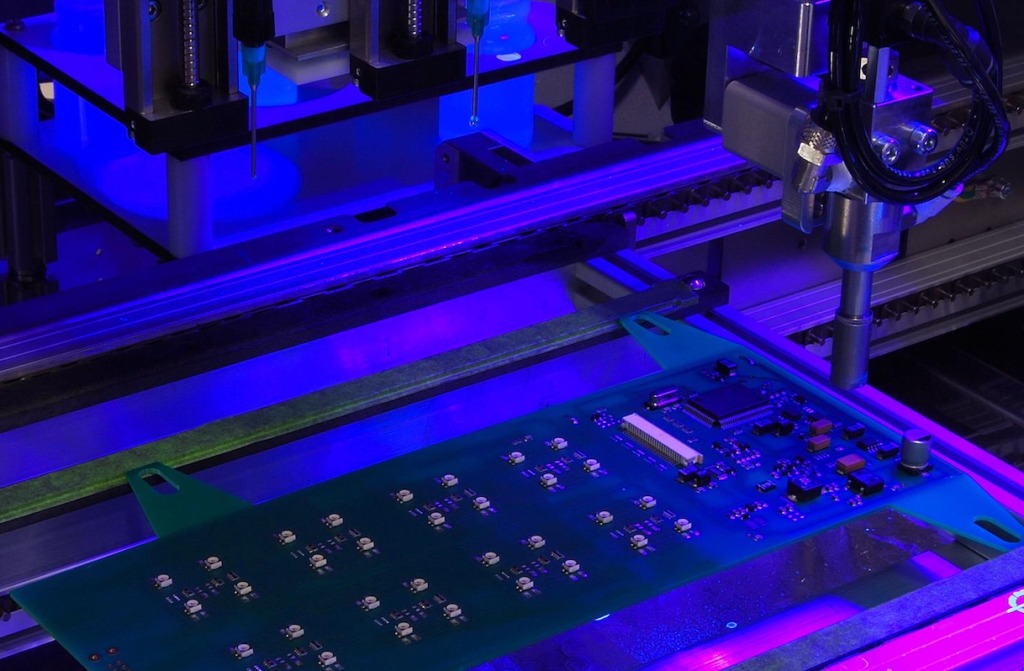
Step 8: Automatic Selective Coating
An automatic selective coating machine follows a programmed path to apply material to defined PCB regions.
Potential advantages include:
- Repeatable application
- Controlled material placement
- Reduced operator dependence
Reduced overspray compared with uncontrolled manual spraying
Support for automated production
Recipe management
However, final coating quality still depends on:
Machine + Valve + Material + PCB Geometry + Programming + Surface Condition + Process Control
Automation alone does not guarantee coating quality.
Coating Accuracy Is Not Only Machine Positioning Accuracy
Machine suppliers may provide motion accuracy specifications.
But actual coating boundaries also depend on:
- Material viscosity
- Valve type
- Nozzle
- Pressure
- Valve height
- Travel speed
- PCB flatness
- Component geometry
- Material flow after application
For demanding keep-out areas, evaluate actual coated samples rather than relying only on nominal positioning specifications.

Step 9: Coating Inspection
Inspection should verify whether the coating process meets the defined acceptance criteria.
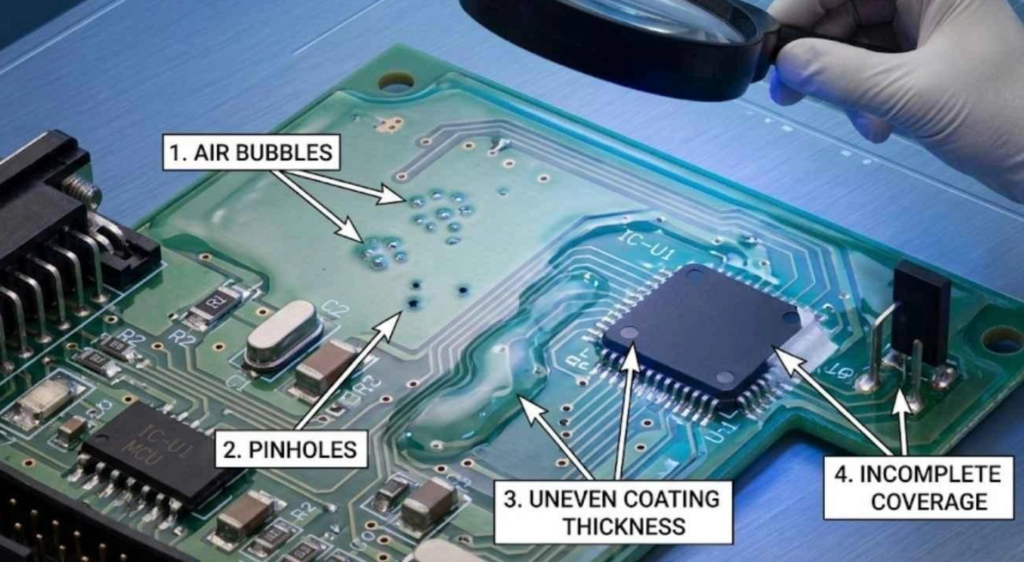
Typical inspection items can include:
- Coverage
- Missed areas
- Overspray
- Keep-out contamination
- Bubbles
- Pinholes
- Pooling
- Dewetting
- General coating uniformity
Inspection can be:
- Manual
- UV-assisted where compatible
- Automated where appropriate
- UV Inspection
Some coating materials contain fluorescent tracers that are easier to see under suitable UV illumination.
This can help identify:
- Missing coverage
- Coating boundaries
- Certain application inconsistencies
However, UV fluorescence does not automatically confirm:
- Correct thickness
- Adhesion
- Complete curing
- Long-term environmental protection
It should therefore be used as one part of the inspection process.

Step 10: Flash-Off
Some coating materials require a flash-off period before curing.
Flash-off requirements depend on:
- Coating chemistry
- Solvent content
- Applied quantity
- Thickness
- Environmental conditions
- Curing process
An automated line may use:
- Flash-off conveyor
- Buffer
- Controlled waiting section
Flash-off capacity must be matched to coating-machine output.
Step 11: Select the Curing System
The curing process depends on coating chemistry.
Possible methods include:
- Ambient cure
- Thermal cure
- UV cure
- Moisture cure
- Dual-cure mechanisms
There is no universal curing process suitable for every conformal coating.
Material specifications and the validated process should determine the equipment.
Thermal Curing
A thermal curing system may include:
- Conveyor
- Heating zones
- Temperature controls
- Exhaust
- Cooling
Important factors include:
- Required process temperature
- Residence time
- PCB dimensions
- Component temperature limitations
- Conveyor speed
- Production capacity
- UV Curing
UV curing can support fast processing for compatible materials.
However, industrial control PCBAs may contain tall components that create shadow regions.
Examples include:
- Relays
- Transformers
- Terminal blocks
- Capacitors
If UV cannot reach all coated areas, the coating chemistry and curing strategy must account for these shadow regions.
Some materials use secondary or dual-cure mechanisms, depending on their formulation.
Step 12: Final Inspection
After curing, final inspection can check:
- General coverage
- Keep-out areas
- Visible defects
- Coating condition
- Product-specific acceptance criteria
Where required, additional product testing may follow.
The final inspection standard should be defined by the manufacturer’s process and customer requirements.
Common Conformal Coating Defects
Overspray
Potential contributors include:
- Incorrect valve
- Excess pressure
- Incorrect height
- Poor programming
- Material behavior
Bubbles
Investigate:
- Material handling
- Air introduction
- Application conditions
- Coating quantity
- Surface condition
Pinholes
Review:
- Surface contamination
- Material
- Application
- Film formation
- Cure conditions
Dewetting
Possible contributors include:
- Surface contamination
- Flux residues
- Material incompatibility
- Surface condition
Pooling
Review:
- Excess material
- PCB geometry
- Viscosity
- Application speed
- Valve path
Troubleshooting should evaluate the complete process rather than only the coating machine.
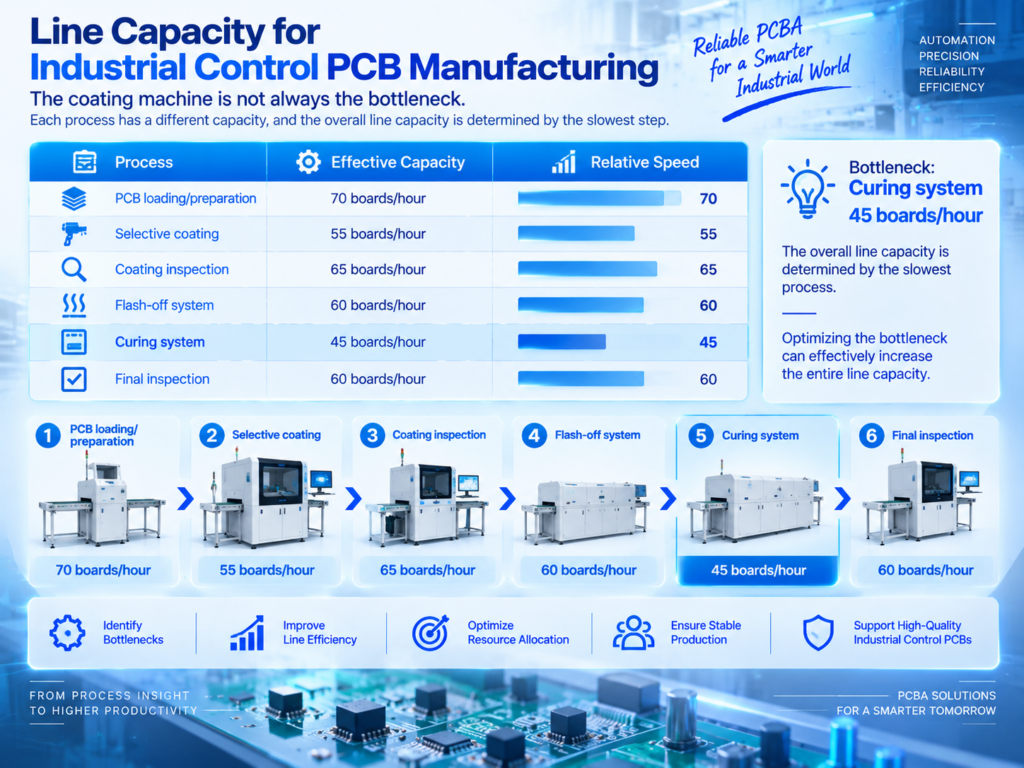
Line Capacity for Industrial Control PCB Manufacturing
The coating machine is not always the bottleneck.
Consider:
The effective finished output is approximately limited by curing at 45 boards per hour, assuming no parallel capacity or other constraints.
Increasing the coating machine to 80 boards per hour would not automatically increase line output.
Curing Residence Time Does Not Equal Cycle Time
Suppose:
- Coating cycle = 50 seconds
- Curing residence time = 15 minutes
This does not mean the line produces only one PCB every 15 minutes.
A conveyorized curing system can process multiple boards simultaneously.
Capacity depends on:
Required Residence Time + Conveyor Speed + PCB Pitch + Available Process Length
This calculation should be completed before choosing the curing system.
High-Mix Industrial Control PCB Production
Industrial electronics manufacturers often produce multiple PCB models.
For high-mix production, important equipment features include:
- Recipe storage
- Fast programming
- Flexible valve configuration
- Adjustable conveyor width
- Easy product changeover
- Easy maintenance
- Flexible inspection
A practical configuration may be:
Manual Loading → Selective Coating → Manual/UV Inspection → Flash-Off → Curing → Final Inspection
This can provide automation without excessive line complexity.
Medium-Volume Automatic Coating Line
A medium-volume configuration may be:
PCB Loader → Selective Coating → Inspection → Flash-Off Conveyor → Curing → Final Inspection → Unloader
Optional functions include:
- Barcode scanning
- Recipe management
- Automatic width adjustment
- Buffers
This provides a balance between flexibility and automation.
Higher-Volume Industrial PCBA Coating Line
For stable higher-volume products, manufacturers can evaluate:
Automatic Loader → Barcode Identification → Automatic Selective Coating → Automatic/Assisted Inspection → Flash-Off → Inline Curing → Final Inspection → Automatic Unloader
Traceability and production-data collection can be integrated where required.
The complete line should still be balanced around the slowest effective process.
Double-Sided Conformal Coating
Some industrial PCBAs may require coating on both sides.
In this case, consider:
- Board flipping
- First-side coating condition
- Handling
- Fixtures
- Second-side coating
- Curing sequence
- Total cycle time
A board-flipping system can be integrated where production volume justifies automation.
PCB Fixtures
Fixtures may be useful when:
- Boards are irregular
- PCB flatness varies
- Heavy components affect stability
- Selected edges require protection
- Conveyor support is insufficient
However, fixtures add:
- Tooling cost
- Cleaning
- Maintenance
- Storage
- Changeover
Use them only when the process requires them.
Exhaust and Factory Utilities
Depending on coating chemistry and equipment, the production line may require:
- Exhaust
- Ventilation
- Electrical power
- Compressed air
- Network connection
Material safety information and local requirements should be considered during factory planning.
Material Supply and Management
A stable coating process also requires controlled material handling.
Consider:
- Container size
- Pressure
- Pumping
- Filtration
- Agitation where required
- Tubing compatibility
- Material level
- Pot life
- Storage conditions
Material-contact components should be compatible with the selected coating chemistry.
Maintenance Requirements
Routine maintenance may include:
- Valve cleaning
- Nozzle cleaning
- Needle inspection
- Filter replacement
- Tubing inspection
- Conveyor maintenance
- Sensor cleaning
- Exhaust maintenance
- Motion-system inspection
Manufacturers should ask the equipment supplier about:
- Cleaning procedure
- Cleaning frequency
- Consumables
- Recommended spare parts
- Maintenance time
- Technical support
Maintenance requirements should be considered before purchasing the line.
Traceability for Industrial Control PCB Coating
Depending on product and customer requirements, traceability may include:
- PCB ID
- Product model
- Coating recipe
- Process time
- Machine
- Inspection result
- Cure process information
Barcode integration can help connect the PCB with its process record.
Not every industrial PCBA requires the same traceability level.
New vs Pre-Owned Conformal Coating Equipment
Manufacturers can consider both new and suitable pre-owned coating equipment.
For pre-owned machines, inspect:
- Motion system
- Conveyor
- Valves
- Material supply
- Tanks
- Tubing
- Seals
- Sensors
- Controls
- Software
- Exhaust
- Maintenance history
- Spare-parts availability
Previous coating chemistry should also be considered because material-contact components may need cleaning or replacement before using a different coating.
Conformal Coating Solutions from Fuliu Electronics
Established in 2014, Fuliu Electronics is dedicated to providing customers with high-quality PCBA intelligent manufacturing solutions and services.
With extensive experience in the SMT industry, we specialize in dependable equipment, professional technical support, and complete SMT and PCBA production line solutions.
Our product portfolio includes SMT pick and place machines from Fuji, Panasonic, ASM, Yamaha, JUKI, and Hanwha, together with ERSA reflow ovens from Germany, MagicRay SPI/AOI inspection systems, automatic solder paste printers, supporting PCBA equipment, pre-owned SMT equipment, SMT spare parts, machine leasing, and maintenance services.
The objective is to evaluate the complete process:
PCBA Testing → Preparation → Selective Coating → Inspection → Flash-Off → Curing → Final Inspection
rather than selecting a coating machine independently.
As part of our global growth strategy, Fuliu Electronics is actively expanding into international markets, with key focus areas including India, Vietnam, the Philippines, Indonesia, the Middle East, South Africa, and Europe.
Conclusion
A conformal coating line for industrial control PCB manufacturing should be configured around the complete product and process requirements.
A typical process is:
PCBA Testing → Cleaning/Surface Preparation → Masking Where Required → Selective Coating → Inspection → Flash-Off → Curing → Final Inspection
For high-mix industrial control production, a flexible selective coating machine combined with manual or assisted inspection may provide an efficient solution.
For stable higher-volume production, manufacturers can evaluate an integrated line with automatic PCB loading, selective coating, inspection, flash-off, inline curing, and unloading.
Most importantly, coating equipment should not be selected independently. A faster coating machine does not improve finished output if curing becomes the bottleneck, and higher motion accuracy alone cannot compensate for unsuitable coating chemistry, contamination, difficult PCB geometry, or incorrect valve configuration.
If you are planning a new industrial control PCBA conformal coating line, upgrading from manual coating, or integrating coating into an existing SMT/THT production process, Fuliu Electronics can help evaluate your PCB dimensions, component layout, coating material, keep-out areas, target capacity, curing process, inspection requirements, existing equipment, factory layout, automation target, and investment budget to develop a suitable PCBA coating solution.
Frequently Asked Questions
Depending on the application, coating can help protect PCB surfaces from moisture, humidity, condensation, dust, and certain contaminants.
No. The requirement depends on operating environment, enclosure, PCB design, product specification, and customer requirements.
A line can include PCB handling, selective coating, inspection, flash-off, curing, final inspection, exhaust, and optional traceability equipment.
It depends on PCB geometry and coating requirements. Film or spray methods may suit larger areas, while needle dispensing can help with narrow or localized regions.
It can reduce masking, but difficult geometry, tight keep-outs, or coating flow may still require masking.
Not universally. Cleaning depends on flux chemistry, surface condition, coating material, product requirements, and the validated process.