
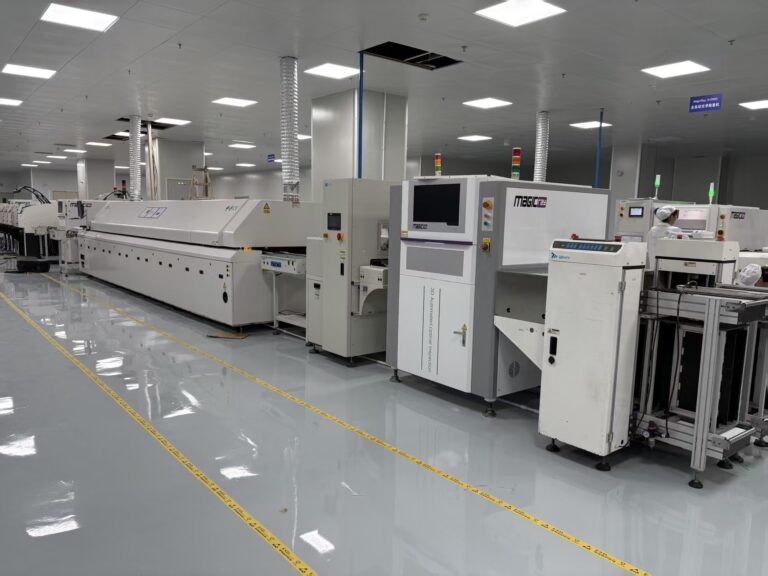
SMT equipment is the foundation of modern PCB assembly manufacturing. From solder paste printers and pick and place machines to reflow ovens, SPI systems, and AOI equipment, every machine must operate accurately and consistently to maintain production quality.
Even a minor maintenance issue can cause placement errors, printing defects, unexpected downtime, or reduced first-pass yield. Over time, neglected maintenance may also increase spare parts costs and shorten equipment service life.
For this reason, manufacturers need a structured SMT equipment maintenance program that combines daily inspections, preventive servicing, cleaning, calibration, lubrication, software management, and operator training.
How to Maintain SMT Equipment
In this guide, we’ll explain how to maintain SMT equipment, provide practical maintenance schedules, and show how proper maintenance improves production efficiency and long-term equipment reliability.
Why SMT Equipment Maintenance Is Important
SMT machines operate at high speed and require exceptional precision. Components may be placed at extremely small pitches, while solder paste printers and inspection systems must maintain consistent accuracy across thousands of production cycles.
Regular maintenance helps manufacturers:
- Reduce unplanned downtime
- Improve placement accuracy
- Maintain stable production quality
- Extend equipment service life
- Reduce emergency repair costs
- Improve first-pass yield
- Prevent production delays
- Maintain consistent cycle times
A preventive maintenance program is far more cost-effective than waiting for equipment to fail.
What Is Preventive Maintenance for SMT Equipment?
Preventive maintenance is a planned process of inspecting, cleaning, lubricating, calibrating, and replacing components before they cause machine failure.
Unlike reactive maintenance, which is performed after a breakdown, preventive maintenance is scheduled according to:
- Operating hours
- Production cycles
- Manufacturer recommendations
- Equipment condition
- Historical failure data
The objective is to identify potential problems early and maintain stable machine performance.
Common Causes of SMT Equipment Failure
SMT machine problems often develop gradually rather than appearing suddenly.
Common causes include:
- Dust and solder paste contamination
- Worn nozzles
- Feeder damage
- Insufficient lubrication
- Loose belts
- Clogged filters
- Sensor contamination
- Improper calibration
- Unstable compressed air
- Software or program errors
- Poor operator handling
Regular inspections help prevent these issues from developing into costly breakdowns.
Daily SMT Equipment Maintenance
Daily maintenance should be completed before production begins or after each shift.
Clean Machine Surfaces
Remove dust, solder paste, component debris, and oil from machine surfaces.
Focus on:
- Conveyor rails
- Worktables
- Machine covers
- Sensors
- Camera areas
- Feeder platforms
Clean equipment is easier to inspect and less likely to experience contamination-related errors.
Check Air Pressure
Many SMT machines depend on stable compressed air.
Operators should verify:
- Air pressure
- Air leakage
- Moisture in air lines
- Filter condition
Low or unstable air pressure can affect nozzle movement, feeder operation, and component pickup.
Inspect Nozzles
Nozzles should be checked for:
- Blockages
- Cracks
- Wear
- Contamination
- Incorrect installation
Damaged nozzles may cause pickup failures, dropped components, or placement errors.
Check Feeders
Inspect feeders for:
- Tape feeding problems
- Damaged sprockets
- Loose parts
- Improper alignment
- Component jams
Well-maintained feeders improve pickup reliability and reduce production interruptions.
Clean Vision Cameras and Sensors
Dust or residue on cameras and sensors can affect machine accuracy.
Use approved cleaning materials and avoid damaging sensitive optical surfaces.
Weekly SMT Equipment Maintenance
Weekly maintenance should include more detailed inspection and cleaning.
Inspect Conveyor Systems
Check:
- Belt tension
- Conveyor alignment
- Rail movement
- Sensors
- Board transfer stability
Misaligned conveyors can cause PCB jams and production interruptions.
Clean Filters
Filters in machines, air systems, and reflow ovens should be inspected regularly.
Clogged filters may cause:
- Reduced airflow
- Overheating
- Contamination
- Unstable temperature control
Check Lubrication Points
Linear guides, lead screws, bearings, and moving parts require proper lubrication.
Only use lubricants recommended by the equipment manufacturer.
Inspect Cables and Connectors
Look for:
- Loose connections
- Damaged cables
- Worn insulation
- Bent pins
- Abnormal heat
Electrical connection problems may cause intermittent machine faults that are difficult to diagnose.
Monthly SMT Equipment Maintenance
Monthly maintenance should focus on accuracy, wear, and machine condition.
Verify Machine Calibration
Calibration may include:
- Placement accuracy
- Conveyor position
- Vision alignment
- Nozzle height
- Printer alignment
- Inspection system measurement
Regular calibration helps prevent gradual accuracy loss.
Inspect Belts and Motors
Check for:
- Belt wear
- Belt tension
- Motor noise
- Excessive vibration
- Abnormal temperature
Early detection helps prevent unexpected mechanical failure.
Review Machine Error Logs
Error logs provide useful information about recurring problems.
Manufacturers should identify:
- Frequent pickup errors
- Feeder alarms
- Vision recognition failures
- Conveyor faults
- Temperature deviations
Repeated alarms may indicate developing equipment problems.
Inspect Safety Systems
Verify that:
- Emergency stop buttons work
- Safety doors close properly
- Interlocks function correctly
- Warning lights and alarms operate
Safety systems should never be bypassed.
Maintenance Requirements by Equipment Type
Different SMT machines require different maintenance procedures.
Solder Paste Printer Maintenance
Key maintenance tasks include:
- Cleaning the stencil support area
- Inspecting squeegee blades
- Checking printer alignment
- Cleaning solder paste residues
- Inspecting conveyor rails
- Verifying stencil cleaning systems
Poor printer maintenance can lead to insufficient paste, bridging, and printing misalignment.
SPI Equipment Maintenance
SPI systems require:
- Camera lens cleaning
- Lighting system inspection
- Calibration verification
- Software data backup
- Conveyor cleaning
- Sensor inspection
Accurate SPI measurement depends on clean optics and stable calibration.
Pick and Place Machine Maintenance
Pick and place machines are among the most complex machines in an SMT line.
Important maintenance tasks include:
- Cleaning and inspecting nozzles
- Maintaining feeders
- Lubricating axes
- Checking vacuum systems
- Inspecting placement heads
- Cleaning cameras
- Verifying machine calibration
- Checking belts and motors
Maintenance should follow the machine manufacturer’s recommended schedule.
Reflow Oven Maintenance
Reflow ovens require regular cleaning because flux vapors accumulate inside the system.
Key tasks include:
- Cleaning flux collection systems
- Inspecting exhaust ducts
- Cleaning filters
- Checking conveyor chains
- Verifying temperature sensors
- Inspecting heaters and fans
- Confirming thermal profile accuracy
Poor oven maintenance can cause unstable soldering quality and excessive energy consumption.
AOI Equipment Maintenance
AOI maintenance should include:
- Camera cleaning
- Lighting inspection
- Conveyor cleaning
- Sensor checks
- Calibration verification
- Software backup
- Database management
Dirty optics may increase false calls or reduce defect detection accuracy.
X-Ray Inspection Equipment Maintenance
X-ray systems require specialized maintenance due to radiation safety and high-voltage components.
Maintenance should include:
- Radiation safety inspection
- Detector calibration
- Image quality verification
- Cooling system inspection
- Interlock testing
- Preventive servicing by qualified technicians
Only trained personnel should service X-ray equipment.
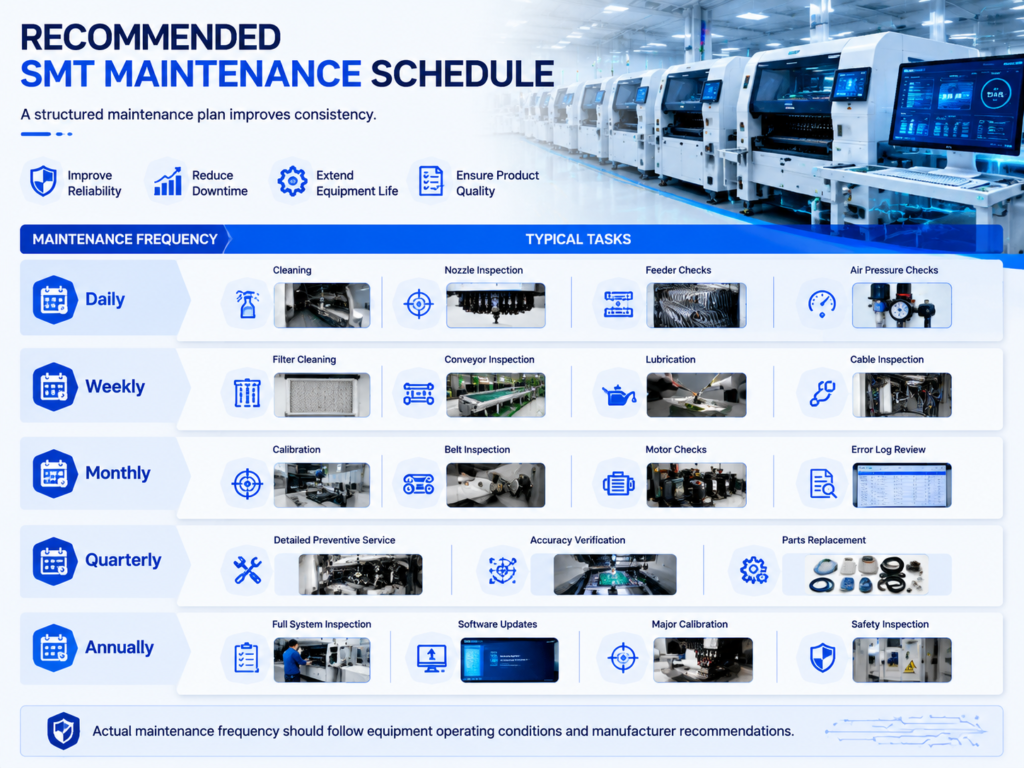
Recommended SMT Maintenance Schedule
A structured maintenance plan improves consistency.
Actual maintenance frequency should follow equipment operating conditions and manufacturer recommendations.
How to Create an SMT Maintenance Checklist
A maintenance checklist helps ensure that no critical task is missed.
The checklist should include:
- Equipment name
- Machine model
- Serial number
- Maintenance task
- Required frequency
- Responsible person
- Completion date
- Replacement parts used
- Observed problems
- Corrective actions
Digital maintenance records can also be integrated into MES or factory management systems.
Spare Parts Management
Proper spare parts planning reduces downtime when components fail.
Common spare parts include:
- Nozzles
- Feeder parts
- Belts
- Sensors
- Filters
- Motors
- Solenoid valves
- Vacuum components
- Conveyor components
- Squeegee blades
Manufacturers should prioritize parts with long delivery times or high failure frequency.
The Role of Operator Training
Even well-maintained equipment can be damaged by improper operation.
Operators should understand:
- Correct startup and shutdown procedures
- Alarm handling
- Nozzle replacement
- Feeder installation
- Cleaning requirements
- Basic troubleshooting
- ESD protection
- Safety procedures
Training reduces operator errors and helps identify equipment problems earlier.
How Maintenance Reduces SMT Downtime
Preventive maintenance reduces downtime by addressing problems before they interrupt production.
Benefits include:
- Fewer emergency repairs
- Faster troubleshooting
- More stable production schedules
- Improved equipment availability
- Reduced waiting time for spare parts
- Better maintenance planning
Factories should track downtime by machine and failure type to identify improvement opportunities.
Maintenance KPIs to Monitor
Manufacturers can evaluate maintenance performance using key indicators.
Common maintenance KPIs include:
- Mean Time Between Failures (MTBF)
- Mean Time to Repair (MTTR)
- Equipment availability
- Preventive maintenance completion rate
- Unplanned downtime
- Maintenance cost per machine
- Repeat failure frequency
These indicators help determine whether the maintenance program is effective.
Common SMT Maintenance Mistakes
Manufacturers should avoid several common mistakes.
Waiting Until the Machine Fails
Reactive maintenance usually results in higher costs and longer downtime.
Using Incorrect Lubricants
Improper lubricants may damage seals, bearings, or precision components.
Ignoring Small Alarms
Repeated minor alarms often indicate developing mechanical or electrical problems.
Skipping Calibration
A machine may continue running while gradually producing inaccurate results.
Using Unqualified Spare Parts
Low-quality replacement parts may reduce machine reliability and create additional failures.
Failing to Keep Records
Without maintenance history, repeated problems are difficult to identify and prevent.
When to Use Professional Maintenance Services
Some maintenance tasks can be completed by trained factory technicians, while others require professional service support.
Professional maintenance may be required for:
- Placement head repair
- Laser or vision calibration
- Servo motor replacement
- Control board repair
- Reflow oven profiling
- X-ray system servicing
- Software upgrades
- Major machine relocation
Using qualified technicians helps protect equipment accuracy and safety.
Why Choose Fuliu Electronics?
Established in 2014, Fuliu Electronics is dedicated to providing customers with high-quality PCBA intelligent manufacturing solutions and comprehensive technical services.
With extensive experience in the SMT industry, Fuliu Electronics supplies complete SMT production line solutions featuring internationally recognized brands such as Fuji, Panasonic, ASM, Yamaha, JUKI, and Hanwha, together with ERSA reflow ovens, MagicRay SPI/AOI inspection systems, automatic solder paste printers, pre-owned SMT equipment, SMT spare parts, equipment leasing, and maintenance services.
Serving customers across India, Vietnam, the Philippines, Indonesia, the Middle East, South Africa, and Europe, Fuliu Electronics supports manufacturers with equipment inspection, preventive maintenance, machine repair, spare parts supply, calibration, installation, commissioning, and long-term technical assistance.
Conclusion
Understanding how to maintain SMT equipment is essential for achieving stable PCB assembly production. Daily cleaning, regular calibration, feeder and nozzle inspection, lubrication, filter replacement, and preventive servicing all contribute to higher machine availability and consistent product quality.
A successful maintenance program should be planned, documented, and supported by trained operators and qualified technicians. Manufacturers that maintain their SMT equipment proactively can reduce downtime, extend machine life, improve first-pass yield, and avoid costly emergency repairs.
Rather than treating maintenance as an expense, electronics manufacturers should view it as a long-term investment in production stability, product quality, and factory profitability.
Frequently Asked Questions
Daily cleaning and inspection should be performed during every shift, while more detailed maintenance should be scheduled weekly, monthly, quarterly, and annually according to machine usage and manufacturer recommendations.
Daily cleaning is one of the most important tasks because dust, solder paste, and component debris can affect cameras, sensors, nozzles, feeders, and conveyors.
Implement preventive maintenance, maintain spare parts inventory, track machine alarms, train operators, and inspect high-wear components regularly.
Regularly clean nozzles and cameras, inspect feeders, check vacuum systems, lubricate moving axes, verify calibration, and review error logs.
Flux residue, clogged filters, and unstable airflow can affect temperature control, solder joint quality, and energy efficiency. Regular cleaning and profile verification are essential.
Daily and basic preventive tasks can be handled by trained factory staff. Complex calibration, placement head repair, control board servicing, and major repairs should be completed by qualified technicians.