
In modern PCB assembly manufacturing, two major electronic assembly technologies are widely used: SMT (Surface Mount Technology) and DIP (Dual In-line Package / Through-Hole Technology).
Understanding the difference between SMT and DIP is essential for electronics manufacturers, factory investors, procurement managers, and engineers planning to build or upgrade a PCB assembly production line.
Different PCB assembly technologies directly affect:
- production efficiency
- manufacturing cost
- product reliability
- automation capability
- factory investment strategy
Today, many electronics factories combine SMT and DIP processes together to achieve both high production efficiency and strong mechanical reliability.
In this guide, we will explain the key differences between SMT and DIP manufacturing, their advantages, applications, costs, and how to choose the right PCB assembly solution.
What is SMT?
SMT (Surface Mount Technology) is a PCB assembly process where electronic components are mounted directly onto the surface of a printed circuit board.
SMT is the dominant assembly technology in modern electronics manufacturing because it supports:
- high-speed automation
- miniaturized components
- compact PCB design
- high-density assembly
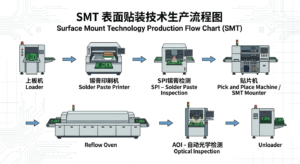
How SMT Assembly Works
A typical SMT production process includes:
A solder paste printer applies solder paste onto PCB pads.
Pick and Place Process
Pick and place machines mount electronic components onto the PCB surface.
Reflow Soldering
The PCB passes through a reflow oven where solder paste melts and forms solder joints.
SPI Inspection
SPI systems inspect solder paste quality before placement.
AOI Inspection
AOI systems inspect solder joints and component placement after reflow soldering.
Common SMT Equipment
Typical SMT production line equipment includes:
- PCB loader
- solder paste printer
- SPI system
- pick and place machine
- reflow oven
- AOI inspection system
- conveyor system
- PCB unloader
Advantages of SMT Manufacturing
High-Speed Automation
SMT production lines can place tens of thousands of components per hour.
Compact PCB Design
SMT supports high-density PCB assembly for miniaturized electronic products.
Lower Labor Cost
Automated SMT lines reduce manual operation requirements.
High Production Efficiency
SMT manufacturing is ideal for mass production environments.
Smart Factory Compatibility
Modern SMT systems support Industry 4.0 integration and intelligent manufacturing.
What is DIP?
DIP (Dual In-line Package), also known as Through-Hole Technology (THT), is a PCB assembly process where electronic component leads are inserted through holes in the PCB and soldered on the opposite side.
Although SMT dominates modern electronics manufacturing, DIP assembly is still widely used for components requiring stronger mechanical connection and higher power handling capability.
How DIP Assembly Works
The DIP production process typically includes:
Component Insertion
Components are inserted into PCB holes manually or automatically.
Wave Soldering
The PCB passes through a wave soldering machine where molten solder creates electrical connections.
Inspection and Testing
Finished assemblies undergo AOI inspection or functional testing.
Common DIP Equipment
Typical DIP production equipment includes:
- insertion machines
- wave soldering machines
- conveyor systems
- DIP assembly workstations
- selective soldering systems
Why DIP is Still Important
DIP manufacturing is still used because it provides:
- stronger solder joints
- higher mechanical durability
- better support for large components
- easier manual repair and replacement
Advantages of DIP Manufacturing
Strong Mechanical Connection
Through-hole soldering provides excellent mechanical stability.
Suitable for High-Power Components
Large transformers, capacitors, and connectors often require DIP assembly.
Easier Repair and Maintenance
DIP components are easier to replace manually.
Better Reliability for Harsh Environments
Industrial and automotive products often use DIP for critical components.
SMT and DIP Combined Production Process
Many modern PCB assembly factories combine SMT and DIP technologies.
A typical hybrid PCB assembly workflow includes:
- SMT solder paste printing
- Pick and place process
- Reflow soldering
- DIP component insertion
- Wave soldering
- AOI inspection
- Functional testing
This hybrid manufacturing approach combines:
- SMT efficiency
- DIP mechanical strength
Mixed-technology PCB assembly is very common in industrial electronics manufacturing.
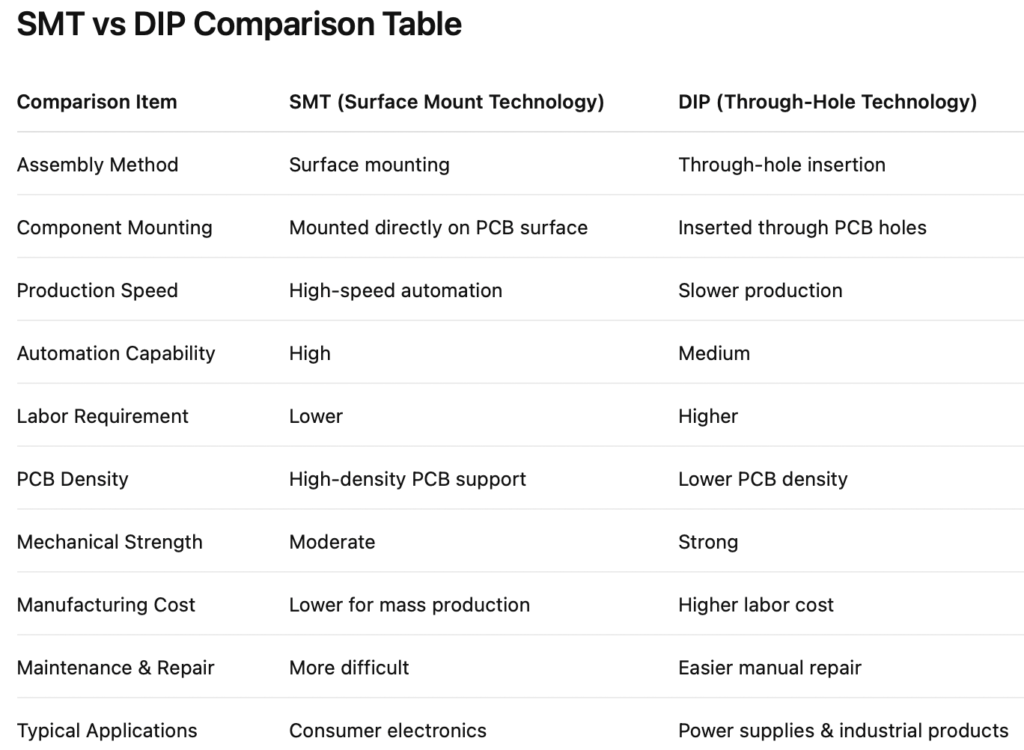
How to Choose Between SMT and DIP
Choose SMT When:
- high-speed production is required
- compact PCB design is important
- products use miniature components
- automation is a priority
- mass production is planned
Choose DIP When:
- products require strong mechanical durability
- large components are used
- high-current applications are involved
- easier maintenance is required
Choose Hybrid SMT + DIP Production When:
- products contain both miniature and large components
- reliability and automation are equally important
- industrial or automotive products are manufactured
Common Challenges in SMT and DIP Production
SMT Soldering Defects
Common SMT defects include:
- tombstoning
- solder bridging
- insufficient solder
Solutions:
- optimize stencil design
- improve reflow profile
- use SPI inspection
DIP Insertion Errors
Incorrect manual insertion may cause polarity issues or component damage.
Solutions:
- operator training
- automated insertion systems
Wave Soldering Defects
Common defects include:
- solder bridging
- icicles
- insufficient solder filling
Solutions:
- optimize wave height
- control conveyor speed
- stabilize preheating temperature
PCB Warpage and Thermal Stress
Improper thermal control may damage PCBs during soldering.
Solutions:
- optimize thermal profile
- improve PCB support systems
SMT vs DIP Cost Comparison
SMT Manufacturing Cost
Advantages:
- lower labor cost
- high production efficiency
- scalable automation
Disadvantages:
higher equipment investment
DIP Manufacturing Cost
Advantages:
lower equipment complexity
Disadvantages:
- higher labor requirement
- lower production speed
Production Volume Impact
High-volume production typically favors SMT because automation reduces long-term operating cost.
Small-batch or specialized manufacturing may still benefit from DIP processes.
Real-World Application Scenarios
Consumer Electronics
Preferred Technology:
SMT
Reason:
- miniaturized components
- high-speed production
LED Products
Preferred Technology:
SMT + DIP hybrid
Reason:
mixed component types
Automotive Electronics
Preferred Technology:
Hybrid SMT + DIP
Reason:
reliability requirements
mechanical durability
Industrial Control Systems
Preferred Technology:
DIP + SMT hybrid
Reason:
high-power components
long-term stability
Communication Equipment
Preferred Technology:
SMT
Reason:
high-density PCB assembly
Why Inspection Systems Matter
Modern PCB assembly requires advanced inspection systems to improve quality control.
Important systems include:
SPI Inspection
Checks solder paste quality before placement.
AOI Inspection
Detects soldering and placement defects automatically.
X-Ray Inspection
Used for hidden solder joints such as BGA components.
Functional Testing
Verifies PCB electrical performance.
About FULIU Electronics
FULIU Electronics is a professional provider of SMT and DIP production line solutions for global electronics manufacturers.
We provide:
- turnkey SMT and DIP production line solutions
- SMT equipment supply
- wave soldering equipment
- AOI and SPI inspection systems
- factory layout planning
- installation and training support
- global delivery and after-sales service
Our team helps customers build efficient, scalable, and reliable PCB assembly factories based on their production goals and manufacturing requirements.
Conclusion
SMT and DIP are both important PCB assembly technologies with different advantages and applications.
SMT provides:
- high-speed automation
- compact PCB assembly
- lower long-term manufacturing cost
DIP offers:
- stronger mechanical reliability
- support for large and high-power components
- easier maintenance and repair
Today, many modern electronics factories combine SMT and DIP technologies to achieve optimal production flexibility and product reliability.
Choosing the right PCB assembly process depends on:
- product type
- production volume
- budget
- reliability requirements
- automation goals
Working with an experienced PCB assembly solution provider can help manufacturers build efficient and cost-effective production lines.
Contact FULIU Electronics today to get a customized SMT and DIP production line solution for your factory.