
The automotive industry is undergoing a rapid transformation driven by electrification, autonomous driving, connectivity, and intelligent vehicle technologies. Modern vehicles contain hundreds of electronic control systems, significantly increasing the demand for high-quality PCB assemblies.
From Engine Control Units (ECUs) and Advanced Driver Assistance Systems (ADAS) to Battery Management Systems (BMS), automotive lighting, radar modules, and infotainment systems, automotive electronics have become the core of vehicle innovation.
As a result, manufacturers require highly reliable SMT production lines capable of meeting strict automotive quality standards while ensuring long-term traceability and manufacturing consistency.
Unlike consumer electronics, automotive PCBs must operate under harsh conditions, including:
- Extreme temperatures
- High vibration
- Humidity exposure
- Electrical stress
- Long service life requirements
To meet these demands, automotive manufacturers increasingly invest in specialized SMT line solutions featuring advanced inspection systems, intelligent traceability, and smart factory integration.
Why Automotive Electronics Require Specialized SMT Lines
Higher Reliability Requirements
Automotive electronic products are expected to perform reliably for 10–15 years or longer.
Failures can lead to:
- Vehicle recalls
- Warranty claims
- Safety risks
- Brand reputation damage
Therefore, automotive SMT production lines must deliver exceptional process stability and defect prevention capabilities.
Long-Term Product Stability
Automotive components often operate in environments ranging from:
- -40°C to +125°C
- High vibration conditions
- Dust and moisture exposure
This requires:
- High-quality solder joints
- Stable component placement
- Consistent process contro
Strict Industry Standards
Automotive electronics manufacturers commonly comply with:
IATF 16949
The global automotive quality management standard.
IPC-A-610 Class 3
The highest PCB assembly workmanship standard.
ISO 9001
Ensures continuous quality improvement and process consistency.
Meeting these standards requires comprehensive inspection and traceability systems throughout the SMT manufacturing process.
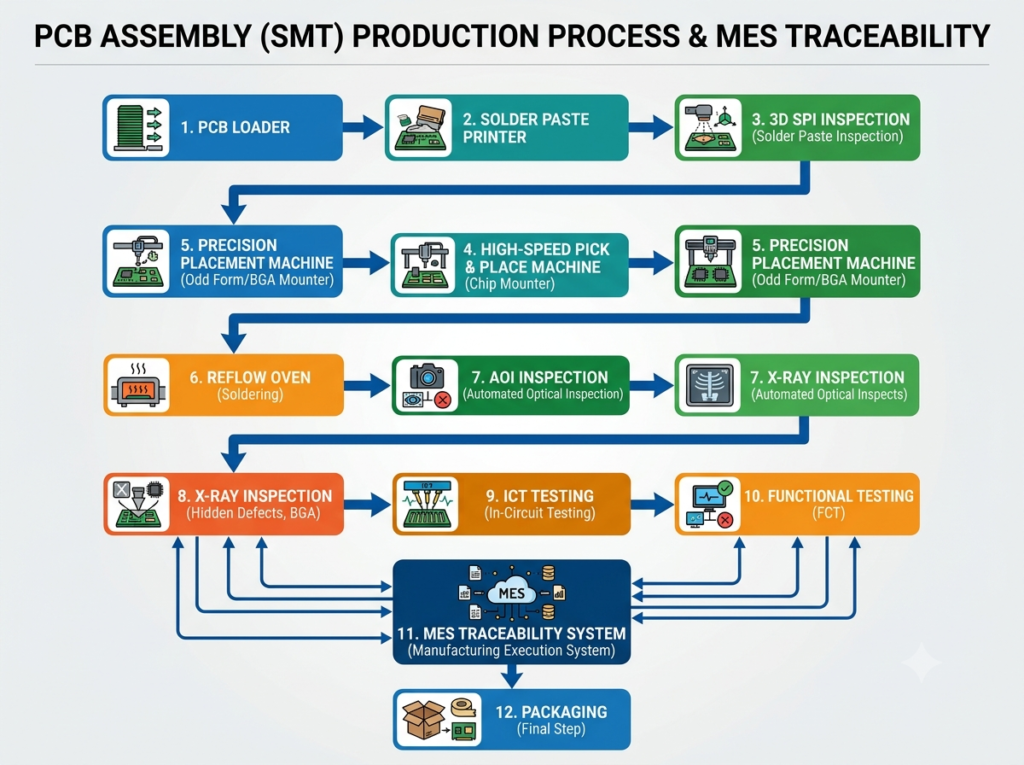
Typical Automotive Electronics SMT Production Process
A modern automotive SMT line typically follows this workflow:
Each stage plays a critical role in ensuring automotive-grade product quality.
Key SMT Equipment for Automotive Electronics Manufacturing
PCB Loader
The PCB loader automatically feeds boards into the SMT production line.
Benefits
Consistent material handling
Reduced operator intervention
Improved production efficiency
Integration with barcode traceability systems
Automated loading minimizes human error and supports continuous production.
High-Precision Solder Paste Printer
Solder paste printing is one of the most critical steps in automotive PCB assembly.
Key Features
- High printing accuracy
- Automatic stencil alignment
- Closed-loop control
- Automatic stencil cleaning
Even minor printing defects can lead to serious soldering problems later in the process.
3D SPI Inspection System
SPI (Solder Paste Inspection) verifies solder paste quality immediately after printing.
Inspection Items
- Paste volume
- Paste height
- Paste area
- Offset printing
- Bridge risk
- Missing paste
Benefits
- Early defect prevention
- Reduced rework
- Improved first-pass yield
- Real-time printer feedback
For automotive electronics, 3D SPI has become an industry standard.
Pick and Place Machines
High-Speed Mounters
Used for:
- Resistors
- Capacitors
- Standard chip components
Advantages include:
- High throughput
- Consistent placement quality
- Reduced labor dependency
Precision Placement Machines
Designed for complex automotive components:
- BGA packages
- QFN packages
- Automotive processors
- Radar chips
- Communication modules
Automotive applications often require placement accuracy better than ±30 μm.
Reflow Oven
Reflow soldering creates permanent electrical and mechanical connections between components and PCBs.
Important Features
- Multi-zone heating
- Accurate thermal profiling
- Nitrogen reflow capability
- Uniform heat distribution
Automotive Benefits
- Reduced solder defects
- Better solder joint reliability
- Improved thermal consistency
Nitrogen reflow systems are commonly used for high-reliability automotive applications.
AOI Inspection System
AOI (Automatic Optical Inspection) verifies assembly quality after soldering.
Detectable Defects
- Missing components
- Wrong components
- Polarity errors
- Component shifts
- Tombstoning
- Solder bridges
- Lifted leads
Why Inline AOI Matters
Inline AOI allows immediate defect detection without interrupting production flow.
Benefits include:
- Higher yield
- Reduced rework costs
- Improved quality consistency
X-Ray Inspection System
Many automotive products use BGA and other hidden solder joint packages.
These joints cannot be inspected visually.
X-Ray Detects
- BGA solder quality
- Voids
- Head-in-pillow defects
- Hidden bridges
- Insufficient solder
For ADAS, ECU, and BMS applications, X-ray inspection is often mandatory.
MES and Traceability Systems
Automotive manufacturers require complete product traceability.
MES Functions
- Barcode tracking
- Process monitoring
- Equipment data collection
- Defect analysis
- Quality reporting
Benefits
- Faster root-cause analysis
- Compliance with automotive standards
- Full production history records
Traceability is increasingly becoming a requirement for automotive OEM suppliers.
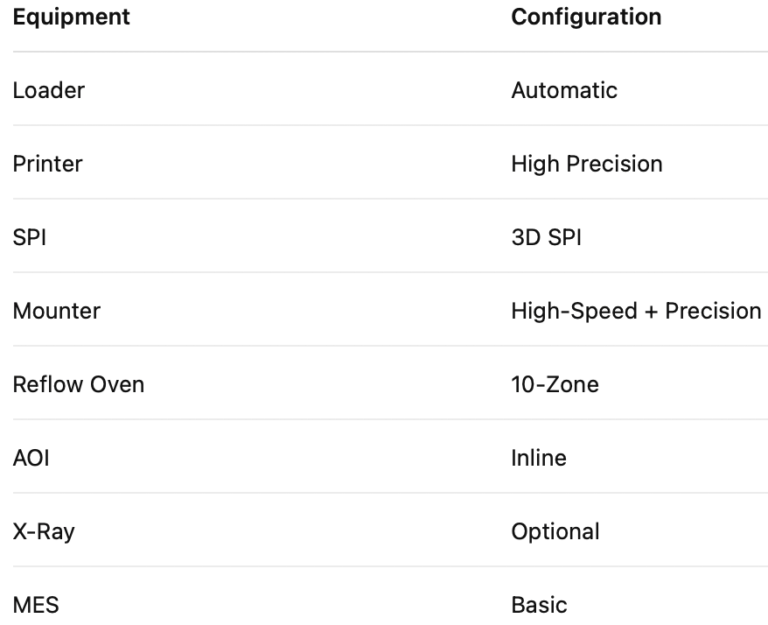
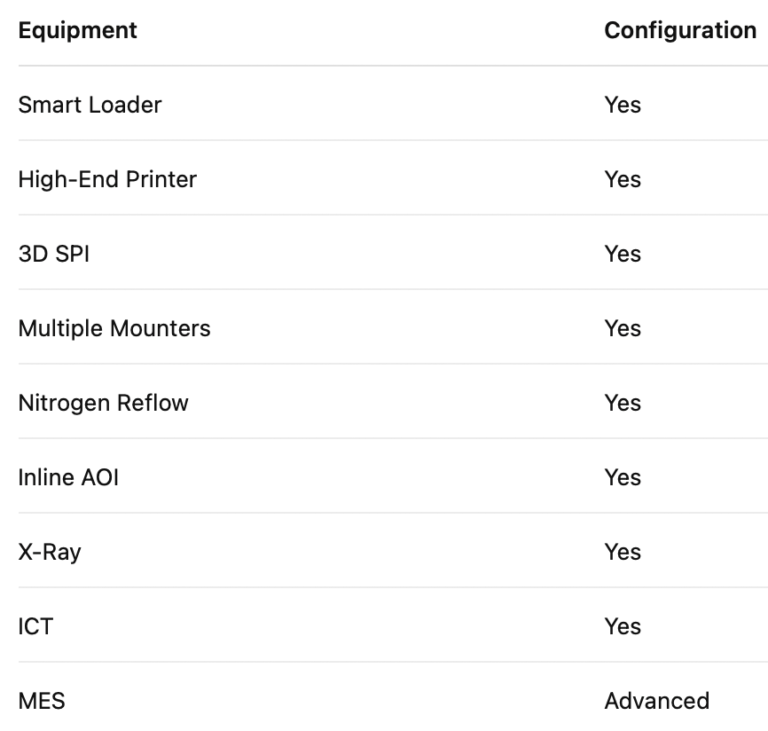
Recommended SMT Line Configuration for Automotive Electronics
Standard Automotive SMT Line
Suitable for:
- Automotive lighting
- Sensor modules
- Dashboard electronics
Capacity
30,000–60,000 CPH
Advanced Automotive SMT Line
Suitable for:
- ECU production
- ADAS modules
- BMS systems
Capacity
60,000–120,000+ CPH
Quality Control Requirements in Automotive SMT Production
SPI Inspection
Purpose:
Prevent solder paste defects before assembly begins.
AOI Inspection
Purpose:
Detect component placement and soldering defects after reflow.
X-Ray Inspection
Purpose:
Verify hidden solder joints and complex package integrity.
ICT Testing
Purpose:
Perform electrical verification of assembled PCBs.
Functional Testing
Purpose:
Validate real operating performance before shipment.
Multiple inspection stages work together to achieve near-zero defect manufacturing.
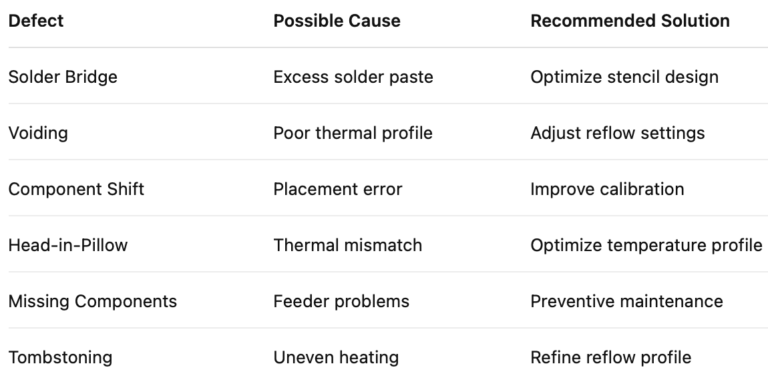
Automotive SMT Defects and Solutions
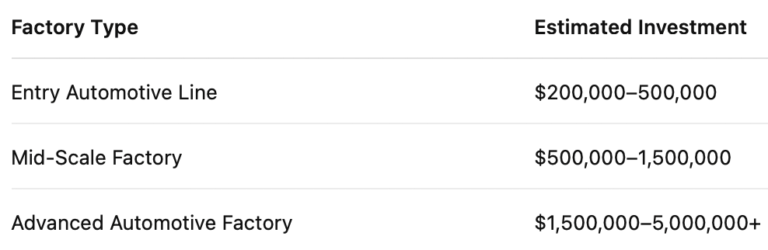
Automotive SMT Line Cost Analysis
Cost drivers include:
High-precision placement equipment
AOI systems
3D SPI systems
X-ray inspection
MES software
Factory infrastructure
While automotive SMT lines require higher initial investment, they deliver superior product quality and long-term ROI.
Smart Factory Trends in Automotive Electronics Manufacturing
Industry 4.0 Integration
Automotive manufacturers increasingly deploy smart factory technologies.
Key Trends
- MES integration
- Real-time production monitoring
- AI-assisted inspection
- Predictive maintenance
- Big data analytics
Digital traceability
These technologies improve productivity while reducing defects and downtime.
Industry-Specific Automotive Applications
ECU Manufacturing
Recommended Solution:
High-precision SMT line with AOI, SPI, and X-ray inspection.
Battery Management Systems (BMS)
Recommended Solution:
Full traceability-enabled SMT production line.
ADAS Modules
Recommended Solution:
Advanced SMT line with high-precision placement and comprehensive inspection systems.
Automotive Lighting
Recommended Solution:
Cost-effective high-speed SMT production line.
Radar Modules
Recommended Solution:
Ultra-high precision placement equipment and advanced X-ray inspection.
Why Turnkey SMT Solutions Are Ideal for Automotive Electronics
Many automotive manufacturers choose turnkey SMT solutions because they simplify project implementation and reduce risk.
Advantages
- Single supplier responsibility
- Faster factory deployment
- Better equipment compatibility
- Simplified validation
- Easier maintenance
- Reduced project management complexity
A turnkey approach can significantly shorten project timelines while ensuring optimal production performance.
Frequently Asked Questions
What is the best SMT line for automotive electronics?
A line equipped with 3D SPI, high-precision mounters, AOI, X-ray inspection, MES integration, and traceability systems is typically ideal.
Why do automotive factories require X-ray inspection?
Because hidden solder joints in BGA and advanced packages cannot be inspected visually.
Is AOI enough for automotive PCB assembly?
No. AOI should be combined with SPI, testing systems, and often X-ray inspection.
What standards apply to automotive SMT production?
IATF 16949, IPC-A-610 Class 3, and ISO 9001 are commonly required.
How much does an automotive SMT line cost?
Investment typically ranges from $200,000 to over $5 million depending on capacity and inspection requirements.
What placement accuracy is required?
Many automotive applications require accuracy better than ±30 μm.
Why is MES important?
MES provides full production traceability and supports automotive quality management systems.
Can automotive SMT lines be expanded later?
Yes. Modern SMT lines are often designed with scalability for future production growth.
Conclusion
Automotive electronics manufacturing demands significantly higher quality standards than conventional PCB assembly. From ECUs and BMS modules to ADAS systems and automotive lighting, every product must meet strict requirements for reliability, traceability, and long-term performance.
A successful automotive SMT production line combines:
- High-precision SMT equipment
- 3D SPI inspection
- Inline AOI systems
- X-ray inspection
- Functional testing
- MES-based traceability
By investing in the right SMT line solution, manufacturers can improve yield, reduce defects, ensure compliance, and achieve long-term profitability.
About FULIU Electronics
FULIU Electronics is a professional provider of turnkey SMT production line solutions for automotive electronics manufacturers worldwide.
Our solutions include:
- Turnkey automotive SMT production lines
- AOI, SPI, and X-ray inspection systems
- MES and traceability integration
- SMT factory layout planning
- Reflow soldering equipment
- Installation and training services
- Global delivery and technical support
With extensive experience supporting automotive electronics projects, FULIU Electronics helps manufacturers build reliable, efficient, and future-ready PCB assembly factories that meet the highest industry standards.