
When building a new SMT production line or upgrading an existing PCB assembly factory, one of the first purchasing decisions is whether to invest in new SMT equipment or refurbished SMT machines.
A new machine offers the latest technology, manufacturer support, and potentially a longer service life. A professionally refurbished machine, on the other hand, can reduce initial investment while still providing suitable production capabilities for many PCB assembly applications.
So, when comparing a new SMT machine vs refurbished SMT machine, which option should you choose?
There is no universal answer. The right decision depends on production volume, PCB complexity, component range, required placement capacity, available budget, technical support, spare parts availability, and the expected return on investment.
This guide compares the two options from a practical PCB manufacturing perspective to help factories make a more informed SMT equipment investment.
What Is a New SMT Machine?
A new SMT machine is equipment purchased new from a manufacturer or authorized sales channel and has not previously been used in production.
For pick and place equipment, a new-generation machine may provide features such as:
- Current placement technology
- Support for modern component ranges
- Updated software and control systems
- Advanced automation functions
- Current-generation feeders and accessories
- Manufacturer warranty and support options
- Integration with intelligent manufacturing systems
New equipment is often considered by manufacturers building high-capacity SMT lines, producing technically demanding products, or planning long-term production around a specific equipment platform.
However, higher initial investment means the purchase should be evaluated against actual manufacturing requirements.
What Is a Refurbished SMT Machine?
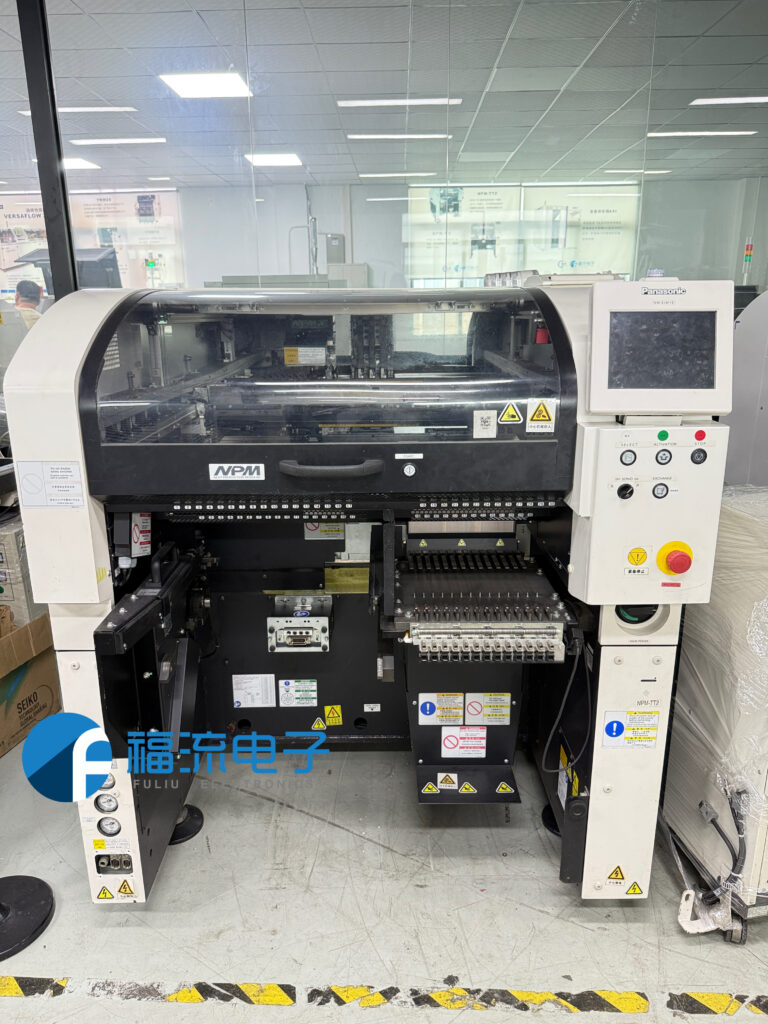
A refurbished SMT machine is pre-owned equipment that has undergone inspection, maintenance, repair, replacement of necessary parts, calibration, testing, or other preparation before being returned to production.
This is different from purchasing an unknown used machine directly from its previous operating environment.
A professional refurbishment process should evaluate critical machine systems according to the model and equipment condition.
For a refurbished SMT pick and place machine, this may involve checking:
- Placement heads
- Nozzles
- Feeders
- Cameras and vision systems
- Conveyor systems
- Motors and drives
- Sensors
- Vacuum systems
- Control computers
- Software
- Mechanical condition
- Placement operation
The scope of refurbishment can vary considerably between suppliers. Buyers should therefore understand exactly what inspection and servicing have been performed.
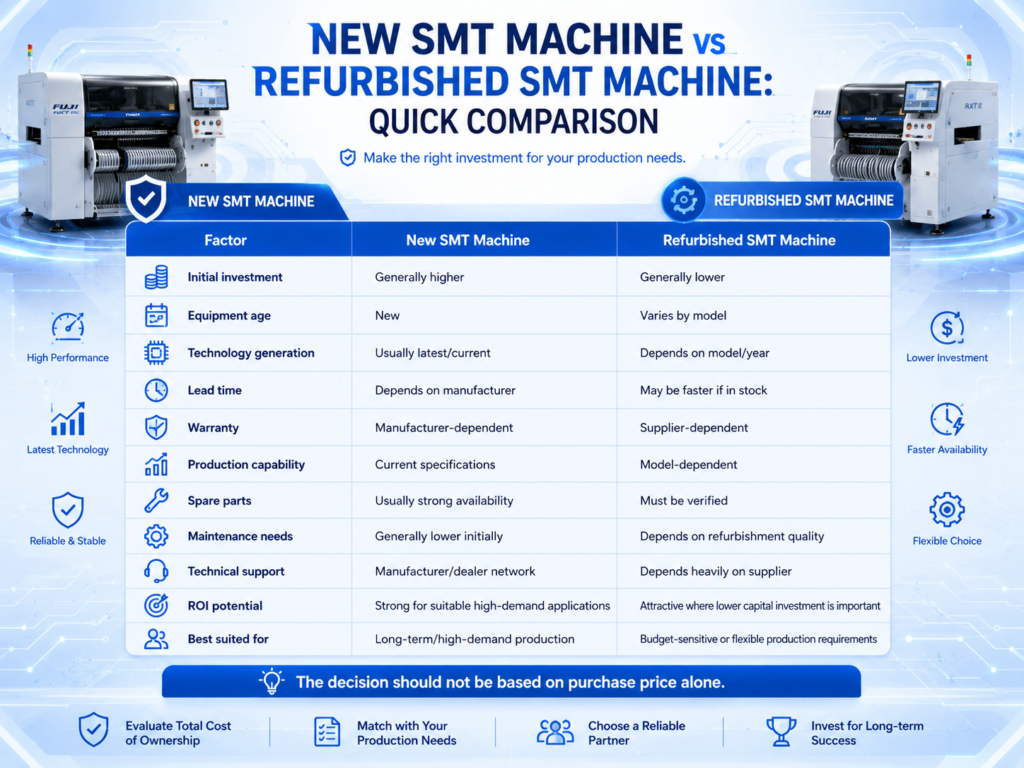
New SMT Machine vs Refurbished SMT Machine: Quick Comparison
Equipment Investment Cost
The most obvious difference between new and refurbished SMT equipment is initial investment.
New SMT machines generally require higher capital expenditure. For factories building several production lines, the difference in total equipment investment can be significant.
Refurbished machines can reduce the upfront cost and allow manufacturers to allocate more of their budget to other essential equipment, such as:
- Automatic solder paste printers
- SPI systems
- Reflow ovens
- AOI systems
- PCB loaders and unloaders
- Conveyors
- Feeders and nozzles
- DIP/THT equipment
- Inspection and testing systems
For a factory with a fixed investment budget, choosing suitable pre-owned machines may make it possible to build a more complete production line rather than spending most of the budget on one piece of equipment.
Production Performance
A common concern is whether a used SMT pick and place machine can still provide suitable production performance.
The answer depends strongly on the machine model, age, operating history, maintenance condition, and refurbishment quality.
Many established SMT machine platforms remain in production for years because they continue to meet the requirements of particular products.
However, buyers should compare actual manufacturing requirements rather than relying only on the machine’s original specifications.
Important factors include:
- Required placement speed
- Component range
- PCB dimensions
- Placement accuracy requirements
- Feeder capacity
- Product changeover frequency
- Component package requirements
- Production hours per day
A machine capable of very high theoretical speed is not automatically the most productive choice for every factory.
Reliability and Equipment Condition
New machines generally provide the advantage of unused mechanical and electronic systems.
With refurbished equipment, reliability depends heavily on the condition of the original machine and the quality of the refurbishment.
Before purchasing a refurbished SMT machine for PCB assembly, buyers should ask:
- Has the machine been inspected?
- Which parts were repaired or replaced?
- Has the placement system been calibrated?
- Has the vision system been checked?
- Are feeders included and tested?
- Can the machine run a production test?
- Are service records available where applicable?
- What technical support is provided after delivery?
A low purchase price provides little value if frequent downtime disrupts production.
Technology and Software
New SMT equipment typically provides access to current machine technology and software.
This may be important for factories requiring advanced automation, new component packages, intelligent material management, production traceability, or integration with factory systems.
Refurbished equipment may use an earlier technology platform, but this is not necessarily a disadvantage if the machine already meets the factory’s production requirements.
The key question is:
Does the machine support the products you need to manufacture?
Purchasing features that are not required can increase capital cost without delivering a meaningful production benefit.
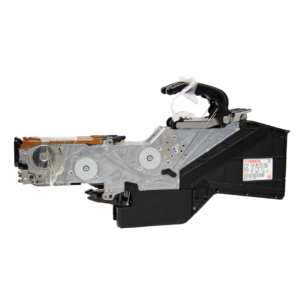
Before choosing an older model, verify the availability of items such as:
- Nozzles
- Feeders and feeder parts
- Sensors
- Belts
- Motors
- Cameras
- Vacuum components
- Electronic boards
- Mechanical parts
- Consumable items
A reliable refurbished SMT equipment supplier should be able to help customers evaluate parts availability before the equipment is purchased.
This is particularly important for factories located in international markets where long parts delivery times can increase downtime.
Maintenance and Technical Support
The machine itself is only part of an SMT equipment investment.
Technical support can have a significant impact on long-term production.
Factories should consider whether the supplier can provide:
- Installation support
- Equipment setup
- Calibration
- Operator training
- Troubleshooting
- Maintenance
- Spare parts
- Remote technical support
- Production line integration assistance
This is especially important when buying second-hand SMT machines, because equipment condition and configuration can differ from machine to machine.
A cheaper machine without reliable technical support may ultimately create higher operating costs.
Lead Time and Production Expansion
Delivery time can influence the purchasing decision when a factory needs to increase production capacity quickly.
New machines may have manufacturing and delivery lead times depending on model and availability.
Refurbished or pre-owned machines already in stock may sometimes be prepared and delivered more quickly.
For manufacturers responding to new customer orders or adding temporary production capacity, equipment availability can therefore become an important selection factor.
However, buyers should not sacrifice proper inspection and testing simply to shorten delivery time.
Total Cost of Ownership Matters More Than Purchase Price
When comparing the cost of new vs used SMT equipment, purchase price is only one part of the calculation.
Manufacturers should consider the total cost of ownership (TCO), including:
- Equipment purchase price
- Shipping and installation
- Feeders and accessories
- Spare parts
- Maintenance
- Energy consumption
- Operator requirements
- Expected downtime
- Software requirements
- Training
- Expected service life
- Future upgrade requirements
For example, a low-priced machine requiring frequent repairs may cost more over several years than a more expensive machine in better condition.
Likewise, purchasing the newest machine may not provide the best ROI if the factory only uses a small percentage of its available production capability.
When Should You Choose a New SMT Machine?
A new SMT machine may be the better option when:
- You require current-generation technology
- Your products have demanding placement requirements
- Production volume is high and stable
- Downtime must be minimized
- Long-term equipment standardization is important
- Advanced automation or factory integration is required
- The investment can be justified by expected production demand
For a high-volume factory with long-term orders, investing in new equipment can provide a strong foundation for future production.
When Should You Choose a Refurbished SMT Machine?
A refurbished SMT machine may be a practical choice when:
- Capital budget is limited
- The required component range is supported by an established machine platform
- Production volume does not justify the cost of the newest equipment
- You need to add capacity to an existing SMT line
- Your factory already uses the same machine brand or platform
- Spare parts and technical support are available
- The equipment has been properly inspected and tested
Refurbished equipment can also be useful for startups, laboratory or pilot production, high-mix manufacturing, secondary production lines, and factories expanding capacity in stages.
How to Buy a Used or Refurbished SMT Machine
If you are considering how to buy used SMT equipment, avoid making the decision based only on photos, model name, or price.
Before purchasing, evaluate the following:
Machine Model and Configuration
Confirm the exact model, year where available, head configuration, feeder capacity, PCB specifications, and included accessories.
Equipment Condition
Ask for detailed information about the machine’s current condition and refurbishment process.
Production Testing
Where practical, confirm that the machine has been tested under operating conditions.
Feeder and Nozzle Requirements
Check whether the supplied feeders and nozzles match your component packaging.
Spare Parts
Verify the availability of critical spare and wear parts.
Technical Support
Confirm who will provide installation, maintenance, troubleshooting, and after-sales support.
Compatibility with Your Production Line
Make sure conveyor height, PCB flow direction, board dimensions, communication requirements, and upstream/downstream equipment are compatible.
New and Refurbished Equipment Can Be Used in the Same SMT Line
Factories do not always need to choose an entirely new or entirely refurbished production line.
A hybrid investment strategy can sometimes provide a better balance.
For example, a manufacturer may select a refurbished pick and place machine while investing in a suitable printer, inspection equipment, or reflow oven according to production requirements.
A complete SMT production line may include:
PCB Loader → Automatic Solder Paste Printer → SPI → Pick and Place Machine → Reflow Oven → AOI → PCB Unloader
Each machine should be selected according to its role in the complete process.
The objective is to build a balanced production line—not simply to purchase the most expensive equipment at every stage.
Why Equipment Brand and Platform Matter
The SMT industry includes several established equipment manufacturers with different strengths, machine platforms, feeder systems, and production capabilities.
Brands commonly used in electronics manufacturing include Fuji, Panasonic, ASM, Yamaha, JUKI, and Hanwha.
When selecting either new or pre-owned equipment, factories should consider:
- Existing machine brands in the factory
- Operator familiarity
- Feeder compatibility
- Spare parts inventory
- Maintenance knowledge
- Product requirements
- Local technical support
Standardizing around an existing platform can sometimes reduce training, spare parts, and feeder investment.
New and Pre-Owned SMT Solutions from Fuliu Electronics
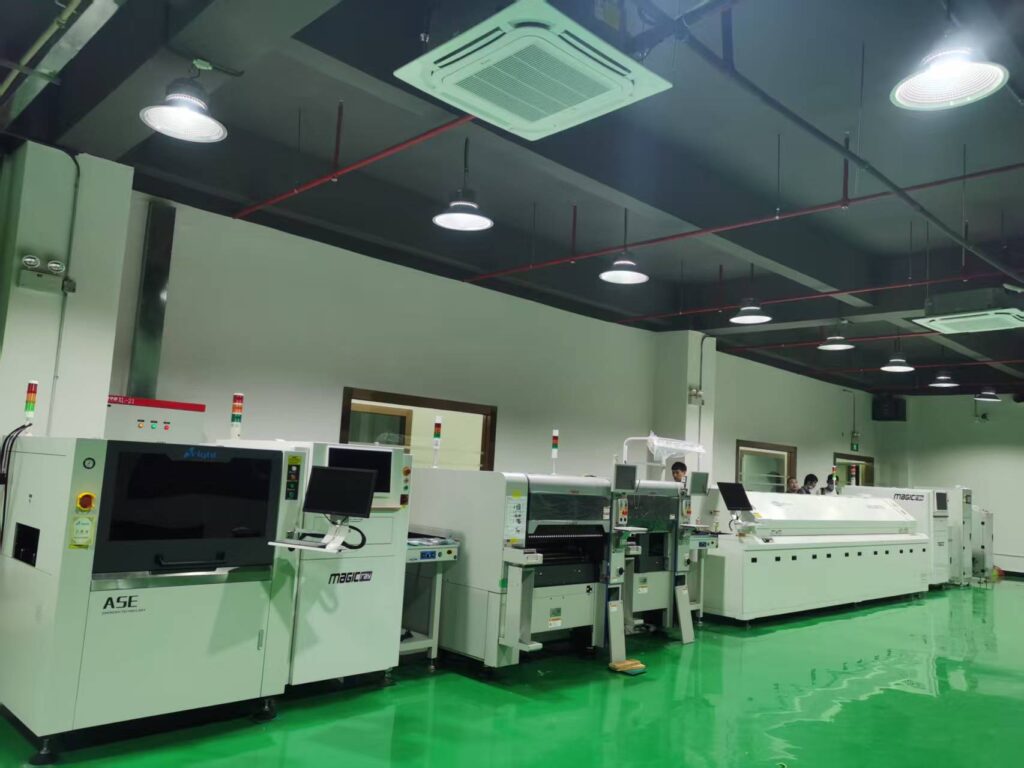
Established in 2014, Fuliu Electronics is dedicated to providing customers with high-quality PCBA intelligent manufacturing solutions and services.
With extensive experience in the SMT industry, we specialize in dependable equipment, professional technical support, and complete SMT production line solutions.
Our portfolio includes SMT pick and place machines from Fuji, Panasonic, ASM, Yamaha, JUKI, and Hanwha, along with ERSA reflow ovens from Germany, MagicRay SPI/AOI inspection systems, automatic solder paste printers, supporting SMT equipment, pre-owned SMT machines, SMT spare parts, machine leasing, and maintenance services.
For customers considering new SMT machines vs refurbished SMT machines, our focus is to evaluate actual production requirements rather than recommend equipment based solely on machine age.
PCB dimensions, BOM, component range, target capacity, factory layout, available budget, and future expansion plans should all be considered when configuring an SMT line.
As part of our international growth strategy, Fuliu Electronics is actively expanding into India, Vietnam, the Philippines, Indonesia, the Middle East, South Africa, and Europe.
New or Refurbished SMT Machine: Which Should You Choose?
When comparing a new SMT machine vs refurbished SMT machine, the best choice is not automatically the newest machine or the lowest-priced option.
A new SMT machine may be appropriate when current technology, high production demand, advanced automation, and long-term equipment standardization justify the investment.
A properly refurbished SMT machine can be an attractive alternative when manufacturers want to reduce capital expenditure, expand capacity, or use a proven equipment platform that already meets their PCB assembly requirements
The most important question is whether the machine can reliably manufacture your products at the required quality and capacity while providing an acceptable total cost of ownership.
If you are planning a new SMT line, expanding an existing factory, or evaluating new and pre-owned SMT equipment, Fuliu Electronics can help you compare equipment configurations based on your actual production needs.
Provide your PCB dimensions, BOM, component package range, target capacity, preferred SMT machine brand, existing equipment, factory layout, and budget range, and our team can recommend a suitable SMT production line solution.
Frequently Asked Questions
It can be. A professionally inspected and refurbished SMT machine may provide a cost-effective solution when its placement capability, component range, condition, spare parts availability, and technical support match the factory’s requirements.
The decision should be based on total cost of ownership rather than purchase price alone.
A used machine may be sold in its existing condition, while a refurbished machine has generally undergone some level of inspection, maintenance, repair, calibration, testing, or parts replacement.
Because refurbishment standards vary between suppliers, buyers should ask exactly what work has been completed.
Reliability depends on machine age, operating history, original condition, refurbishment quality, maintenance, and parts availability. An established machine model in good condition can remain suitable for production, but it should be properly inspected and tested before purchase.
Not necessarily. A new machine generally provides current technology and unused equipment condition, but a refurbished machine may offer better investment efficiency when an older platform already meets the required production specifications.
The better machine is the one that fits the factory’s actual manufacturing and financial requirements.
There is no universal percentage because prices vary significantly according to brand, model, age, configuration, condition, feeders, accessories, refurbishment scope, and market availability.
Buyers should compare complete quotations and expected operating costs rather than relying on a general discount percentage.
Check the exact machine model and configuration, placement heads, vision system, conveyors, feeders, nozzles, sensors, mechanical condition, software, calibration status, spare parts availability, production test results, and technical support.