
If you are planning to introduce conformal coating into your PCB assembly process, one of the first questions is likely:
How much does a conformal coating line cost?
There is no single price that applies to every project.
A conformal coating production line may range from a relatively simple semi-automatic coating setup to a fully automated inline system integrating selective coating, inspection, curing, PCB handling, barcode traceability, and MES connectivity.
The final investment depends on factors such as PCB dimensions, production capacity, coating material, automation level, curing technology, inspection requirements, and factory layout.
For electronics manufacturers, the better question is therefore not simply “What is the cheapest coating machine?” but:
What conformal coating line configuration provides the best cost per PCB for my production requirements?
This guide explains typical conformal coating line cost structures, the major factors that affect price, and how manufacturers can evaluate total cost of ownership before investing.
What Equipment Is Included in a Conformal Coating Line?
Before comparing prices, it is important to understand what a complete production line may include.
A typical automated line can be configured as:
PCB Loader → Conveyor → Selective Conformal Coating Machine → Inspection → UV/Hot-Air Curing Oven → Final Inspection → PCB Unloader
Depending on production requirements, the project may also include:
- PCB cleaning equipment
- Automatic width adjustment
- Buffer conveyors
- Coating material supply systems
- Exhaust and ventilation equipment
- Barcode readers
- MES integration
- Coating inspection systems
- Traceability software
- Automatic board handling
The more processes included in the project, the higher the initial investment—but also potentially the higher the level of automation and process control.
Typical Conformal Coating Line Cost
Because equipment specifications and regional pricing vary significantly, the following figures should be treated as planning estimates rather than quotations.
Actual project prices can fall outside these ranges depending on the equipment brand, configuration, coating chemistry, inspection technology, curing requirements, customization, and service scope.
For an accurate quotation, the supplier normally needs to evaluate the customer’s actual PCB and production requirements.
What Determines Conformal Coating Line Price?
Automation Level
Automation is one of the biggest cost factors.
Manual System
May consist of:
- Manual spraying equipment
- Coating booth
- Basic curing equipment
- Manual inspection
Advantages:
- Lower initial investment
- Simple operation
- Suitable for prototypes
However, labor requirements and process variation may be higher.
Semi-Automatic System
May use programmable coating equipment while PCB loading, unloading, or inspection remains manual.
This provides a balance between investment and productivity.
Fully Automatic Line
May include:
- Automatic PCB loading
- Inline conveyors
- Selective coating
- Automated curing
- Inspection
- Barcode traceability
- MES connectivity
- Automatic unloading
The initial investment is higher, but labor requirements and process variation can be reduced.
Selective Conformal Coating Machine Cost
The selective coating machine is usually one of the most important investments in the line.
Price depends on:
- Working area
- Maximum PCB size
- Number of motion axes
- Positioning accuracy
- Coating speed
- Valve configuration
- Material compatibility
- Conveyor functions
- Software capabilities
- MES compatibility
A basic selective coating system will naturally cost less than a high-speed machine equipped with multiple coating valves and advanced production control.
Number and Type of Coating Valves
Different PCB designs may require different coating technologies.
Common valve options include:
- Film coating valve
- Spray valve
- Needle dispensing valve
- Jetting system
A simple PCB may require only one coating method.
Complex assemblies may require multiple valves to handle:
- Large coating areas
- Narrow regions
- Corners
- Areas near connectors
- Complex component layouts
Additional valves increase machine flexibility but also increase equipment cost.
PCB Size
Larger PCB assemblies require:
- Larger machine working areas
- Wider conveyors
- Longer coating paths
- Potentially larger curing systems
Therefore, a line designed for large industrial control boards may cost more than one designed for compact consumer electronics PCBs.
Always provide the supplier with:
Minimum PCB Size + Maximum PCB Size + PCB Thickness + Maximum Component Height
when requesting a quotation.
Required Production Capacity
Production capacity directly affects equipment selection.
A factory producing a few hundred boards per day may not require the same system as a factory producing thousands of boards per shift.
Manufacturers should provide:
- Boards per hour
- Boards per day
- Number of shifts
- Required takt time
- Number of PCB models
Higher capacity may require:
- Faster coating machines
- Longer curing ovens
- Parallel processing
- Additional buffers
- Higher-speed handling systems
These requirements increase the overall project investment.
Curing System Cost
The coating material determines the required curing process.
Common options include:
UV Curing Oven
Suitable for compatible UV-curable coating materials and high-speed inline manufacturing.
Hot-Air / Thermal Curing Oven
Used for coating materials requiring controlled heating.
Combined or Dual-Cure System
Certain coating materials may require multiple curing mechanisms.
The size, number of heating zones, UV configuration, conveyor width, and temperature control requirements all influence curing equipment cost.
The coating material should therefore be confirmed before selecting the curing oven.
Conformal Coating Inspection
Inspection can range from simple manual UV verification to automated inspection.
Possible configurations include:
Manual Inspection
Lower initial investment but greater dependence on operators.
UV Inspection Station
Allows operators to inspect fluorescent coating coverage.
Automated Coating Inspection
Can identify:
- Missing coating
- Coverage problems
- Coating in keep-out areas
- Process inconsistencies
Advanced inspection increases equipment investment but may provide stronger quality control and traceability.
PCB Cleaning Equipment
Not every production line requires an inline PCB cleaning machine, but cleanliness should always be evaluated.
PCBs may contain:
- Flux residues
- Dust
- Oils
- Fingerprints
- Ionic contamination
For high-reliability applications, a cleaning process may be required before coating.
Adding PCB cleaning equipment increases project cost, but applying coating over contaminated surfaces may create greater reliability risks later.
Exhaust and Ventilation
Some conformal coating materials require dedicated ventilation or exhaust systems.
Costs may include:
- Extraction fans
- Ducting
- Filtration
- Air treatment
- Factory modifications
These costs are sometimes overlooked when calculating the initial project budget.
Always evaluate the coating material’s Safety Data Sheet (SDS) when planning ventilation requirements.
MES and Traceability Integration
Automotive, industrial, telecommunications, medical, and other high-reliability manufacturers may require detailed process traceability.
An advanced coating line can record:
- PCB serial number
- Product recipe
- Coating parameters
- Machine status
- Inspection results
- Curing data
- Production timestamps
Integrating barcode readers, factory software, and MES increases initial project cost but can significantly improve production management.
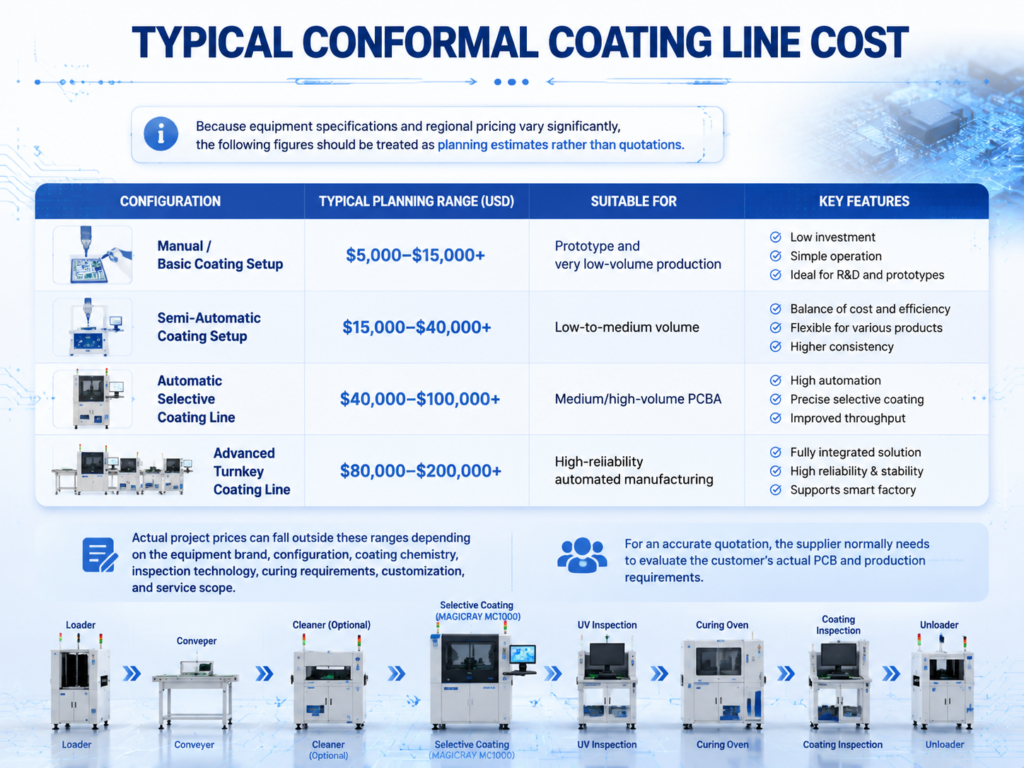
Example Coating Line Configurations
Configuration A: Entry-Level
Suitable for:
- Prototypes
- Small production batches
- R&D facilities
Possible equipment:
Manual/Semi-Automatic Coating → Manual Inspection → Basic Curing
Main advantage:
Lowest initial investment
Configuration B: Standard Automatic Line
Suitable for:
- EMS factories
- Industrial electronics
- Medium-volume PCBA manufacturing
Possible configuration:
Loader → Conveyor → Selective Coating Machine → Inspection → Curing Oven → Unloader
Main advantages:
- Better repeatability
- Reduced manual handling
- Higher production efficiency
Configuration C: High-Reliability Turnkey Line
Suitable for:
- Automotive electronics
- BMS
- Telecommunications
- Industrial controls
- High-value electronics
Possible configuration:
PCB Handling → Cleaning → Selective Coating → Automated Inspection → Controlled Curing → Final Inspection → Traceability → Unloading
Main advantages:
- Strong process control
- Higher automation
- Better traceability
- Scalable production
Equipment Price Is Not the Same as Production Cost
One of the most common purchasing mistakes is comparing only equipment prices.
Manufacturers should instead evaluate Total Cost of Ownership (TCO).
TCO includes:
- Equipment purchase
- Installation
- Coating material
- Masking materials
- Labor
- Energy consumption
- Maintenance
- Spare parts
- Inspection
- Rework
- Downtime
- Training
A cheaper machine that requires significant manual masking and frequent maintenance may eventually cost more than a higher-quality automated solution.
Selective Coating vs Manual Coating Cost
Manual coating generally has a lower initial investment.
However, costs can increase through:
- Higher labor requirements
- Greater masking requirements
- Operator variation
- Higher coating consumption
- Rework
- Lower traceability
Automatic selective coating requires more upfront capital but may reduce ongoing operating costs.
For medium- and high-volume manufacturing, calculating cost per coated PCB is more meaningful than comparing equipment purchase prices.
Selective Coating vs Dip Coating Cost
Dip coating can offer relatively low application equipment costs for suitable products.
However, manufacturers should also calculate:
- Masking labor
- Masking consumables
- Material consumption
- Fixture costs
- Product changeover
- Inspection
- Rework
Selective coating may require higher initial equipment investment but can reduce masking and provide greater flexibility for complex PCBs.
The best choice depends on the product.
How to Calculate ROI for a Conformal Coating Line
A simplified ROI analysis can compare the investment against annual operating savings.
Consider:
Annual Labor Savings + Material Savings + Reduced Rework + Increased Output + Reduced Quality Losses
against:
Equipment Investment + Installation + Maintenance + Operating Costs
For example, automation may reduce the number of manual coating and masking operations required per shift.
If the production volume is sufficiently high, these savings can gradually offset the equipment investment.
However, ROI should always be calculated using actual factory data rather than generic assumptions.
How to Reduce Conformal Coating Line Investment
Manufacturers can control initial investment in several ways.
Choose the Correct Automation Level
Do not purchase unnecessary automation for low-volume production.
Design for Future Expansion
A modular production line can allow additional inspection or automation equipment to be added later.
Optimize PCB Handling
Avoid unnecessary conveyors and buffers while maintaining proper production flow.
Match the Curing System to the Material
Do not purchase an expensive curing solution before confirming coating chemistry.
Compare Total Cost, Not Machine Price
A well-configured system can provide better long-term value even if the initial price is higher.
What Information Is Needed for an Accurate Quotation?
To receive an accurate conformal coating line quotation, prepare the following information:
- PCB dimensions
- PCB photos or drawings
- Maximum component height
- Required production capacity
- Coating material/brand
- Areas requiring coating
- Keep-out areas
- Required coating thickness, if specified
- Curing requirements
- Factory layout
- Automation level
- Inspection requirements
- MES/traceability requirements
- Destination country
Providing this information allows engineers to recommend a configuration based on actual production requirements.
How to Choose a Conformal Coating Line Supplier
Price should not be the only criterion.
Evaluate whether the supplier can provide:
- Process analysis
- Equipment configuration
- Factory layout planning
- Selective coating equipment
- Curing solutions
- Inspection equipment
- Conveyor integration
- Installation
- Commissioning
- Training
- Spare parts
- Maintenance
- Long-term technical support
A supplier capable of integrating the entire production line can reduce compatibility problems and project implementation risk.
Why Choose Fuliu Electronics?
Established in 2014, Fuliu Electronics is dedicated to providing customers with high-quality PCBA intelligent manufacturing solutions and professional technical services.
With extensive experience in the SMT industry, we provide production equipment and integrated solutions covering SMT, DIP/THT, inspection, and PCBA conformal coating processes.
Our broader equipment portfolio includes SMT pick and place machines from internationally recognized brands such as Fuji, Panasonic, ASM, Yamaha, JUKI, and Hanwha, together with ERSA reflow ovens from Germany, MagicRay SPI/AOI inspection systems, automatic solder paste printers, high-quality pre-owned SMT equipment, spare parts, equipment leasing, and maintenance services.
For conformal coating applications, Fuliu Electronics can provide:
- Selective conformal coating machines
- UV curing ovens
- Hot-air curing systems
- PCB conveyors
- PCB handling equipment
- Coating inspection solutions
- Automation integration
- Factory layout planning
- Installation and commissioning
- Operator training
- Long-term technical support
Rather than recommending the same coating line to every customer, our engineering team evaluates PCB dimensions, coating material, required capacity, coating areas, factory layout, automation level, quality requirements, and budget before configuring the solution.
Fuliu Electronics is actively expanding across India, Vietnam, the Philippines, Indonesia, the Middle East, South Africa, and Europe, supporting electronics manufacturers with flexible and scalable PCBA production solutions.
Conclusion
So, how much does a conformal coating line cost?
A basic manual or semi-automatic setup may require a relatively modest investment, while a fully automated turnkey coating line with selective application, controlled curing, inspection, PCB handling, and MES integration represents a significantly larger project.
The final price depends on:
PCB Size + Production Capacity + Coating Technology + Curing Method + Inspection + Automation + Traceability + Service Scope
Rather than choosing equipment based on the lowest initial price, manufacturers should evaluate the complete production process and calculate the total cost per PCB.
For low-volume production, a simpler system may provide the best return. For medium- and high-volume manufacturing, automated selective coating can reduce labor, improve repeatability, strengthen traceability, and support long-term production growth.
The most accurate way to determine project cost is to provide your PCB and production requirements to an experienced PCBA line integrator and obtain a configuration-specific quotation.
Frequently Asked Questions
As a broad planning estimate, basic systems may start from several thousand US dollars, while automated selective coating lines can range into tens of thousands of dollars or more. Advanced turnkey lines with curing, inspection, automation, and traceability can exceed $100,000 depending on configuration.
The price depends on PCB size, working area, valve configuration, positioning accuracy, software, conveyor integration, and automation features. A quotation should therefore be based on actual production requirements.
The selective coating machine, advanced curing equipment, and automated inspection systems are often major investment components, although this varies by configuration.
For medium- and high-volume manufacturing, automation can reduce labor, masking, material consumption, and process variation. Whether it is financially justified should be determined through an ROI analysis using actual production data.
Yes. A modular system can allow manufacturers to begin with coating and curing equipment and later add automatic handling, inspection, traceability, or additional process equipment.
This depends on the supplier and quotation. Manufacturers should confirm whether installation, commissioning, operator training, transportation, spare parts, and after-sales support are included.