
As electronics are increasingly used in industrial control, automotive systems, energy equipment, communication devices, home appliances, and other demanding environments, PCB assemblies may require additional protection after soldering and testing.
One widely used protection method is conformal coating.
Conformal coating applies a thin protective layer over selected areas of a PCBA to help protect the assembly against environmental factors such as:
- Moisture
- Humidity
- Condensation
- Dust
- Certain contaminants
- Corrosive environments, depending on the coating chemistry and application
However, stable conformal coating production requires much more than purchasing a single spraying machine.
A complete turnkey conformal coating line may involve:
PCB Loading → Surface Preparation → Masking/Keep-Out Control → Selective Coating → Inspection → Flash-Off → Curing → Final Inspection → PCB Unloading
Depending on the product, the line may also integrate:
- Barcode scanning
- Traceability
- Automatic width adjustment
- Buffers
- UV inspection
- Oven curing
- UV curing
- Fume extraction
- Material management
This guide explains how to configure a turnkey conformal coating line for PCBA manufacturing and what information manufacturers should prepare before selecting equipment.
What Is a Conformal Coating Line?
A conformal coating line is a production system used to apply, dry or cure, inspect, and handle protective coating on assembled PCBs.
The line can be:
- Manual
- Semi-automatic
- Fully automatic
The correct configuration depends on:
- PCB dimensions
- Product volume
- Product mix
- Coating material
- Keep-out areas
- Required coverage
- Curing method
- Inspection requirements
- Factory layout
- Automation level
For medium- and high-volume PCBA production, an automatic selective coating line can help improve repeatability and reduce unnecessary material application compared with fully manual spraying.

Why Do PCB Assemblies Use Conformal Coating?
Not every PCB requires conformal coating.
The need depends on the product design, operating environment, enclosure, reliability requirements, and customer specification.
Where required, conformal coating may help reduce exposure of the PCB surface to environmental stress.
Typical application areas can include:
- Industrial control systems
- Energy equipment
- Automotive electronics
- Charging systems
- Battery management systems
- Communication electronics
- Outdoor electronics
- Home appliance control boards
- LED control systems
- Power electronics
The actual protection level depends on the coating chemistry, thickness, coverage, curing, PCB cleanliness, and overall product design.
Conformal coating should not be treated as a substitute for good PCB design, reliable soldering, cleanliness, enclosure design, or thermal management.
What Does “Turnkey” Mean in a Conformal Coating Project?
A turnkey coating solution means planning the coating process as one complete production system rather than selecting machines individually.
A turnkey project may consider:
- Incoming PCBA condition
- Cleaning requirements
- Masking requirements
- PCB loading
- Conveyor transport
- Coating valve selection
- Coating path programming
- Material supply
- Flash-off
- Curing
- Inspection
- PCB unloading
- Exhaust
- Utilities
- Factory layout
- Traceability
- Capacity balancing
- Training
- Maintenance
- Spare parts
This approach is important because the coating machine itself may not be the bottleneck.
For example, a fast coating machine can still produce low line output if the curing process takes much longer than coating.
Typical Turnkey Conformal Coating Line Process
A complete automated coating process can look like:
PCB Loader → Preparation/Inspection → Selective Coating Machine → Coating Inspection → Flash-Off Conveyor → Curing System → Final Inspection → PCB Unloader
Optional processes may be added before or after coating depending on the product.
Step 1: PCB Loading and Handling
The first stage is stable PCB handling.
Boards can be loaded:
- Manually
- From a magazine loader
- Directly from upstream equipment
- From a buffer system
The handling system should support:
- PCB width
- PCB length
- PCB thickness
- Panel weight
- Component height
- Conveyor direction
For automated factories, barcode scanning may also be integrated at the loading stage.
Step 2: Surface Preparation
Good coating performance begins with the condition of the PCBA surface.
Potential contaminants can include:
- Flux residues
- Dust
- Fingerprints
- Oil
- Moisture
- Process contamination
Whether cleaning is required depends on:
- Flux chemistry
- Coating material
- Product specification
- Manufacturing process
- Required reliability level
Some processes may permit coating without a dedicated cleaning stage, while others require controlled cleaning and drying before coating.
The decision should be validated for the actual materials and product requirements.
Step 3: Masking and Keep-Out Control
Certain PCB areas should not be coated.
Typical keep-out areas may include:
- Connectors
- Test points
- Switch contacts
- Programming interfaces
- Sockets
- Mechanical contact areas
- Selected sensors
- Grounding or electrical contact points
Keep-out control can be achieved through:
- Manual masking
- Fixtures
- Boots
- Caps
- Plugs
- Selective coating programming
Automatic selective coating can reduce masking requirements in many applications, but it does not always eliminate masking completely.
Closely spaced components, complex geometries, tall components, or sensitive interfaces may still require physical protection.
Step 4: Automatic Selective Coating
The core equipment in an automatic coating line is the selective conformal coating machine.
Unlike manual spraying, the machine follows a programmed path and applies coating only where required.
Common application methods can include:
- Spray coating
- Film coating
- Needle dispensing
- Controlled dispensing
- Combination valve systems
The most suitable valve depends on:
- Coating viscosity
- Target area
- Edge definition
- Component spacing
- Coating width
- Production speed
- Required thickness
How Does a Selective Coating Machine Work?
A typical machine uses a motion platform to position a coating valve relative to the PCB.
The production program defines:
- Coating path
- Coating width
- Valve type
- Flow rate
- Travel speed
- Start and stop points
- Z-height
- Number of passes
Depending on machine configuration, the PCB may move through a conveyor while the coating head moves over the board.
This enables repeatable processing across production batches.
Step 5: Control Coating Coverage and Thickness
Applying more coating is not automatically better.
Too little coating may leave inadequate coverage.
Too much coating can create problems such as:
- Pooling
- Long curing time
- Bubbles
- Cracking risk depending on material
- Unnecessary material use
- Difficulty with rework
The required dry-film thickness depends on:
- Coating chemistry
- Product specification
- Supplier recommendations
- Operating environment
There is no universal coating thickness suitable for every PCBA.
The process should therefore be defined according to the coating material and product requirement.
Step 6: Coating Inspection
Inspection immediately after application can help identify problems before curing.
Operators or automated systems may check:
- Missing coating
- Excess coating
- Overspray
- Coating on keep-out areas
- Bubbles
- Pooling
- Uneven coverage
- Interrupted coating paths
Some conformal coating materials contain UV-trace additives that can make coated areas more visible under suitable UV inspection.
However, UV visibility should not be assumed to directly prove final coating thickness or full functional protection.
It is primarily an aid for coverage inspection where applicable.
Step 7: Flash-Off
Some coating materials require a period between application and final curing.
This is often referred to as flash-off.
During flash-off, solvents or other volatile components may evaporate according to the material chemistry.
A flash-off section may include:
- Conveyor
- Buffer
- Controlled airflow
- Temperature management
If flash-off is rushed, coating quality may be affected.
The required time should follow the coating material process requirements.
Step 8: Curing
Curing is a critical part of the conformal coating process.
Depending on the coating chemistry, curing methods can include:
- Ambient curing
- Thermal curing
- UV curing
- Moisture curing
- Dual-cure systems
The correct curing technology must match the coating material.
For example, a UV-curable coating may cure quickly in directly illuminated areas, but shadowed areas beneath components may require secondary chemistry or dual-cure mechanisms depending on the material.

Why Curing Capacity Must Match the Coating Machine
Curing can become the main bottleneck in a coating line.
Consider an example:
- Selective coating machine: 30 seconds per PCB
- Flash-off: 5 minutes
- Curing: 15 minutes
- Final inspection: 40 seconds per PCB
A single-board curing arrangement would not support the coating machine’s potential throughput.
The solution may require:
- Multi-zone conveyor curing
- Batch capacity
- Longer oven length
- Multiple lanes
- Controlled buffering
The complete line should therefore be balanced around material process time.
Step 9: Final Inspection
After curing, the PCBA should be inspected according to production requirements.
Inspection may include:
- Coverage
- Surface appearance
- Keep-out condition
- Bubbles
- Cracking
- Delamination
- Pinholes
- Excessive buildup
- Cure condition
Some applications may require additional testing based on the product specification.
Step 10: PCB Unloading
Finished PCBAs can be:
- Manually collected
- Transferred to magazine unloaders
- Sent to downstream testing
- Sent to assembly
- Sent to packaging
The downstream process should be considered when determining the final conveyor and unloader configuration.
Common Types of Conformal Coating Materials
Different coating chemistries have different process requirements.
Common categories include:
Acrylic Coatings
Acrylic materials are widely used in electronics manufacturing and may offer relatively convenient processing and repair characteristics depending on formulation.
Silicone Coatings
Silicone coatings can be useful where wider temperature ranges or flexibility are important.
Polyurethane Coatings
Polyurethane coatings may provide good chemical and environmental resistance depending on formulation.
Epoxy Coatings
Epoxy coatings can provide durable protection but may be more difficult to remove during repair.
UV-Curable Coatings
UV-curable materials can support fast processing where the chemistry and PCB geometry are suitable.
Some products use secondary curing mechanisms for areas not directly reached by UV light.
Material selection should be based on:
- Operating environment
- Temperature range
- Chemical exposure
- Repair requirements
- Curing process
- Product specification
- Production throughput
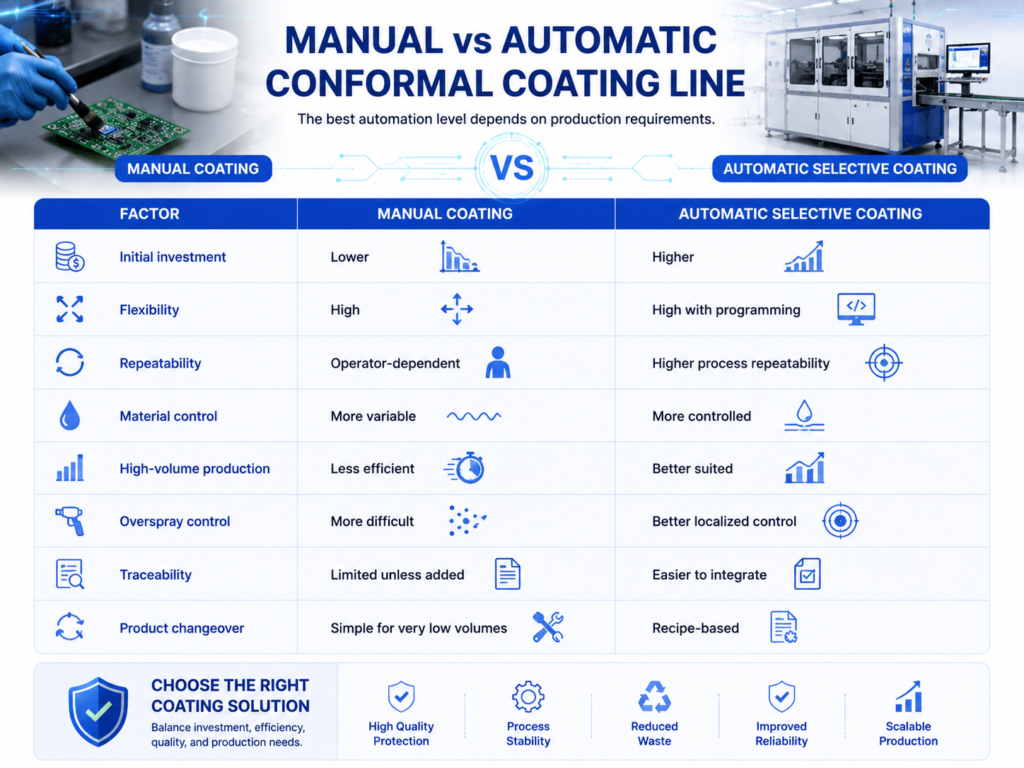
Manual vs Automatic Conformal Coating Line
The best automation level depends on production requirements.
Manual coating remains useful for prototypes and low-volume products.
Automatic selective coating is usually more attractive when repeatability, throughput, material control, and automation are priorities.
Semi-Automatic Conformal Coating Line
A semi-automatic solution may include:
Manual PCB Loading → Automatic Selective Coating → Manual Inspection → Flash-Off Conveyor → Curing Oven → Manual Unloading
This can be suitable for:
- Medium production volumes
- Multiple product models
- Factories upgrading from manual spraying
- Limited automation budgets
It often provides a practical transition toward higher automation.
Fully Automatic Conformal Coating Line
A more automated configuration may include:
Automatic Loader → Barcode Identification → Selective Coating → Automatic Inspection → Flash-Off → Automatic Curing → Final Inspection → Automatic Unloader
Optional integration can include:
- Automatic width adjustment
- Production data collection
- Recipe management
- Buffers
- Traceability
- MES connectivity where required
This configuration can be useful for higher-volume and more standardized production.
How to Choose a Selective Coating Machine
Before selecting a machine, manufacturers should evaluate:
- PCB length and width
- PCB thickness
- Maximum component height
- Panel design
- Keep-out areas
- Required coating regions
- Coating material
- Material viscosity
- Required coating width
- Target coating thickness
- Production capacity
- Product mix
- Changeover frequency
- Required valve types
- Factory layout
- Upstream/downstream equipment
- Traceability requirements
- Budget
Providing PCB drawings or representative board samples can also help evaluate valve access and coating paths.
How to Choose the Right Coating Valve
Different PCB geometries may require different coating methods.
Spray Valve
Suitable for broader coverage areas where controlled spraying is acceptable.
Film Coating Valve
Useful for applying wider controlled coating patterns.
Needle Dispensing
Useful for:
- Narrow areas
- Localized application
- Tight clearances
Multi-Valve Systems
Some products benefit from multiple valve types in the same machine.
For example:
- Film coating for large open regions
- Needle dispensing around tight component areas
The correct valve strategy can improve both throughput and coating accuracy.
Factory Layout for a Conformal Coating Line
A coating line requires careful layout planning because coating materials may involve ventilation and curing requirements.
Important factors include:
- Incoming PCB location
- Material preparation area
- Masking area
- Coating machine
- Flash-off space
- Curing equipment
- Inspection station
- Rework area
- Exhaust
- Operator access
- Maintenance access
- Finished goods flow
A typical layout may be linear:
Loading → Coating → Flash-Off → Curing → Inspection → Unloading
However, factory space may require U-shaped or segmented layouts.
Exhaust and Ventilation Requirements
Depending on the coating material and process, appropriate exhaust and ventilation may be required.
Manufacturers should review:
- Coating material safety data
- Solvent content
- Process emissions
- Machine exhaust interface
- Local environmental and workplace requirements
The exhaust system should be planned before equipment installation.
Material Supply and Management
Coating material management influences process stability.
Potential considerations include:
- Material container size
- Pressure control
- Agitation where required
- Filtration
- Tubing compatibility
- Material pot life
- Storage conditions
- Viscosity variation
The coating delivery system should be compatible with the specific chemical material being used.
Common Conformal Coating Defects
Several problems may occur if the process is not properly controlled.
Bubbles
Potential causes can include:
- Air trapped during application
- Material handling
- Excessive coating thickness
- Inappropriate flash-off
- Surface contamination
Pinholes
Pinholes can result from:
- Surface contamination
- Air release
- Material behavior
- Application conditions
Dewetting
Coating may pull away from certain PCB areas.
Possible causes include:
- Oil
- Silicone contamination
- Flux residues
- Other surface contamination
Surface cleanliness should be investigated before simply increasing coating quantity.
Overspray
Overspray can affect:
- Connectors
- Test points
- Switches
- Other keep-out areas
Possible solutions include:
- Better programming
- Different valve selection
- Lower spray width
- Masking
- Fixture design
Uneven Coating
Possible causes can include:
- Incorrect valve height
- Inconsistent pressure
- Viscosity changes
- Speed variation
- Poor programming
Pooling
Coating may collect around tall components or dense areas.
This can occur when material flow and PCB geometry are not properly considered.
How to Improve Conformal Coating Process Stability
A stable process requires consistent control from incoming PCB condition through curing.
Important areas include:
- Clean PCB surfaces
- Controlled material storage
- Stable viscosity
- Proper valve selection
- Correct coating path
- Consistent flow rate
- Accurate Z-height
- Controlled flash-off
- Correct curing method
- Routine equipment cleaning
- Regular nozzle maintenance
- Standardized recipes
- Inspection records
Manufacturers should treat coating, flash-off, and curing as one integrated process.
Conformal Coating vs Potting
Conformal coating and potting are not the same process.
Conformal Coating
Usually forms a relatively thin layer that follows PCB and component contours.
Potential advantages include:
- Lower material volume
- Lower added weight
- Easier visual inspection
- Potentially easier repair, depending on material
Potting
Encapsulates a larger part of the assembly in a much thicker resin layer.
It may provide different levels of:
- Mechanical protection
- Environmental isolation
- Tamper resistance
However, it can increase:
- Weight
- Material use
- Repair difficulty
The correct approach depends on the product requirement.
Conformal coating should not automatically be used as a replacement for potting, or vice versa.
Where Does Conformal Coating Fit in the Complete PCBA Process?
For many products, coating is performed after assembly, soldering, and key testing stages.
A possible mixed-technology PCBA flow is:
Solder Paste Printing → SPI → SMT Placement → Reflow → AOI → THT Insertion → Wave/Selective Soldering → Inspection → Testing → Cleaning/Preparation → Conformal Coating → Curing → Final Inspection
Testing before coating can be practical because coating may make later repair more difficult.
However, the exact sequence should follow the product’s manufacturing and quality requirements.
Integrating the Coating Line with an SMT Factory
A conformal coating line should not be planned in isolation.
Manufacturers should consider:
- SMT output
- THT output
- Testing capacity
- Buffer capacity
- Cleaning time
- Coating cycle time
- Curing time
- Final assembly requirements
If SMT produces 100 boards per hour but coating can handle only 30 acceptable boards per hour, large WIP buffers may develop.
Production planning should therefore consider coating as part of total factory capacity.
How to Calculate Conformal Coating Line Capacity
Do not calculate capacity using only machine travel speed.
Evaluate the effective cycle time of:
- Loading
- Masking
- Coating
- Inspection
- Flash-off
- Curing
- Final inspection
- Unloading
Suppose:
- Loading: 15 seconds
- Coating: 40 seconds
- Inspection: 30 seconds
- Flash-off: 5 minutes
- Curing: 12 minutes
- Final inspection: 30 seconds
The line configuration must provide enough parallel flash-off and curing capacity to prevent these long process stages from restricting throughput.
This is one of the most important considerations in a turnkey project.
How to Reduce Labor Without Over-Automating
A factory does not always need a completely automatic line.
A practical upgrade strategy can be:
Stage 1: Replace manual spraying with automatic selective coating.
Stage 2: Add conveyors and controlled flash-off.
Stage 3: Integrate automatic curing.
Stage 4: Add automatic loading/unloading and barcode identification.
Stage 5: Integrate inspection and traceability where required.
This phased approach can reduce labor while keeping investment aligned with production demand.
New vs Pre-Owned Coating Equipment
Both new and suitable pre-owned equipment can be evaluated according to project requirements.
For pre-owned equipment, important checks include:
- Motion system condition
- Valve condition
- Conveyor condition
- Control system
- Material supply system
- Exhaust interfaces
- Software compatibility
- Maintenance history
- Spare parts
- Technical support
If curing equipment is included, also evaluate:
- Heating or UV system condition
- Conveyor
- Temperature control
- Ventilation
- Process compatibility with the intended coating material
The decision should consider total cost of ownership rather than purchase price alone.
Turnkey Conformal Coating and PCBA Solutions from Fuliu Electronics
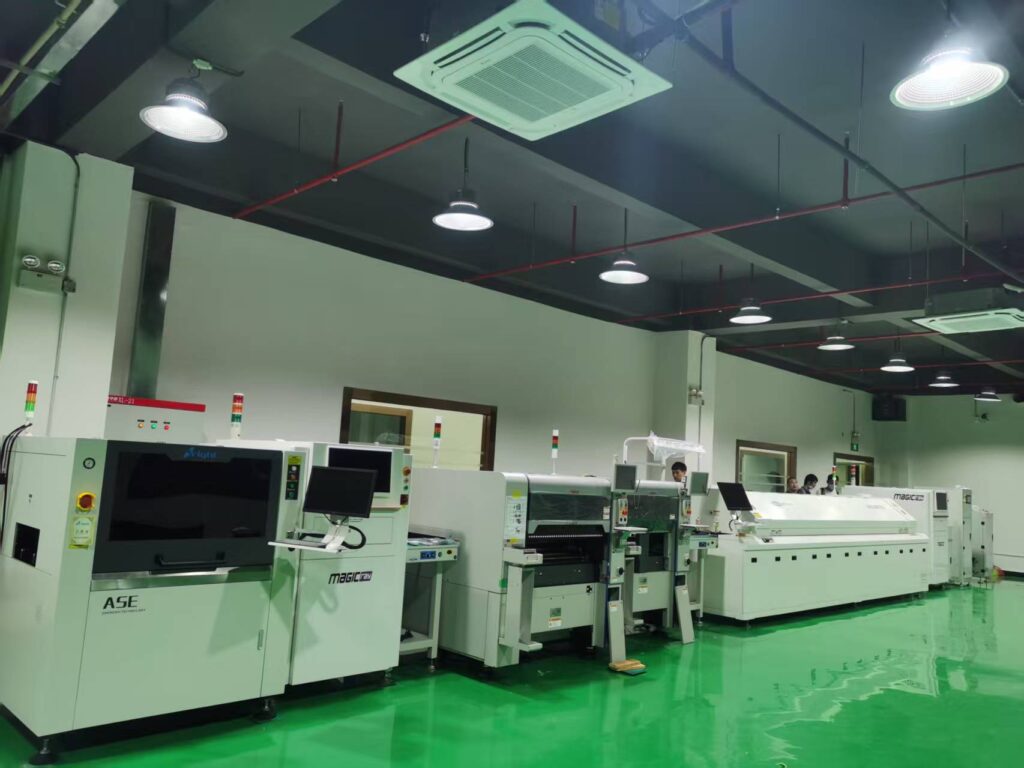
Established in 2014, Fuliu Electronics is dedicated to providing customers with high-quality PCBA intelligent manufacturing solutions and services.
With extensive experience in the SMT industry, we specialize in dependable equipment, professional technical support, and complete SMT and PCBA production line solutions.
Our product portfolio includes SMT pick and place machines from Fuji, Panasonic, ASM, Yamaha, JUKI, and Hanwha, together with ERSA reflow ovens from Germany, MagicRay SPI/AOI inspection systems, automatic solder paste printers, supporting PCBA equipment, pre-owned SMT equipment, SMT spare parts, machine leasing, and maintenance services.
For manufacturers planning a turnkey conformal coating line, Fuliu Electronics can help evaluate:
- PCB dimensions
- Component layout
- Keep-out areas
- Coating material
- Coating coverage
- Target production capacity
- Product mix
- Selective coating method
- Flash-off requirements
- Curing technology
- Inspection requirements
- Existing SMT/THT equipment
- Factory layout
- Automation level
- Investment budget
By reviewing the entire PCBA process, manufacturers can match coating equipment with upstream assembly and downstream curing, inspection, and handling requirements.
As part of our global growth strategy, Fuliu Electronics is actively expanding into international markets, with key focus areas including India, Vietnam, the Philippines, Indonesia, the Middle East, South Africa, and Europe.
Conclusion
A turnkey conformal coating line solution for PCBA manufacturing should be planned as a complete process rather than as a single coating machine.
A typical line may include:
PCB Loading → Surface Preparation → Selective Coating → Inspection → Flash-Off → Curing → Final Inspection → PCB Unloading
The correct configuration depends on:
- PCB dimensions
- Component layout
- Keep-out areas
- Coating material
- Required coverage
- Coating method
- Flash-off conditions
- Curing technology
- Target capacity
- Product mix
- Inspection requirements
- Factory layout
- Automation level
- Budget
For low-volume and high-mix production, manual or semi-automatic coating may provide sufficient flexibility.
For medium- and high-volume production, an automatic selective coating line can improve repeatability, material control, and production integration.
Most importantly, coating capacity must be matched with flash-off and curing capacity.
A high-speed selective coating machine alone will not create a high-output production line if curing remains the bottleneck.
If you are planning a new automatic conformal coating line, upgrading from manual spraying, or integrating coating into a complete SMT + THT PCBA factory, Fuliu Electronics can help evaluate your PCB dimensions, component layout, coating material, keep-out areas, target capacity, curing process, factory layout, existing equipment, automation requirements, and investment budget to develop a suitable turnkey production solution.
Frequently Asked Questions
A typical line can include a PCB loader, inspection or preparation station, selective coating machine, inspection conveyor, flash-off section, curing system, final inspection station, and PCB unloader.
No. The need for coating depends on the operating environment, product design, enclosure, reliability requirements, and customer specification.
For repeat production, selective coating can provide better repeatability, localized application, and easier automation. Manual spraying can remain practical for prototypes and low-volume production.
It can reduce masking in many applications, but some connectors, contacts, test points, or difficult geometries may still require physical masking.
Common categories include acrylic, silicone, polyurethane, epoxy, UV-curable, and other specialized materials. Equipment compatibility must be checked for the selected chemistry.
The curing system must match the coating material. Possible methods include ambient, thermal, UV, moisture, or dual-cure processes.