
Electric vehicles rely on increasingly sophisticated electronic systems to control batteries, power conversion, charging, thermal management, communication, and vehicle functions.
Among these systems, the Battery Management System (BMS) plays a critical role in monitoring and managing battery operation. Its PCB assemblies can contain sensors, microcontrollers, communication circuits, connectors, power-related components, and other electronic devices.
Depending on their location and product design, EV and BMS electronics may encounter environmental conditions such as moisture, condensation, dust, contaminants, temperature changes, and chemical exposure.
For manufacturers, protecting sensitive PCB assemblies against the relevant operating environment is therefore an important production consideration.
One commonly used solution is conformal coating.
A properly configured conformal coating solution for EV and Battery Management System PCBs can apply a controlled protective coating to selected PCB areas while integrating coating, curing, inspection, material handling, and process control into the PCBA manufacturing workflow.
This guide explains how conformal coating works, why it is used for EV and BMS electronics, and how manufacturers can configure an automated PCB coating line.
Conformal Coating Solution for EV and Battery Management System PCBs
Conformal coating is a thin protective coating applied to the surface of a PCB assembly.
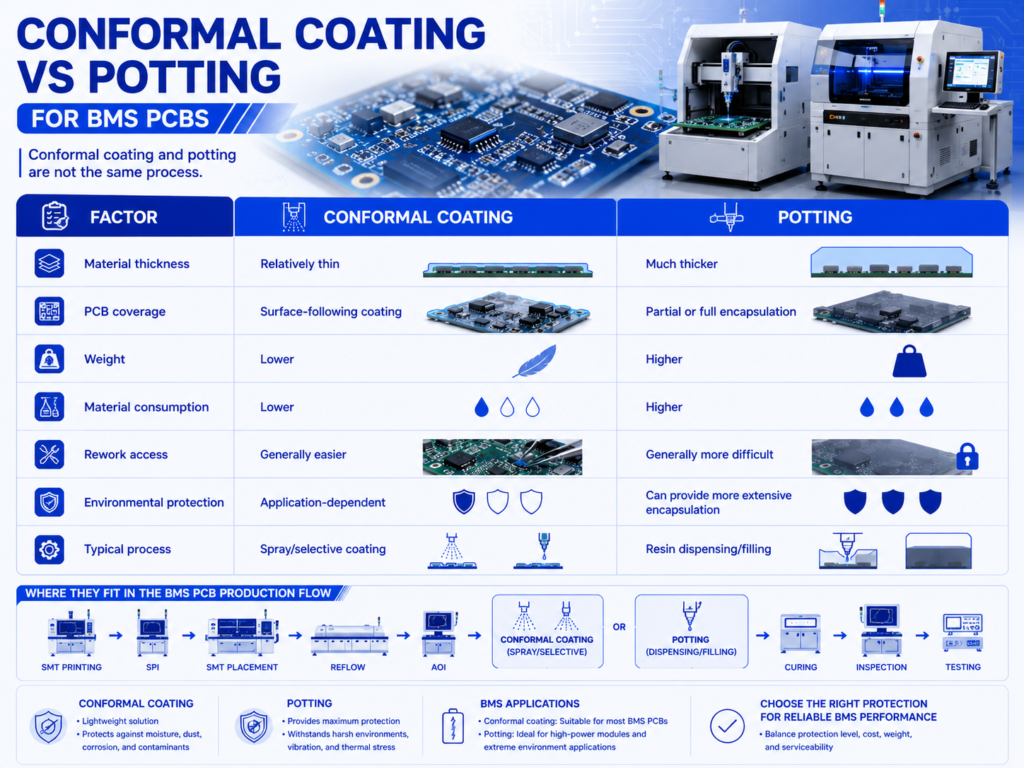
Unlike potting, which can encapsulate large areas or the complete assembly in a relatively thick compound, conformal coating generally follows the contours of the PCB and components.
Depending on the selected coating material and application requirements, conformal coating may help protect PCB assemblies against environmental influences such as:
- Moisture
- Humidity
- Condensation
- Dust
- Certain contaminants
- Corrosive environments
- Electrical leakage caused by environmental exposure
However, coating performance depends on material selection, PCB cleanliness, coating thickness, coverage, curing conditions, design, and process control.
Conformal coating should therefore be treated as an engineered manufacturing process rather than simply spraying protective material onto a PCB.
Why Do EV and BMS PCBs Need Conformal Coating?
EV electronics may operate in environments that are more demanding than many indoor consumer electronics applications.
A BMS PCB, for example, may experience repeated temperature changes during vehicle operation and charging. Depending on enclosure design and installation location, environmental exposure may also create moisture or contamination risks.
Conformal coating can be considered where PCB protection requirements justify it.
Moisture Protection
Moisture and condensation can affect exposed PCB surfaces and electrical connections.
A suitable coating can provide an additional environmental barrier.
Contamination Protection
Dust, residues, and certain environmental contaminants can influence PCB performance over time.
Corrosion Resistance
Where corrosive environmental exposure is a concern, an appropriate coating system may help protect conductive surfaces.
Electrical Insulation
Some conformal coatings can provide additional dielectric protection between conductive areas, subject to material properties, thickness, design, and process requirements.
Long-Term Reliability
For automotive electronics designed for extended service, controlling environmental exposure can form part of a broader reliability strategy.
Conformal coating, however, does not compensate for poor PCB design, unsuitable materials, contamination, or uncontrolled manufacturing processes.
Where Is Conformal Coating Used in EV Electronics?
Conformal coating may be considered for different electronic assemblies depending on product design and environmental requirements, including:
- Battery Management System PCBs
- Battery monitoring electronics
- Charging-related electronics
- Power control boards
- Motor control electronics
- DC-DC converter control boards
- Vehicle control electronics
- Sensor modules
- Communication modules
- Thermal management electronics
Not every EV PCB requires the same coating material or process.
The coating solution should be selected according to the specific operating environment, PCB design, customer requirements, and applicable manufacturing standards.

What Does an Automatic Conformal Coating Line Include?
A typical automatic conformal coating line may follow this process:
PCB Loading → Surface Preparation/Inspection → Selective Coating → Coating Inspection → Flash-Off → Curing → Final Inspection → PCB Unloading
Depending on the product, material, and factory requirements, additional processes may be incorporated.
- PCB Loading and Handling
Automatic PCB handling equipment transfers boards into the coating process.
Important parameters include:
- PCB dimensions
- PCB thickness
- Panel dimensions
- Board weight
- Conveyor width
- Transfer direction
- Required throughput
For a complete PCBA factory, the coating line should also be coordinated with upstream testing and downstream assembly processes.
- PCB Cleaning and Surface Preparation
One of the most important considerations before conformal coating is PCB surface condition.
Contaminants such as flux residues, oils, fingerprints, dust, and process residues may affect coating adhesion or long-term performance.
Whether cleaning is required depends on the manufacturing process, flux chemistry, coating material, PCB condition, and product requirements.
The key principle is that the coating should be applied to a surface that meets the defined process specification.
- Masking Sensitive Areas
Not every part of a PCB should necessarily be coated.
Areas that may require protection from coating can include, depending on the design:
- Connectors
- Test points
- Switches
- Contact surfaces
- Certain sensors
- Programming interfaces
- Mechanical interfaces
Traditional production may use masking tape, plugs, caps, or fixtures.
Selective coating equipment can reduce unnecessary coating of keep-out areas, although the process still needs to be validated for the actual PCB.
- Selective Conformal Coating Machine
The conformal coating machine is the core equipment in an automated line.
A programmable selective coating system applies material to specified areas while avoiding defined keep-out zones.
Depending on the equipment and coating material, application technologies may include:
- Spray
- Film coating
- Needle dispensing
- Jetting or other controlled dispensing methods
The appropriate application method depends on material viscosity, PCB layout, component height, required coating pattern, and production speed.
For EV and BMS PCB manufacturing, repeatable material application is particularly important when large production volumes are involved.
- Coating Thickness and Coverage Control
Applying more coating does not automatically provide better protection.
Excessive coating can increase material consumption and may create process issues, while insufficient coverage may leave required areas unprotected.
Manufacturers should define and control:
- Target coating thickness
- Coverage area
- Edge coverage
- Application path
- Material flow
- Coating speed
- Spray or dispensing parameters
Requirements should be established according to the coating material, PCB design, customer specification, and applicable standards.
- Flash-Off Process
Some coating materials require a flash-off period before curing.
This allows appropriate solvent evaporation or material leveling before the PCB enters the curing process.
The required flash-off conditions depend on the coating chemistry and material manufacturer’s recommendations.
A production line should therefore provide sufficient process time and space when flash-off is required.
- Conformal Coating Curing
After application, the coating must be cured according to its material requirements.
Possible curing methods can include:
- Ambient curing
- Thermal curing
- UV curing
- Moisture curing
- Dual-cure processes
The appropriate method depends on the coating chemistry.
An automated coating line may incorporate a curing oven or UV curing system to improve production consistency and throughput.
Temperature, time, UV exposure, and other curing parameters should follow the selected material’s validated process requirements.
- Conformal Coating Inspection
Inspection helps verify whether the coating has been applied to the required areas.
Depending on the coating material and process, inspection can evaluate:
- Coverage
- Missing coating
- Coating in keep-out areas
- Bubbles
- Excessive accumulation
- Inconsistent application
- Surface defects
Some coating materials contain UV tracers that make coverage easier to inspect under suitable UV illumination.
Automated or manual inspection can be selected according to production volume and quality requirements.

How to Configure a Conformal Coating Line for BMS PCBs
A coating line should begin with the product requirements rather than equipment specifications.
Step 1: Analyze the PCB
Collect information such as:
- PCB dimensions
- Panel configuration
- Component height
- Coating areas
- Keep-out areas
- Connectors
- Test points
- Sensitive components
A PCB image or coating drawing can be useful for developing the application path.
Step 2: Define the Operating Environment
Understand the environmental protection requirements.
Consider potential exposure to:
- Humidity
- Condensation
- Dust
- Chemicals
- Temperature cycling
- Other application-specific contaminants
These conditions influence material and process selection.
Step 3: Select the Coating Material
Common conformal coating chemistry categories include:
- Acrylic
- Silicone
- Polyurethane
- Epoxy
- UV-curable coatings
- Other specialized materials
Each material has different characteristics related to curing, flexibility, chemical resistance, temperature performance, repairability, and processing.
Material selection should be based on the product specification and application environment.
Step 4: Select the Application Method
Determine whether the process requires spray, selective film coating, dispensing, or a combination of methods.
For high-volume BMS production, automated selective coating can help improve repeatability and reduce manual application.
Step 5: Determine Curing Requirements
The curing process must match the coating chemistry.
This decision influences curing equipment, line length, energy requirements, cycle time, and factory layout.
Step 6: Define Inspection Requirements
Determine how coating coverage and process quality will be verified.
Inspection requirements should be established before mass production.
Selective Coating vs Manual Coating
Manual Conformal Coating
Manual spraying or brushing may be appropriate for:
- Prototypes
- Low-volume production
- Frequent product changes
- Simple coating requirements
Initial equipment investment may be lower, but process consistency depends more heavily on operator control.
Automatic Selective Coating
Automated selective coating is more suitable when manufacturers require:
- Higher production volume
- Repeatable coating paths
- Controlled material application
- Reduced manual masking
- Consistent process parameters
- Multiple programmable PCB recipes
For automotive and EV electronics manufacturing, automation can also support production data collection and standardized process control.
Conformal Coating vs Potting for BMS PCBs
Conformal coating and potting are not the same process.
A BMS PCB does not automatically require potting simply because it is used in an EV.
The correct protection method depends on enclosure design, operating environment, mechanical requirements, electrical requirements, thermal considerations, and service strategy.
In some applications, conformal coating may be sufficient. In others, potting or another protection method may be required.
Integrating Conformal Coating into a Complete PCBA Line
For EV electronics manufacturing, coating is typically a downstream process following PCB assembly and appropriate testing.
A possible manufacturing flow is:
Solder Paste Printing → SPI → SMT Placement → Reflow → AOI → THT/DIP Assembly → Selective/Wave Soldering → Inspection → Testing → Conformal Coating → Curing → Coating Inspection → Final Assembly
The actual sequence depends on product requirements.
Where practical, manufacturers should complete relevant inspection and testing before coating because coating may make certain rework operations more difficult.
This is why conformal coating should be considered during the initial PCBA production line planning stage.
Common Conformal Coating Problems
Incomplete Coverage
Some required PCB areas may not receive sufficient coating.
Potential causes include an unsuitable coating path, shadowing from tall components, or incorrect application parameters.
Coating in Keep-Out Areas
Connectors or test points may accidentally receive coating if masking or selective programming is incorrect.
Bubbles
Air trapped in the coating can affect appearance and potentially coating performance.
Material handling and application parameters should be investigated.
Poor Adhesion
Surface contamination, incompatible materials, or unsuitable process conditions can affect adhesion.
Excessive Coating
Too much material can increase cost and may create curing or process problems.
Insufficient Curing
Incorrect time, temperature, UV exposure, or other curing conditions can prevent the coating from reaching its intended properties.
Process troubleshooting should evaluate the complete material/application/curing system.
How to Improve EV and BMS PCB Coating Quality
Manufacturers can improve coating consistency by controlling several key areas:
- Maintain PCB cleanliness
- Control coating material storage and handling
- Define coating and keep-out areas
- Program repeatable coating paths
- Control material flow and application speed
- Monitor coating thickness
- Follow validated curing conditions
- Inspect coating coverage
- Maintain dispensing and spray equipment
- Record important process parameters where required
For automotive electronics, coating should be integrated into the broader quality management and traceability strategy.
Conformal Coating and PCBA Solutions from Fuliu Electronics
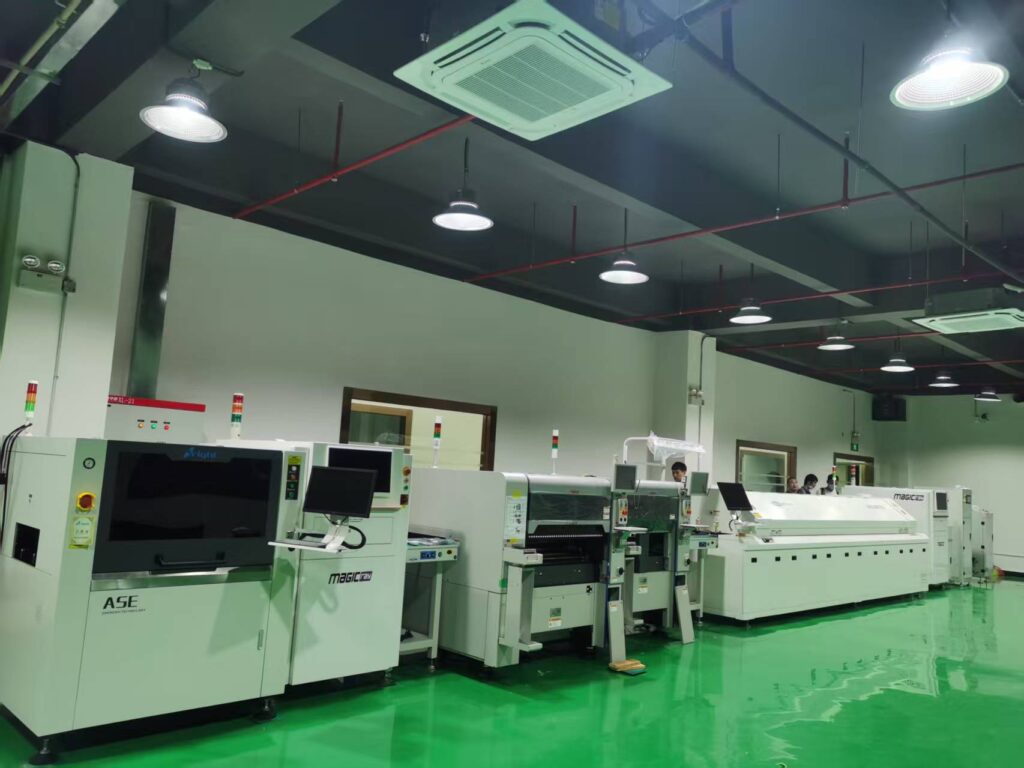
Established in 2014, Fuliu Electronics is dedicated to providing customers with high-quality PCBA intelligent manufacturing solutions and services.
With extensive experience in the SMT industry, we specialize in delivering dependable equipment, professional technical support, and complete solutions for SMT and PCBA production lines.
Our product portfolio includes SMT pick and place machines from Fuji, Panasonic, ASM, Yamaha, JUKI, and Hanwha, along with ERSA reflow ovens from Germany, MagicRay SPI/AOI inspection systems, automatic solder paste printers, supporting production equipment, pre-owned SMT equipment, SMT spare parts, machine leasing, and maintenance services.
For customers planning EV, automotive, BMS, or other electronics production lines, Fuliu Electronics can help evaluate the complete PCBA manufacturing process, including upstream SMT equipment and downstream processes such as THT assembly, inspection, testing, and conformal coating according to project requirements.
When planning a conformal coating solution, important information includes:
- PCB dimensions
- PCB images or drawings
- Coating areas
- Keep-out areas
- Component height
- Coating material
- Required production capacity
- Curing method
- Factory layout
- Upstream and downstream equipment
By evaluating these factors together, manufacturers can develop a more suitable automatic PCB conformal coating line rather than selecting coating equipment in isolation.
As part of our global growth strategy, Fuliu Electronics is actively expanding into international markets, with key focus areas including India, Vietnam, the Philippines, Indonesia, the Middle East, South Africa, and Europe.
Conclusion
A reliable conformal coating solution for EV and Battery Management System PCBs requires more than choosing a coating machine.
PCB cleanliness, material selection, selective application, coating thickness, keep-out control, flash-off, curing, inspection, and process traceability all influence the final result.
For higher-volume EV electronics manufacturing, an automated process such as:
PCB Loading → Selective Conformal Coating → Inspection → Flash-Off → Curing → Final Inspection → Unloading
can provide a more controlled and repeatable production workflow.
More importantly, conformal coating should be considered as part of the complete PCBA manufacturing process, alongside SMT placement, reflow soldering, SPI/AOI inspection, THT assembly, testing, and final product assembly.
If you are planning a new EV or BMS PCB production line, upgrading an existing conformal coating process, or developing a complete PCBA factory, Fuliu Electronics can help evaluate your PCB specifications, BOM, coating requirements, target capacity, factory layout, and automation needs to develop a suitable production line solution.
Frequently Asked Questions
Conformal coating can provide an additional protective barrier against environmental influences such as moisture, condensation, dust, and certain contaminants.
Whether a BMS requires coating depends on its design, enclosure, operating environment, and reliability requirements.
There is no single coating material that is best for every EV PCB.
Acrylic, silicone, polyurethane, epoxy, UV-curable, and other coating technologies have different properties. Selection should consider temperature, humidity, chemical exposure, flexibility, repair requirements, curing process, and product specifications.
A selective conformal coating machine uses programmable motion and controlled dispensing or spraying to apply coating to specified PCB areas while avoiding defined keep-out zones.
It can improve repeatability and reduce manual application in higher-volume production.
Depending on the design, connectors, electrical contacts, test points, switches, programming interfaces, and certain sensors may need to remain coating-free.
The keep-out requirements should be defined by the product engineering team.
It depends on the PCB condition, flux chemistry, coating material, process specification, and product requirements.
Contamination can affect coating adhesion and performance, so PCB cleanliness should be evaluated and controlled before coating.
Curing methods depend on coating chemistry and may include ambient, thermal, UV, moisture, or dual-cure processes.
The coating manufacturer’s recommended and validated process conditions should be followed.