
Modern electronics are becoming smaller, faster, and more densely populated with components than ever before. While manufacturers invest heavily in high-precision SMT equipment, inspection systems, and automated production lines, one critical process is sometimes overlooked—PCB cleaning after assembly.
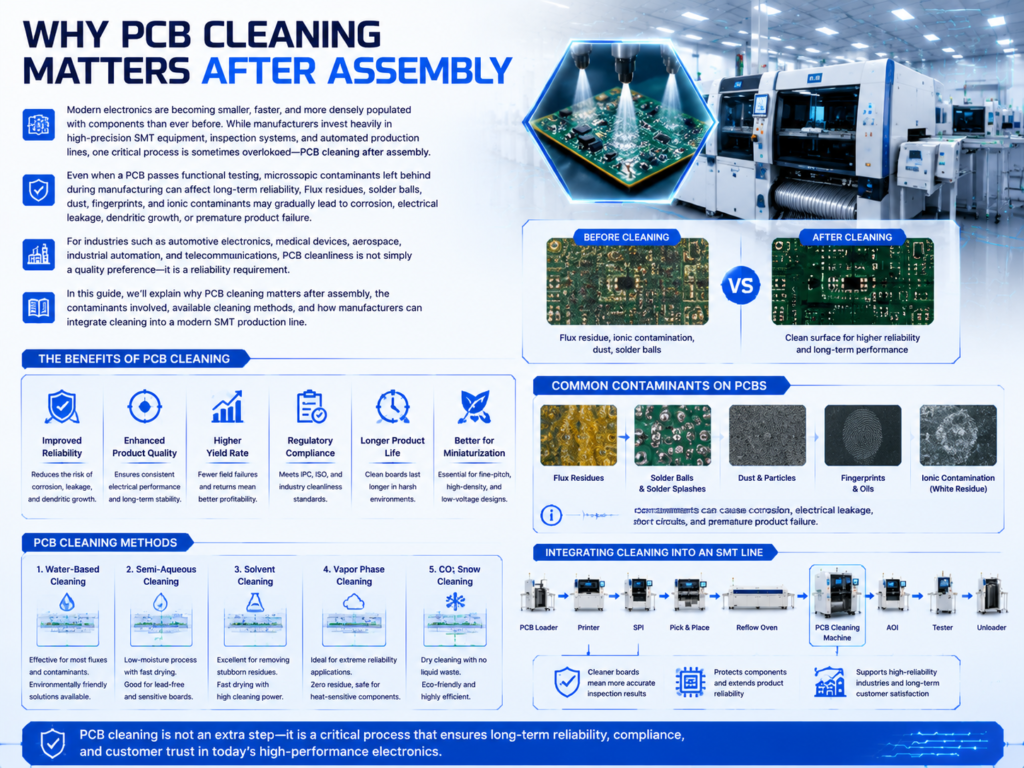
Even when a PCB passes functional testing, microscopic contaminants left behind during manufacturing can affect long-term reliability. Flux residues, solder balls, dust, fingerprints, and ionic contaminants may gradually lead to corrosion, electrical leakage, dendritic growth, or premature product failure.
For industries such as automotive electronics, medical devices, aerospace, industrial automation, and telecommunications, PCB cleanliness is not simply a quality preference—it is a reliability requirement.
In this guide, we’ll explain why PCB cleaning matters after assembly, the contaminants involved, available cleaning methods, and how manufacturers can integrate cleaning into a modern SMT production line.
What Is PCB Cleaning After Assembly?
PCB cleaning after assembly is the process of removing contaminants from a printed circuit board after soldering and assembly have been completed.
The objective is to eliminate residues that may negatively affect electrical performance, product reliability, or long-term durability.
Cleaning is commonly performed after:
- Reflow soldering
- Wave soldering
- Selective soldering
- Manual solder repair
- Final assembly
Depending on the application, cleaning may occur before functional testing or before final product packaging.
Why Is PCB Cleaning Important?
Not every PCB requires cleaning, but many high-reliability products do.
Residues remaining on the PCB surface can attract moisture, promote corrosion, reduce insulation resistance, and interfere with sensitive electronic circuits.
Effective cleaning helps manufacturers:
- Improve product reliability
- Extend product lifespan
- Prevent corrosion
- Reduce electrical leakage
- Improve coating adhesion
- Meet industry cleanliness standards
- Reduce field failures
For mission-critical electronics, proper cleaning is often considered an essential manufacturing process.
Common Contaminants Found on PCB Assemblies
Several types of contamination can remain after PCB assembly.
Flux Residues
Flux improves soldering performance by removing oxidation during the soldering process.
However, leftover flux residues may contain ionic materials that absorb moisture and become electrically conductive under certain environmental conditions.
Solder Balls
Tiny solder balls may become trapped beneath components or remain loose on the PCB surface.
These particles can eventually create electrical shorts if they move during product operation.
Dust and Airborne Particles
Manufacturing environments naturally generate dust.
If not removed, these particles may interfere with optical sensors, high-frequency circuits, or conformal coating adhesion.
Fingerprints and Oils
Manual handling introduces oils, salts, and organic contaminants that may accelerate corrosion over time.
Ionic Contamination
Invisible ionic residues are among the most serious reliability concerns.
Although not visible to the naked eye, they can cause:
- Leakage current
- Electrochemical migration
- Dendrite growth
- Insulation failure
What Problems Can Poor PCB Cleaning Cause?
Failure to remove contaminants may lead to numerous long-term reliability issues.
Common problems include:
Corrosion
Moisture combined with ionic residues gradually corrodes copper traces and solder joints.
Electrical Leakage
Conductive contamination lowers insulation resistance and may cause unstable circuit performance.
Dendritic Growth
Metal ions migrate across PCB surfaces, forming conductive paths that eventually create short circuits.
Conformal Coating Failure
Residues reduce coating adhesion, leaving the PCB vulnerable to moisture and harsh environments.
Reduced Product Lifetime
Even if products pass factory testing, contamination can accelerate aging and increase warranty claims.
Which Industries Require PCB Cleaning?
PCB cleaning is especially important in industries with strict reliability requirements.
These include:
- Automotive electronics
- Medical devices
- Aerospace systems
- Military electronics
- Industrial automation
- Telecommunications
- Railway electronics
- Power electronics
Products operating in humid, dusty, or high-temperature environments benefit significantly from thorough cleaning.
Common PCB Cleaning Methods
Different cleaning technologies are used depending on production requirements and contamination levels.
Aqueous Cleaning
Aqueous cleaning uses water-based cleaning solutions combined with spray pressure or ultrasonic agitation.
Advantages include:
- Environmentally friendly
- Effective flux removal
- Suitable for high-volume production
Solvent Cleaning
Specialized solvents dissolve flux residues and oils quickly.
This method is often used for precision electronics but requires appropriate environmental and safety controls.
Semi-Aqueous Cleaning
Semi-aqueous systems combine solvent chemistry with water rinsing.
They provide excellent cleaning performance for difficult contaminants while reducing solvent consumption.
Ultrasonic Cleaning
Ultrasonic waves generate microscopic bubbles that remove contamination from complex PCB geometries.
This method is particularly effective for certain assemblies but should be carefully evaluated for delicate components.
Automated PCB Cleaning Machines
Modern SMT factories increasingly use automated PCB cleaning machines.
Typical features include:
- Automatic loading and unloading
- Multi-stage cleaning
- DI water rinsing
- Hot-air drying
- Closed-loop filtration
- Cleanliness monitoring
- Recipe management
Automation improves cleaning consistency while reducing manual labor.
PCB Cleaning and No-Clean Flux
Many manufacturers use no-clean flux, leading to the misconception that cleaning is unnecessary.
Although no-clean flux leaves fewer visible residues, cleaning may still be required when:
- Conformal coating is applied.
- High-voltage circuits are manufactured.
- Products operate in harsh environments.
- Medical or aerospace standards apply.
- Customers specify cleanliness requirements.
The decision should be based on product reliability requirements rather than the flux type alone.
Best Practices for PCB Cleaning
Manufacturers can improve cleaning effectiveness by following several best practices.
- Select the appropriate cleaning process for the application.
- Use compatible cleaning chemistry.
- Verify cleaning effectiveness through cleanliness testing.
- Maintain cleaning equipment regularly.
- Minimize manual handling after cleaning.
- Control environmental contamination.
- Monitor process consistency using documented procedures.
Routine verification helps ensure reliable cleaning performance over time.
Integrating PCB Cleaning into an SMT Turnkey Line
PCB cleaning becomes even more effective when integrated into a complete SMT production line.
A typical workflow may include:
- PCB Loader
- Solder Paste Printer
- SPI Inspection
- Pick and Place Machine
- Reflow Oven
- AOI Inspection
- PCB Cleaning Machine
- Functional Testing
- Conformal Coating (if required)
- Final Inspection
- PCB Unloader
Proper process integration minimizes contamination while supporting consistent product quality.
Why Choose Fuliu Electronics?
Established in 2014, Fuliu Electronics is dedicated to providing customers with high-quality PCBA intelligent manufacturing solutions and comprehensive technical services.
With extensive experience in the SMT industry, Fuliu Electronics supplies complete SMT production line solutions featuring internationally recognized brands such as Fuji, Panasonic, ASM, Yamaha, JUKI, and Hanwha, together with ERSA reflow ovens, MagicRay SPI/AOI inspection systems, automatic solder paste printers, PCB cleaning equipment, refurbished SMT machines, SMT spare parts, equipment leasing, and maintenance services.
Serving customers across India, Vietnam, the Philippines, Indonesia, the Middle East, South Africa, and Europe, Fuliu Electronics helps manufacturers build reliable SMT production lines by integrating advanced inspection, cleaning, testing, and intelligent manufacturing technologies into customized turnkey solutions.
Conclusion
Although PCB cleaning is sometimes viewed as an optional process, it plays a critical role in ensuring long-term product reliability. Removing flux residues, ionic contaminants, solder particles, and other manufacturing residues helps prevent corrosion, electrical leakage, coating failures, and premature field failures.
As electronic products continue to become more compact and performance demands increase, integrating PCB cleaning after assembly into a well-designed SMT production line is an effective way to improve product quality, extend service life, and reduce warranty costs. Manufacturers that prioritize cleanliness alongside precision assembly are better positioned to deliver reliable products in today’s competitive electronics market.
Frequently Asked Questions
PCB cleaning removes flux residues, solder particles, dust, and ionic contaminants that can affect electrical performance, reliability, and long-term durability.
No. Whether cleaning is required depends on the product application, flux type, customer requirements, environmental conditions, and industry standards. High-reliability products generally benefit from cleaning.
Common contaminants include flux residues, solder balls, fingerprints, oils, dust, and invisible ionic residues.
- Can no-clean flux eliminate the need for PCB cleaning?
Aqueous cleaning is widely used because it offers effective contaminant removal, good environmental performance, and compatibility with automated production.
PCB cleaning is typically performed after AOI inspection and before functional testing, conformal coating, or final product assembly, depending on the manufacturing process.