
As electronic products become increasingly compact and complex, maintaining consistent product quality has become one of the biggest challenges for manufacturers. Even a tiny soldering defect or misplaced component can lead to product failure, costly repairs, or customer complaints.
This is why AOI in SMT (Automated Optical Inspection) has become an essential part of modern electronics manufacturing. By automatically detecting defects during the production process, AOI systems help manufacturers improve quality, reduce waste, and increase production efficiency.
In this guide, we’ll explain what AOI in SMT is, how it works, why it matters, and how choosing the right AOI solution can enhance your SMT production line.
What Is AOI in SMT?
AOI (Automated Optical Inspection) is an automated inspection technology used in SMT (Surface Mount Technology) production lines to identify manufacturing defects on printed circuit boards (PCBs).
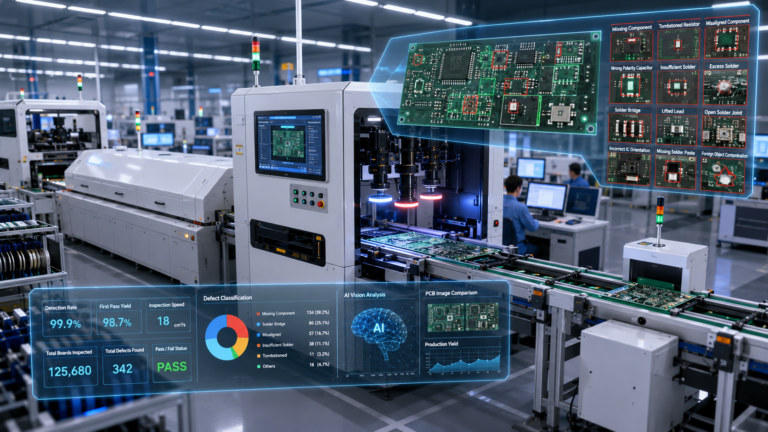
Instead of relying on manual visual inspection, an SMT AOI machine uses high-resolution industrial cameras, advanced lighting systems, and intelligent image-processing software to compare assembled PCBs against predefined standards.
The system automatically detects defects and alerts operators before defective boards move to the next production stage.
Today, AOI has become one of the most widely used methods for PCB assembly inspection, helping manufacturers achieve higher product consistency and lower defect rates.
How Does an AOI Machine Work?
An AOI inspection system performs several key steps during the inspection process.
Image Capture
Multiple high-resolution cameras capture images of the PCB from different angles under controlled lighting conditions.
Image Processing
The software analyzes the captured images and compares them with:
CAD data
Gerber files
Golden board images
Production specifications
Defect Detection
The system automatically identifies abnormalities that exceed acceptable tolerances.
Result Analysis
Inspection results are displayed instantly, allowing operators to review defect locations and determine whether repairs are required.
Modern AOI systems can inspect thousands of components within seconds, making them ideal for high-speed SMT production lines.
Common Defects Detected by AOI
One of the biggest advantages of automated optical inspection is its ability to identify a wide variety of manufacturing defects.
Typical defects include:
- Missing components
- Incorrect component placement
- Component polarity errors
- Lifted leads
- Tombstoning
- Insufficient solder
- Excess solder
- Solder bridges
- Wrong component values
- Component rotation
- Bent pins
- PCB contamination
Early detection helps prevent defective products from reaching functional testing or customers.
Types of AOI Systems
Different production environments require different inspection solutions.
Inline AOI
Inline AOI is installed directly within the SMT production line.
Advantages include:
- Real-time inspection
- Immediate feedback
- Continuous production
- High-volume manufacturing
This is the most common solution for medium- and large-scale electronics manufacturers.
Offline AOI
Offline AOI systems inspect PCBs separately from the production line.
They are commonly used for:
- Prototype production
- Small batch manufacturing
- Quality laboratories
- Process verification
Although inspection speed is lower, offline systems provide greater flexibility.
Why AOI Matters in SMT Manufacturing
Improved Product Quality
Manual inspection can be inconsistent due to operator fatigue or human error.
AOI provides standardized inspections with repeatable accuracy, ensuring every PCB is evaluated using the same criteria.
Higher Production Efficiency
Automated inspection significantly reduces inspection time while increasing throughput.
Instead of stopping production for manual checks, manufacturers can identify defects immediately and continue production with minimal interruption.
Lower Manufacturing Costs
Detecting defects early prevents expensive downstream failures.
Repairing a solder bridge immediately after reflow is much less costly than repairing a completed product after functional testing or customer delivery.
Reduced Human Error
Manual inspection depends heavily on operator experience.
AOI systems maintain consistent inspection standards regardless of shift changes or production volume.
Better Process Control
Inspection data helps manufacturers identify recurring process issues such as:
- Printer alignment problems
- Reflow temperature variations
- Pick and place accuracy
- Component feeder issues
This data supports continuous process improvement.
AOI vs SPI: What’s the Difference?
Many manufacturers confuse AOI and SPI (Solder Paste Inspection) because both contribute to SMT quality control.
However, they serve different purposes.
SPI
SPI inspects solder paste deposits immediately after solder paste printing.
It measures:
- Paste volume
- Paste height
- Paste alignment
- Printing accuracy
AOI
AOI is typically performed after component placement or reflow soldering.
It verifies:
- Component placement
- Solder joint quality
- Component orientation
- Assembly defects
For maximum quality assurance, many SMT production lines use both SPI and AOI together.
How to Choose the Right AOI Machine
When selecting an AOI machine for SMT production, manufacturers should consider several factors.
Inspection Accuracy
Higher camera resolution enables more precise defect detection, particularly for miniature components.
Production Speed
The AOI system should match the throughput of the SMT production line without creating bottlenecks.
Software Intelligence
Advanced software with AI-assisted algorithms can reduce false alarms and improve inspection efficiency.
Ease of Programming
User-friendly programming shortens setup time for new products.
Technical Support
Reliable after-sales service, software updates, spare parts availability, and operator training are essential for maximizing equipment performance.
Why Partner with Fuliu Electronics?
Established in 2014, Fuliu Electronics is dedicated to providing customers with high-quality PCBA intelligent manufacturing solutions and professional technical services.
With extensive experience in the SMT industry, the company supplies complete SMT production line solutions featuring globally recognized brands such as Fuji, Panasonic, ASM, Yamaha, JUKI, and Hanwha, along with ERSA reflow ovens, MagicRay SPI/AOI inspection systems, automatic solder paste printers, pre-owned SMT equipment, spare parts, machine leasing, and maintenance services.
Serving customers across India, Vietnam, the Philippines, Indonesia, the Middle East, South Africa, and Europe, Fuliu Electronics helps electronics manufacturers improve production efficiency, strengthen quality control, and optimize long-term manufacturing performance.
Conclusion
As PCB designs continue to become smaller and more sophisticated, AOI in SMT is no longer optional—it is an essential technology for ensuring consistent product quality and manufacturing efficiency.
By automatically detecting defects early in the production process, AOI systems reduce scrap, lower production costs, improve first-pass yield, and provide valuable process data for continuous improvement.
Whether you are upgrading an existing SMT production line or building a new factory, investing in the right AOI inspection solution can significantly improve your competitiveness and product reliability.
Frequently Asked Questions
What is AOI in SMT?
AOI (Automated Optical Inspection) is an automated inspection method that uses cameras and image-processing software to detect PCB assembly defects during SMT manufacturing.
Why is AOI important in SMT manufacturing?
AOI improves product quality, reduces defects, lowers production costs, and increases manufacturing efficiency through automated inspection.
What defects can an AOI machine detect?
Common defects include missing components, polarity errors, solder bridges, insufficient solder, tombstoning, component rotation, lifted leads, and incorrect component placement.
What is the difference between AOI and SPI?
SPI inspects solder paste quality before component placement, while AOI inspects completed PCB assemblies after placement or reflow soldering.
Should I choose inline AOI or offline AOI?
Inline AOI is ideal for high-volume automated production, while offline AOI is better suited for prototype development, laboratory testing, and small-batch manufacturing.
How do I choose the right AOI machine?
Consider inspection accuracy, production speed, software capability, ease of programming, after-sales support, and compatibility with your SMT production line.
Pingback: What Is AOI Inspection in PCB Assembly? | Complete Guide - Turnkey PCBA Line Solutions|Fuliu Electronics
Pingback: What Is PCB Depaneling? A Complete Guide to PCB Separation Methods - Turnkey PCBA Line Solutions|Fuliu Electronics