
If you are planning a new THT/DIP production line or upgrading an existing PCB assembly factory, one of the first questions is usually:
How much does a wave soldering machine cost?
There is no single price that applies to every wave soldering machine.
The final investment depends on factors such as:
- Machine size
- PCB dimensions
- Conveyor width
- Production capacity
- Fluxing system
- Preheating configuration
- Solder pot capacity
- Wave configuration
- Nitrogen capability
- Cooling system
- Automation
- Control system
- Brand
- New or pre-owned condition
- Installation and technical support
For this reason, comparing wave soldering machines only by purchase price can be misleading.
Manufacturers should instead evaluate the total cost of acquiring, installing, operating, and maintaining the machine while ensuring that it can meet the actual PCB assembly requirements.
How Much Does a Wave Soldering Machine Cost?
This guide explains the major factors affecting wave soldering machine cost and how PCB manufacturers can make a more informed purchasing decision.
What Is a Wave Soldering Machine?
A wave soldering machine is used primarily to solder through-hole components during PCB assembly.
Typical THT components include:
- Connectors
- Transformers
- Relays
- Terminal blocks
- Large capacitors
- Pin headers
- Switches
- Selected power components
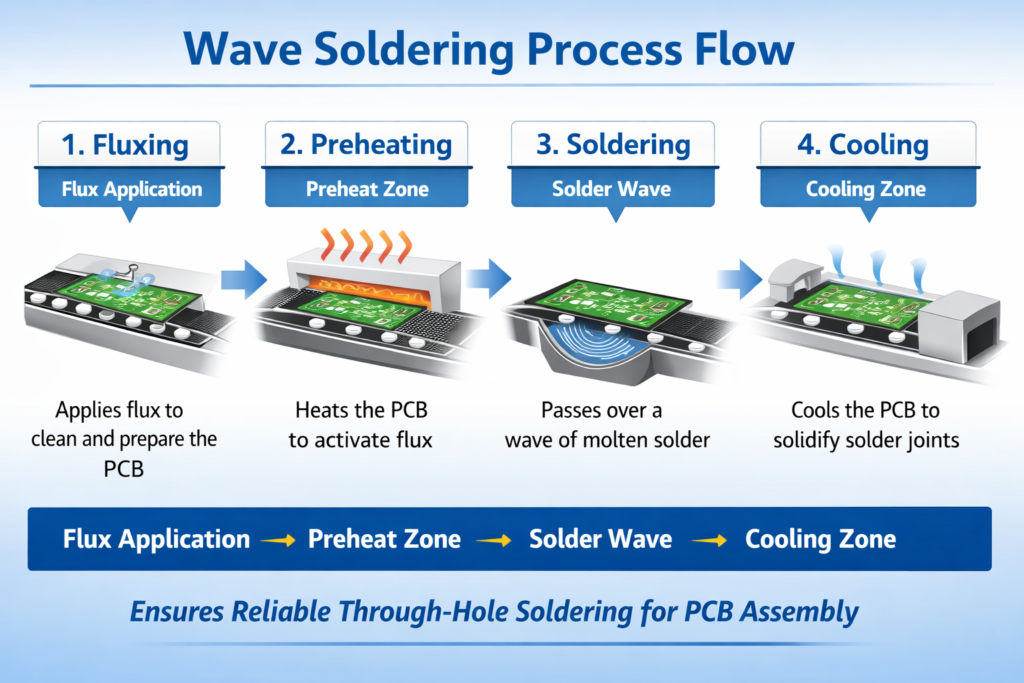
A typical wave soldering process includes:
Fluxing → Preheating → Solder Wave → Cooling
The PCB travels through the machine on a conveyor. Flux is applied to the underside, the assembly is preheated, and the solder side passes over a controlled wave of molten solder.
The process can efficiently solder many through-hole joints during continuous production.
What Is Included in a Wave Soldering Machine?
Understanding machine structure helps explain why prices vary.
A typical machine can include:
- PCB conveyor
- Conveyor width adjustment
- Fluxing system
- Preheating zones
- Solder pot
- Solder pump
- Wave nozzles
- Cooling system
- Exhaust interfaces
- Control system
- Recipe management
- Safety systems
Higher-specification machines may add more advanced control, automation, process monitoring, or nitrogen-related features.
Why Is There No Standard Wave Soldering Machine Price?
Two machines described simply as “wave soldering machines” can have very different configurations.
For example, one factory may need a compact machine for:
- Small PCBs
- Moderate throughput
- Basic THT products
Another may require equipment for:
- Large PCBs
- Heavy assemblies
- High thermal mass
- Higher throughput
- Longer preheating
- Advanced process control
- Automated line integration
Their equipment requirements — and therefore their costs — can be very different.
The correct question is not simply:
“What is the cheapest wave soldering machine?”
A better question is:
“What machine configuration is required to process my products reliably at my target capacity?”
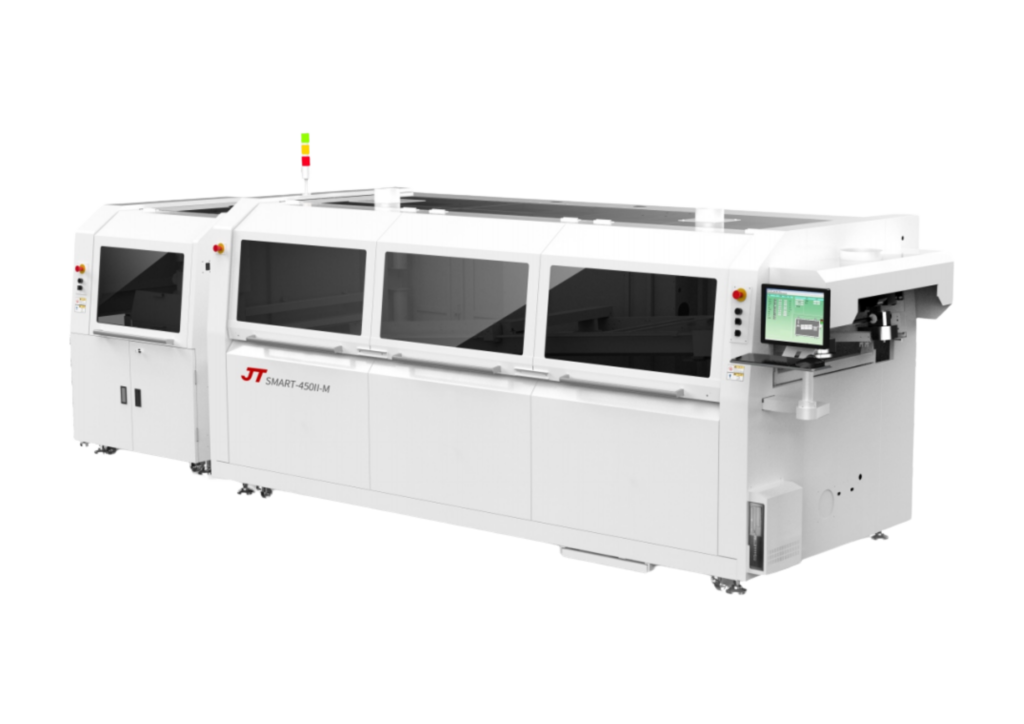
Machine Size Affects Wave Soldering Machine Cost
One of the most basic cost factors is machine size.
Larger machines may require:
- Wider conveyors
- Larger chassis
- Longer heating sections
- Larger solder pots
- More powerful heating
- Larger exhaust systems
If your factory produces relatively small PCBs, purchasing a machine designed for significantly larger products may add unnecessary investment and floor-space requirements.
Always define the actual PCB size range before choosing equipment.
PCB Width and Conveyor Configuration
The machine conveyor must accommodate the maximum PCB or pallet width.
Important parameters include:
- Minimum PCB width
- Maximum PCB width
- PCB thickness
- PCB weight
- Pallet dimensions
- Conveyor height
- Conveyor direction
Wider conveyor capability can affect machine dimensions and cost.
If pallets will be used, the pallet dimensions — not only the bare PCB dimensions — should be included in the equipment specification.
Preheating Configuration
Preheating is a major part of wave soldering.
Machines may use different:
- Preheat lengths
- Number of zones
- Heating technologies
- Temperature controls
A longer or more capable preheating section can increase equipment cost, but it may be important for products with:
- Thick PCBs
- Heavy copper
- Large components
- High thermal mass
Purchasing insufficient preheat capacity simply to reduce initial cost may create process limitations later.
Solder Pot Size
The solder pot contains the molten solder alloy.
Its size influences:
- Initial solder quantity
- Heating requirements
- Machine size
- Maintenance
- Operating cost
A larger solder pot is not automatically better.
It should be appropriate for:
- PCB width
- Wave configuration
- Required throughput
- Production requirements
Remember that the solder alloy required to initially fill the pot is also part of the startup investment.
Wave Configuration
Wave soldering machines can use different wave configurations.
Depending on the process, these may include combinations designed to support soldering across different PCB geometries.
The appropriate configuration depends on:
- Component density
- PCB design
- THT joint layout
- Bottom-side conditions
- Required soldering quality
The objective should be process suitability rather than simply choosing the machine with the largest number of features.
Fluxing System
Flux application affects soldering quality.
A wave soldering machine may include a controlled spray fluxer.
Important considerations include:
- Spray uniformity
- Flux width control
- Flux consumption
- Adjustment range
- Maintenance
- Cleaning
A more sophisticated fluxing system can influence machine cost, but stable flux application can also reduce process variation.
Cooling System
After the solder wave, the PCB enters cooling.
Different machines may offer different cooling configurations.
Cooling can influence:
- Solder solidification
- PCB handling temperature
- Downstream production
- Overall line integration
Factories with continuous high-volume production should include cooling capacity when comparing machine configurations.
Nitrogen Capability
Some wave soldering systems can be configured for nitrogen-assisted processes.
This may affect both:
- Initial equipment investment
- Ongoing operating cost
- Nitrogen can also require additional factory infrastructure.
However, it should not automatically be considered mandatory for every wave soldering application.
The requirement should be evaluated according to:
- PCB
- Solder alloy
- Flux
- Process objective
- Machine configuration
- Quality requirements
Automation Level
Automation is another major cost factor.
A basic standalone system may rely on more manual loading and unloading.
A more automated wave soldering line may include:
- Automatic PCB loading
- Conveyor integration
- Automatic width adjustment
- Recipe management
- Barcode identification
- Production data collection
- Automatic unloading
The correct automation level depends on production volume and labor requirements.
Do not pay for automation that does not solve a real production bottleneck.
Control and Process Monitoring
Modern wave soldering machines may provide different levels of:
- Temperature control
- Conveyor control
- Recipe storage
- Alarm management
- Process monitoring
- Data recording
For factories producing many product models, recipe management can help standardize changeovers.
For products requiring traceability, additional data functions may also be valuable.
These capabilities can affect equipment cost.
Brand and Equipment Platform
Machine brand can influence purchase price because different manufacturers offer different:
- Machine designs
- Component quality
- Control systems
- Process capabilities
- Service networks
- Spare parts support
However, a higher purchase price does not automatically mean that a machine is the best fit for every factory.
Evaluate the machine according to:
Product Compatibility + Capacity + Process Stability + Serviceability + Total Cost of Ownership
New vs Pre-Owned Wave Soldering Machine
One important purchasing decision is whether to buy new or pre-owned equipment.
New Wave Soldering Machine
Potential advantages include:
- New equipment condition
- Current control system
- Warranty options
- Easier equipment standardization
- Potentially longer remaining service life
- The initial investment is generally higher.
- Pre-Owned Wave Soldering Machine
- A suitable pre-owned machine may provide:
- Lower initial investment
- Faster expansion where equipment is available
- Access to established machine platforms
However, machine condition must be carefully evaluated.
What Should You Check on a Pre-Owned Wave Soldering Machine?
Before purchasing, inspect:
- Conveyor system
- Conveyor rails
- Width adjustment
- Fluxing system
- Spray nozzle
- Preheaters
- Solder pot
- Solder pump
- Wave nozzles
- Heating elements
- Cooling system
- Control computer
- Sensors
- Electrical components
- Exhaust interfaces
- Safety systems
- Also review:
- Machine age
- Maintenance history
- Previous production environment
- Software availability
- Spare parts availability
- Technical support
A low purchase price can become expensive if the machine requires major repair immediately after installation.
Wave Soldering Machine Price vs Total Cost of Ownership
Purchase price is only one part of the investment.
A more useful calculation is:
Total Cost of Ownership = Equipment + Installation + Utilities + Tooling + Initial Materials + Spare Parts + Maintenance + Labor + Energy + Downtime + Process Losses
The exact cost structure varies between factories.
Additional Costs to Consider
When budgeting for a wave soldering machine, manufacturers should consider more than the machine quotation.
Potential additional costs include:
- Shipping
- Import-related costs where applicable
- Installation
- Factory electrical work
- Compressed air
- Exhaust installation
- Nitrogen infrastructure if required
- Initial solder alloy
- Flux
- Pallets
- Fixtures
- Spare parts
- Training
- Preventive maintenance
These costs can materially affect the complete project budget.
Solder Alloy Is an Important Startup Cost
The solder pot must be filled before production.
Depending on:
- Solder pot size
- Alloy type
- Local material price
the initial solder fill can represent a meaningful startup cost.
This is especially important when comparing machines with different pot capacities.
A larger solder pot may require more initial alloy and more energy to maintain operating temperature.
Wave Soldering Pallet Cost
Some PCB designs may require pallets.
Pallets can be used for:
- PCB support
- Shielding selected areas
- Protecting bottom-side SMT components
- Controlling solder exposure
However, pallets introduce additional:
- Tooling cost
- Design work
- Cleaning
- Storage
- Maintenance
- Thermal mass
- Not every PCB requires a pallet.
PCB design should be reviewed before adding pallet cost to the project.
Exhaust System Cost
Wave soldering processes require appropriate handling of process fumes.
Depending on the factory and machine, additional investment may be required for:
- Exhaust ducting
- Fume extraction
- Ventilation
- Facility modifications
These costs should be considered before machine installation rather than after equipment arrives.
Energy Consumption
Wave soldering machines use energy for:
- Solder pot heating
- Preheating
- Conveyor
- Cooling
- Control systems
Operating cost therefore depends partly on:
- Machine size
- Heating capacity
- Production schedule
- Standby strategy
- Local energy price
For long-term production, energy efficiency can be more important than a small difference in initial machine price.
Maintenance Costs
Wave soldering equipment requires regular maintenance.
Typical maintenance areas include:
- Solder pot
- Pump
- Wave nozzle
- Flux spray system
- Conveyor
- Preheaters
- Cooling system
- Sensors
- Exhaust
Maintenance cost depends on:
- Machine design
- Production hours
- Flux
- Solder alloy
- Cleaning frequency
- Spare parts
- Technician capability
Maintenance accessibility should therefore be evaluated during machine selection.
Spare Parts Cost
Critical spare parts may include:
- Heaters
- Pumps
- Motors
- Sensors
- Spray nozzles
- Conveyor components
- Electrical components
A machine with a low purchase price but poor spare-parts availability can create expensive downtime.
Ask the supplier which spare parts should be kept in stock.
Labor Cost
Automation level can affect labor requirements.
For example, an inline machine integrated with conveyors may require less manual PCB handling than a standalone process.
However, wave soldering still requires personnel for tasks such as:
- Process monitoring
- Flux replenishment
- Solder management
- Maintenance
- Product changeover
- Inspection
Labor savings should be calculated according to the complete production process.
Defect and Rework Costs
A low-cost machine that cannot maintain a stable process may increase the cost of:
- Rework
- Scrap
- Inspection
- Production interruption
- Troubleshooting
Common wave soldering defects include:
- Solder bridges
- Insufficient solder
- Poor wetting
- Incomplete hole fill
- Icicles
- Solder balls
- Excessive solder
Machine capability matters, but defects also depend on PCB design, flux, preheat, solderability, process settings, component condition, and maintenance.
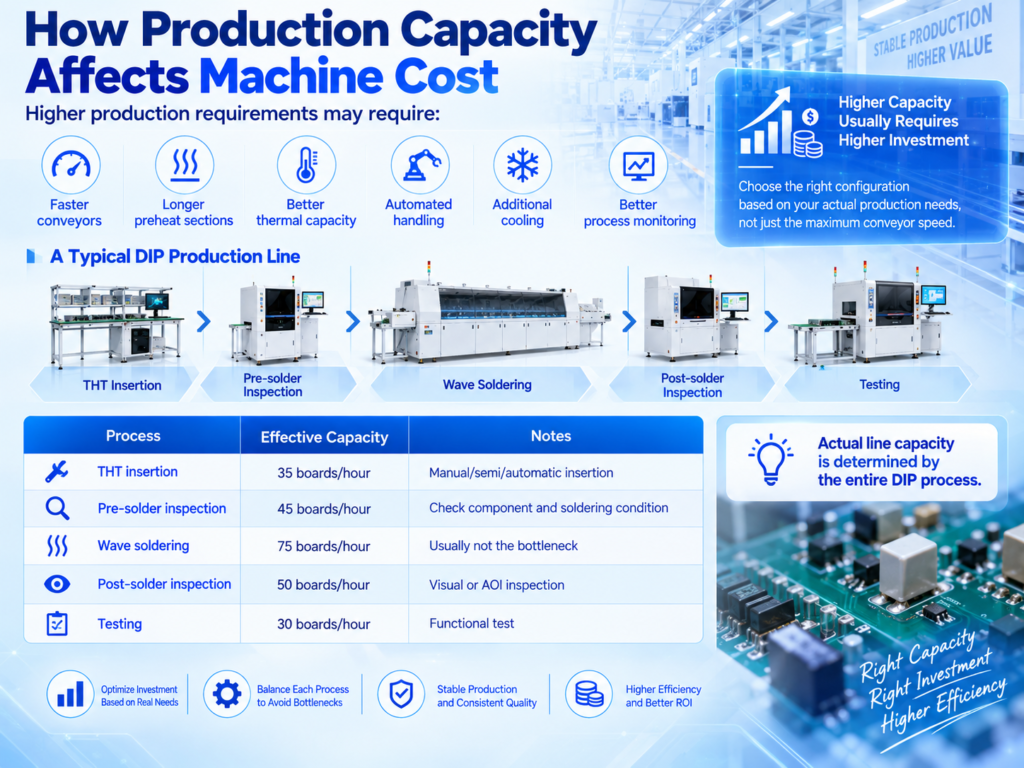
How Production Capacity Affects Machine Cost
Higher production requirements may require:
- Faster conveyors
- Longer preheat sections
- Better thermal capacity
- Automated handling
- Additional cooling
- Better process monitoring
However, manufacturers should avoid purchasing based only on maximum conveyor speed.
Actual line capacity is determined by the entire DIP process.
For example:
Even with a wave soldering machine capable of 75 boards per hour, finished output may remain around 30 boards per hour because testing is the bottleneck.
Paying significantly more for an even faster wave soldering machine would not necessarily increase factory output.
Entry-Level vs Higher-Specification Wave Soldering Machines
Instead of relying on universal price ranges, machines can be considered by configuration level.
The actual quotation depends on machine specifications, condition, market, service scope, and delivery requirements.

Why We Do Not Recommend Using One Universal Price Range
Online searches may show very different wave soldering machine prices.
Those prices may represent:
- Different machine sizes
- Different heating configurations
- Different brands
- Different countries
- New equipment
- Used equipment
- Incomplete systems
- Different service packages
Some quotations may exclude:
- Shipping
- Installation
- Initial solder
- Exhaust
- Training
- Spare parts
- Tooling
Therefore, a low advertised price does not necessarily represent the final project cost.
How to Reduce Wave Soldering Machine Investment
Manufacturers can control investment without simply choosing the cheapest equipment.
Define the Real PCB Size Range
Do not purchase unnecessary conveyor width.
Match Preheat Capacity to the Product
Avoid both insufficient and excessive configuration.
Calculate Real Production Demand
Do not pay for throughput that upstream or downstream processes cannot use.
Evaluate Pre-Owned Equipment
Suitable pre-owned machines can reduce initial investment when condition and support are properly evaluated.
Use Existing Equipment Where Practical
If conveyors, inspection stations, or handling equipment are already available, they may be integrated into the new line where compatible.
Optimize the Whole DIP Line
Removing the real bottleneck may deliver better ROI than purchasing a higher-specification soldering machine.
When Should You Upgrade Your Existing Wave Soldering Machine?
An upgrade may be worth evaluating when:
- Current capacity cannot meet production demand
- PCB size exceeds machine capability
- Preheating is insufficient for new products
- Process stability has become difficult to maintain
- Maintenance downtime is increasing
- Spare parts are difficult to obtain
- New product requirements cannot be supported
- Factory automation requirements have changed
Before replacing the machine, determine whether the problem actually comes from the machine or from process conditions such as flux, PCB design, maintenance, solderability, or line balancing.
Wave Soldering Machine vs Selective Soldering Machine Cost
Price should not be the only factor when choosing between these processes.
Wave soldering is often attractive when:
- Many THT joints need soldering
- PCB design supports wave contact
- Continuous throughput is important
Selective soldering may be more suitable when:
- Only localized THT joints require soldering
- Bottom-side SMT limits wave exposure
- Product mix is high
- Precise solder targeting is required
A more expensive machine can still produce a lower total cost per acceptable PCBA if it better matches the product.
The process should be selected before comparing machine quotations.
How Does Wave Soldering Machine Cost Affect a Complete DIP Line Budget?
The wave soldering machine is only one part of a DIP production line.
A complete line may also require:
PCB Loader → Component Preparation → THT Insertion → Inspection Conveyor → Wave Soldering → Cooling → Inspection → Testing → PCB Unloader
Additional investment can include:
- Lead forming equipment
- Workstations
- Material racks
- Conveyors
- Testing equipment
- ESD systems
- Exhaust
- Rework stations
Factories planning a new project should budget for the complete production system rather than the soldering machine alone.
New Factory vs Existing Factory Expansion
The project cost can differ significantly depending on factory condition.
Existing Factory
An existing facility may already have:
- Electrical infrastructure
- Exhaust
- Conveyors
- Inspection
- Testing
- ESD systems
This may reduce additional investment.
New Factory
A new PCBA factory may need to plan:
- Production layout
- Utilities
- Exhaust
- Material flow
- ESD
- Inspection
- Testing
- Spare parts
- Operator training
For new factories, turnkey line planning can help identify these requirements before equipment installation.
What Information Is Needed for an Accurate Wave Soldering Machine Quotation?
To receive a useful quotation, provide the supplier with:
- PCB dimensions
- PCB thickness
- Maximum PCB or pallet width
- PCB weight
- BOM
- THT component information
- PCB photos
- Bottom-side component layout
- Target production capacity
- Product mix
- Number of shifts
- Solder alloy
- Flux type if already defined
- Preheat requirements if known
- Nitrogen requirements if applicable
- Existing equipment
- Conveyor direction
- Factory electrical conditions
- Factory layout
- Exhaust conditions
- Automation target
- New or pre-owned equipment preference
- Required technical support
- Investment budget
The more complete the information, the more accurately the supplier can recommend a suitable configuration.
Wave Soldering and PCBA Production Solutions from Fuliu Electronics
Established in 2014, Fuliu Electronics is dedicated to providing customers with high-quality PCBA intelligent manufacturing solutions and services.
With extensive experience in the SMT industry, we specialize in dependable equipment, professional technical support, and complete SMT and PCBA production line solutions.
Our product portfolio includes SMT pick and place machines from Fuji, Panasonic, ASM, Yamaha, JUKI, and Hanwha, together with ERSA reflow ovens from Germany, MagicRay SPI/AOI inspection systems, automatic solder paste printers, supporting PCBA equipment, pre-owned SMT equipment, SMT spare parts, machine leasing, and maintenance services.
For manufacturers evaluating wave soldering equipment or a complete DIP/THT production line, Fuliu Electronics can help review:
- PCB dimensions
- BOM
- THT component structure
- Target capacity
- Product mix
- Wave vs selective soldering
- Preheating requirements
- Existing production equipment
- Factory layout
- Inspection and testing
- Automation requirements
- New vs pre-owned equipment
- Investment budget
Rather than comparing machine price alone, manufacturers can evaluate the complete production requirement and total project investment.
As part of our global growth strategy, Fuliu Electronics is actively expanding into international markets, with key focus areas including India, Vietnam, the Philippines, Indonesia, the Middle East, South Africa, and Europe.
Frequently Asked Questions
There is no universal fixed price. Cost depends on machine size, conveyor width, preheating, solder pot, fluxing, cooling, automation, brand, condition, and service scope.
Machines may differ significantly in size, heating capacity, production capability, controls, automation, brand, and whether they are new or pre-owned.
- Is a pre-owned wave soldering machine cheaper?
Depending on the quotation, additional costs may include shipping, installation, exhaust, initial solder alloy, flux, pallets, utilities, training, and spare parts.
It can increase both initial equipment cost and startup material requirements because more solder alloy is needed to fill the pot.
Not for every process. The need for nitrogen depends on the PCB, flux, alloy, equipment configuration, and process requirements.