
As global demand for electronic products continues to grow, manufacturers are expanding PCB assembly capacity to serve industries such as automotive electronics, telecommunications, industrial automation, consumer electronics, medical devices, and energy storage systems.
One of the most important decisions when establishing or expanding a PCB assembly factory is whether to buy or rent an SMT production line.
Both approaches offer significant advantages, but the right choice depends on your company’s financial position, production volume, long-term strategy, and growth plans.
For some manufacturers, purchasing equipment provides greater long-term value and full ownership. For others, renting an SMT production line offers greater financial flexibility, lower upfront investment, and faster deployment.
Buying vs Renting an SMT Production Line: Which Option Is Right for Your Business?
In this guide, we’ll compare buying vs renting an SMT production line, helping manufacturers understand the financial, operational, and strategic differences before making an investment.
What Is Included in an SMT Production Line?
Whether you buy or rent, a complete SMT production line typically includes:
- Automatic PCB Loader
- Automatic Solder Paste Printer
- SPI (Solder Paste Inspection)
- High-Speed Pick and Place Machine
- Precision Chip Mounter
- Multi-Zone Reflow Oven
- AOI Inspection Machine
- X-Ray Inspection System (optional)
- ICT/FCT Testing Equipment
- PCB Cleaning Machine (optional)
- PCB Unloader
- Conveyor Systems
- MES Software
- Air Compressor
- Nitrogen Generator (optional)
The overall investment depends on equipment configuration, production capacity, and automation level.
Buying an SMT Production Line
Buying means purchasing the equipment outright and taking full ownership.
Manufacturers are responsible for:
- Equipment purchase
- Installation
- Maintenance
- Spare parts
- Software upgrades
- Equipment depreciation
- Future replacement
Ownership provides complete control over equipment usage and long-term planning.
Advantages of Buying
Purchasing equipment offers several long-term benefits.
Full Ownership
The equipment becomes a long-term business asset that can continue generating value throughout its service life.
Lower Long-Term Cost
If machines are heavily utilized over many years, purchasing often results in a lower total cost than long-term rental.
Greater Customization
Owners can configure production lines according to specific manufacturing requirements without contractual limitations.
Higher Asset Value
Equipment ownership can strengthen the company’s balance sheet and may support future financing or expansion.
Disadvantages of Buying
Buying also involves several challenges.
These include:
- High upfront investment
- Reduced working capital
- Greater financial risk
- Equipment depreciation
- Technology obsolescence
- Higher maintenance responsibility
Manufacturers must carefully evaluate whether sufficient production volume justifies the investment.
Renting an SMT Production Line
Renting allows manufacturers to use equipment through scheduled lease or rental payments.
Depending on the supplier, rental solutions may include:
- Equipment installation
- Commissioning
- Technical training
- Preventive maintenance
- Spare parts support
- Software updates
- Technical assistance
This approach significantly reduces initial capital requirements.
Advantages of Renting
Rental solutions have become increasingly popular in modern electronics manufacturing.
Key benefits include:
Lower Initial Investment
Manufacturers can begin production without making a substantial capital expenditure.
Better Cash Flow
Working capital remains available for:
- Inventory
- Electronic components
- Marketing
- Hiring
- Product development
- Factory expansion
- Faster Production Startup
Rental solutions allow companies to launch production quickly without waiting to accumulate sufficient capital.
Easier Equipment Upgrades
Technology evolves rapidly.
Rental agreements often provide opportunities to upgrade machines as production requirements change.
Lower Financial Risk
Renting reduces exposure to equipment depreciation and uncertain market conditions.
Disadvantages of Renting
Rental solutions also have limitations.
Potential considerations include:
- Ongoing rental payments
- Limited ownership
- Contract conditions
- Long-term cost may exceed purchase price
- Supplier dependency
Understanding contract details is essential before selecting a rental solution.
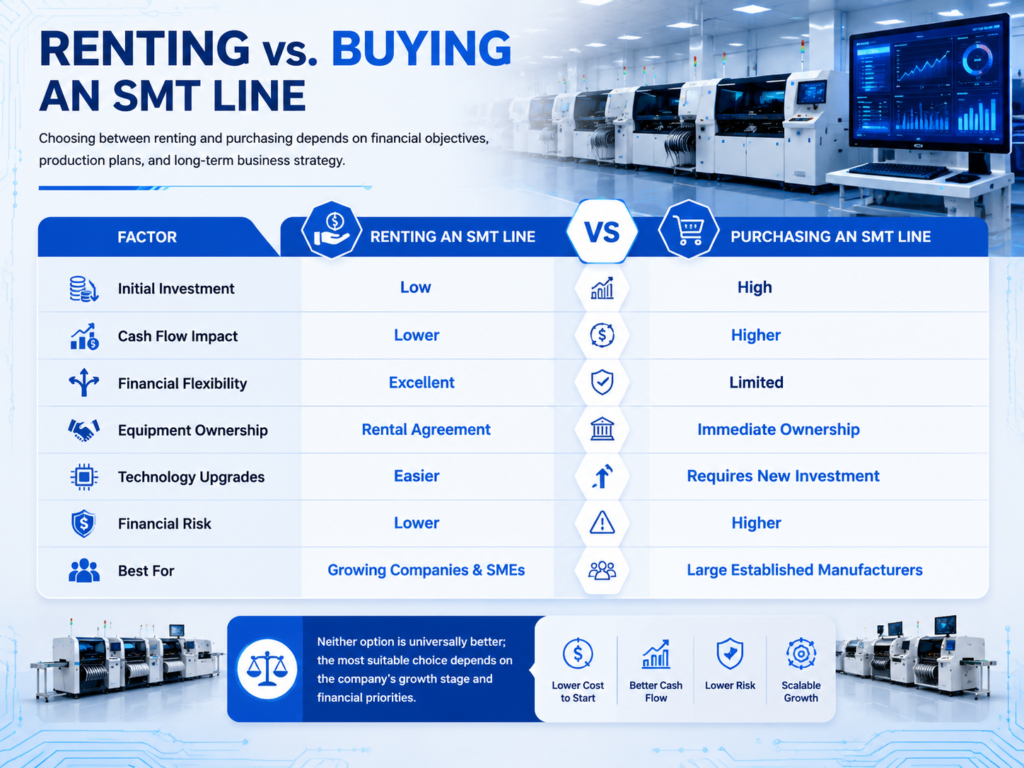
Buying vs Renting: Side-by-Side Comparison
Each approach offers unique advantages depending on business objectives.
Which Option Is Best for Startups?
For new PCB assembly businesses, renting often provides greater flexibility.
Benefits include:
- Lower startup costs
- Faster market entry
- Better cash flow
- Lower investment risk
- Access to advanced equipment
This allows startups to focus resources on customer acquisition and production growth.
Which Option Is Best for Large Manufacturers?
Established manufacturers with stable production volumes often benefit from purchasing equipment.
Ownership may provide:
- Lower long-term operating costs
- Better return on investment
- Asset appreciation
- Greater production control
- Customized factory configurations
For high-utilization production environments, purchasing is frequently the preferred strategy.
Impact on Cash Flow
Cash flow is often the deciding factor.
Buying requires significant capital immediately.
Renting distributes equipment costs over time, allowing businesses to maintain stronger liquidity for daily operations.
For companies experiencing rapid growth, preserving cash flow may be more valuable than owning equipment.
Technology Considerations
SMT equipment continues to evolve rapidly.
New developments include:
- Faster placement speeds
- AI-assisted programming
- 3D SPI
- Advanced AOI
- Smart feeders
- MES integration
- Predictive maintenance
- Industry 4.0 connectivity
Companies expecting frequent technology upgrades may benefit from rental solutions that offer greater flexibility.
Total Cost of Ownership (TCO)
Purchase price alone should not determine investment decisions.
Manufacturers should evaluate the Total Cost of Ownership (TCO), including:
- Equipment purchase
- Installation
- Training
- Maintenance
- Spare parts
- Energy consumption
- Software upgrades
- Downtime
- Equipment depreciation
A lower purchase price does not necessarily result in the lowest long-term operating cost.
Questions to Ask Before Making a Decision
Before buying or renting, manufacturers should consider:
- What is my expected production volume?
- How much working capital do I need?
- Will production requirements grow rapidly?
- How often do I expect technology upgrades?
- Do I have an in-house maintenance team?
- What financing options are available?
- How important is equipment ownership?
- What level of technical support does the supplier provide?
Answering these questions helps align equipment strategy with business goals.
Common Decision-Making Mistakes
Avoid these common mistakes when comparing buying and renting.
Focusing Only on Purchase Price
Evaluate lifecycle costs rather than upfront cost alone.
Ignoring Cash Flow
Healthy cash flow often has greater business value than owning equipment.
Underestimating Maintenance Costs
Purchased equipment requires ongoing maintenance, spare parts, and technical support.
Choosing Equipment Without Future Expansion
Select solutions that can support future production growth.
Overlooking Supplier Support
Reliable technical support is essential regardless of whether equipment is purchased or rented.
Why Choose Fuliu Electronics?
Established in 2014, Fuliu Electronics is dedicated to providing customers with high-quality PCBA intelligent manufacturing solutions and comprehensive technical services.
With extensive experience in the SMT industry, Fuliu Electronics supplies complete SMT production line solutions featuring internationally recognized brands such as Fuji, Panasonic, ASM, Yamaha, JUKI, and Hanwha, together with ERSA reflow ovens, MagicRay SPI/AOI inspection systems, automatic solder paste printers, refurbished SMT equipment, SMT spare parts, equipment rental, equipment leasing, and maintenance services.
Serving customers across India, Vietnam, the Philippines, Indonesia, the Middle East, South Africa, and Europe, Fuliu Electronics helps manufacturers evaluate both purchase and rental options through customized turnkey engineering, factory planning, installation, commissioning, operator training, preventive maintenance, and long-term technical support.
Conclusion
There is no universal answer to the question of buying vs renting an SMT production line. The best solution depends on your company’s financial resources, production strategy, technology roadmap, and long-term business objectives.
Purchasing an SMT line can deliver lower lifecycle costs and full ownership for manufacturers with stable, high-volume production and sufficient capital. Renting, on the other hand, provides lower upfront investment, improved cash flow, faster implementation, and greater flexibility for companies that are expanding rapidly or entering new markets.
By evaluating total cost of ownership, financing options, maintenance responsibilities, and future production needs, manufacturers can make informed decisions that support sustainable growth and long-term competitiveness in the electronics manufacturing industry.
Frequently Asked Questions
It depends on your business goals. Buying is generally better for established manufacturers with stable production, while renting is often ideal for startups, SMEs, and companies seeking greater financial flexibility.
Renting reduces upfront investment, preserves working capital, accelerates production startup, and makes it easier to upgrade equipment as technology evolves.
Buying provides full equipment ownership, lower long-term costs for high-utilization production, greater customization, and the ability to treat equipment as a business asset.
Many turnkey rental solutions include installation, commissioning, operator training, preventive maintenance, spare parts support, and ongoing technical assistance, depending on the supplier.
In addition to purchase price or rental payments, companies should compare total cost of ownership, cash flow impact, maintenance responsibilities, technology upgrade needs, and long-term production plans.
Some suppliers offer lease-to-own or purchase options at the end of the rental agreement. Availability depends on the supplier’s financing and rental programs.