
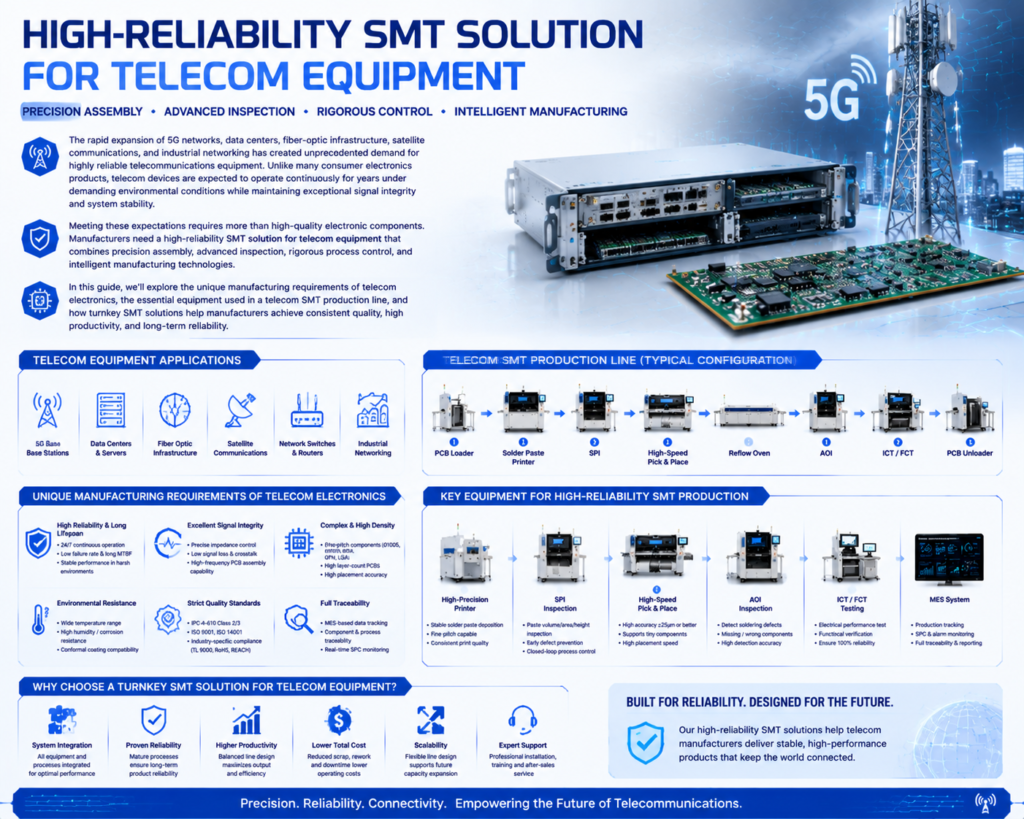
The rapid expansion of 5G networks, data centers, fiber-optic infrastructure, satellite communications, and industrial networking has created unprecedented demand for highly reliable telecommunications equipment. Unlike many consumer electronics products, telecom devices are expected to operate continuously for years under demanding environmental conditions while maintaining exceptional signal integrity and system stability.
Meeting these expectations requires more than high-quality electronic components. Manufacturers need a high-reliability SMT solution for telecom equipment that combines precision assembly, advanced inspection, rigorous process control, and intelligent manufacturing technologies.
In this guide, we’ll explore the unique manufacturing requirements of telecom electronics, the essential equipment used in a telecom SMT production line, and how turnkey SMT solutions help manufacturers achieve consistent quality, high productivity, and long-term reliability.
Why Telecom Equipment Requires High-Reliability SMT Manufacturing
Telecommunications products often operate 24 hours a day, 365 days a year, with minimal tolerance for downtime.
Examples include:
- 5G base stations
- Optical transmission equipment
- Fiber optic communication systems
- Network switches
- Enterprise routers
- Telecom servers
- Microwave communication equipment
- Industrial communication gateways
Failures in these systems can interrupt critical communications, making manufacturing quality a top priority.
Manufacturing Challenges in Telecom PCB Assembly
Compared with standard consumer electronics, telecom PCBs present several manufacturing challenges.
High Component Density
Modern communication boards frequently contain:
- Fine-pitch ICs
- BGA packages
- QFN components
- CSP devices
- High-pin-count processors
These require highly accurate component placement and soldering.
High-Speed Signal Integrity
Communication equipment often processes high-frequency signals.
Poor PCB assembly may introduce:
- Signal loss
- Electromagnetic interference (EMI)
- Crosstalk
- Impedance instability
Maintaining precise assembly tolerances is essential for reliable signal transmission.
Long Product Life Cycles
Telecom equipment typically remains in service for many years.
Manufacturers must ensure:
- Stable solder joints
- Reliable PCB cleanliness
- Long-term component reliability
- Excellent thermal performance
Continuous Operation
Many telecom systems operate continuously without interruption.
High manufacturing quality helps minimize field failures and maintenance costs.
Key Requirements for a Telecom SMT Production Line
A telecom SMT solution must combine precision, consistency, and comprehensive quality control.
Critical requirements include:
- High placement accuracy
- Stable solder paste printing
- Advanced inspection systems
- Reliable thermal management
- Process traceability
- Automated production
- Statistical process control (SPC)
- Low defect rates
Every process must be optimized to support long-term product reliability.
Core Equipment in a Telecom SMT Turnkey Line
A complete telecom SMT production line typically includes the following equipment.
Automatic PCB Loader
Ensures continuous board handling while minimizing manual contact and ESD risks.
Automatic Solder Paste Printer
Accurate solder paste deposition is critical for fine-pitch components commonly used in telecom equipment.
High-precision printers improve solder joint consistency and reduce assembly defects.
SPI (Solder Paste Inspection)
SPI measures solder paste:
- Volume
- Height
- Area
- Alignment
- Shape
Early defect detection prevents costly downstream failures.
High-Speed Pick and Place Machine
Telecom products often require placement of thousands of components per PCB.
Modern placement systems provide:
- High placement accuracy
- High-speed operation
- Intelligent vision alignment
- Support for ultra-small components
Multi-Zone Reflow Oven
Controlled temperature profiles produce reliable solder joints while minimizing thermal stress on sensitive components.
AOI (Automated Optical Inspection)
AOI detects:
- Missing components
- Incorrect polarity
- Component rotation
- Solder bridges
- Tombstoning
- Lifted leads
Automated inspection significantly improves first-pass yield.
X-Ray Inspection
Telecommunications equipment frequently uses BGA and hidden solder joints.
X-ray inspection verifies solder quality where optical inspection cannot.
ICT and Functional Testing
Electrical testing verifies that assembled PCBs perform correctly before shipment.

The Importance of Process Traceability
Modern telecom manufacturers increasingly require complete production traceability.
Typical traceability systems record:
- PCB serial numbers
- Component batch numbers
- Production dates
- Machine programs
- Inspection results
- Temperature profiles
- Operator information
Comprehensive traceability simplifies quality analysis and supports regulatory compliance.
Why Automation Matters in Telecom Manufacturing
Automation plays a vital role in maintaining consistent quality.
Benefits include:
- Higher production efficiency
- Reduced operator variation
- Stable production quality
- Faster product changeovers
- Lower labor costs
- Improved process repeatability
Automated SMT production also supports the increasing complexity of telecom electronics.
Industry 4.0 and Smart Telecom Manufacturing
Many telecom factories now integrate Industry 4.0 technologies into SMT production.
Examples include:
- MES (Manufacturing Execution Systems)
- Real-time equipment monitoring
- SPC analysis
- Predictive maintenance
- Barcode traceability
- AI-assisted process optimization
- Digital production dashboards
These technologies improve visibility while supporting continuous process improvement.
Best Practices for Manufacturing Telecom PCBs
Manufacturers can improve reliability by following several proven practices.
- Use high-quality solder paste.
- Maintain accurate stencil printing.
- Implement SPI and AOI inspection.
- Utilize X-ray inspection for hidden solder joints.
- Optimize reflow temperature profiles.
- Maintain clean PCB assemblies.
- Monitor production KPIs continuously.
- Perform preventive equipment maintenance.
- Implement complete product traceability.
- Train operators regularly.
Consistently applying these practices helps reduce defects and improve long-term field reliability.
Choosing the Right SMT Partner for Telecom Projects
When selecting an SMT solution provider, manufacturers should evaluate more than equipment specifications.
Important considerations include:
- Turnkey engineering capabilities
- Experience with telecom products
- Global technical support
- Equipment integration expertise
- Factory layout planning
- Process optimization
- Spare parts availability
- Long-term after-sales service
An experienced partner can significantly reduce project risk while improving production efficiency.
Why Choose Fuliu Electronics?
Established in 2014, Fuliu Electronics is dedicated to providing customers with high-quality PCBA intelligent manufacturing solutions and comprehensive technical services.
With extensive experience in the SMT industry, Fuliu Electronics supplies complete turnkey SMT production line solutions featuring internationally recognized brands such as Fuji, Panasonic, ASM, Yamaha, JUKI, and Hanwha, together with ERSA reflow ovens, MagicRay SPI/AOI inspection systems, automatic solder paste printers, refurbished SMT equipment, SMT spare parts, equipment leasing, and maintenance services.
Serving customers across India, Vietnam, the Philippines, Indonesia, the Middle East, South Africa, and Europe, Fuliu Electronics helps telecom equipment manufacturers implement reliable SMT production through customized factory planning, intelligent production line integration, advanced inspection technologies, installation, commissioning, operator training, and comprehensive after-sales support.
Conclusion
Telecommunications equipment demands exceptional manufacturing quality because even minor assembly defects can compromise network stability, signal performance, and long-term reliability. A high-reliability SMT solution for telecom equipment combines precision equipment, intelligent inspection, automated production, and comprehensive process control to meet these demanding standards.
By integrating SPI, AOI, X-ray inspection, functional testing, traceability, and Industry 4.0 technologies into a turnkey SMT production line, manufacturers can consistently produce high-performance telecom products while improving efficiency and reducing production risk. Partnering with an experienced SMT solution provider ensures that every stage—from factory planning to ongoing technical support—contributes to reliable, scalable, and future-ready electronics manufacturing.
Frequently Asked Questions
Telecommunications products often operate continuously in mission-critical environments. High-reliability SMT manufacturing minimizes defects, improves signal integrity, and extends product lifespan.
A typical line includes a PCB loader, solder paste printer, SPI system, pick and place machines, reflow oven, AOI system, X-ray inspection, ICT/FCT testing equipment, conveyors, and PCB unloader.
Many telecom boards use BGA and other components with hidden solder joints. X-ray inspection verifies solder quality that cannot be inspected optically.
Automation increases placement accuracy, reduces human error, improves process consistency, enhances productivity, and supports high-volume manufacturing.
Traceability records production data for every PCB, enabling manufacturers to identify quality issues quickly, support compliance requirements, and improve process control.
A turnkey solution integrates equipment selection, factory planning, installation, commissioning, training, and ongoing technical support, helping manufacturers reduce implementation risk while achieving stable, high-quality production.