
The global electronics industry continues to grow rapidly, driven by demand for consumer electronics, automotive systems, industrial automation, medical devices, and communication equipment. As a result, more manufacturers are investing in PCB assembly factories to increase production capacity and improve product quality.
Whether you’re launching a new facility or expanding an existing production line, understanding the PCB assembly equipment required is essential for building an efficient, reliable, and scalable manufacturing operation.
This beginner-friendly guide introduces the core equipment used in a modern PCB assembly factory, explains the function of each machine, and provides practical advice for selecting the right solution for your production needs.
What Is a PCB Assembly Factory?
A PCB assembly factory is a manufacturing facility where electronic components are mounted, soldered, inspected, and tested on printed circuit boards (PCBs) to create finished electronic assemblies (PCBAs).
Most modern factories rely on Surface Mount Technology (SMT) because it offers:
- Higher production efficiency
- Greater placement accuracy
- Lower labor costs
- Improved product consistency
- Support for miniaturized electronic devices
A complete PCB assembly factory typically integrates automated equipment into one continuous SMT production line.
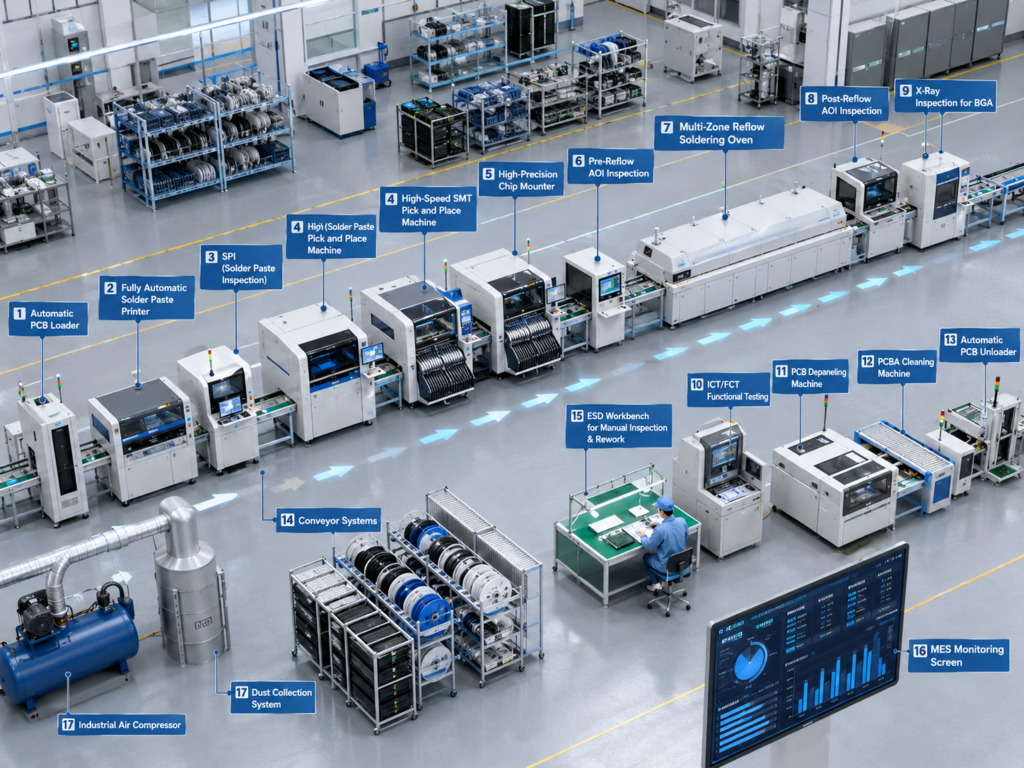
Essential Equipment in a PCB Assembly Factory
Although production requirements vary, most factories require the following equipment.
PCB Loader
The PCB loader automatically feeds bare circuit boards into the production line.
Its advantages include:
- Stable production flow
- Reduced manual handling
- Improved automation
- Higher production efficiency
The loader is typically the starting point of every SMT production line.
The solder paste printer applies solder paste accurately to PCB pads through a stainless-steel stencil.
This process is one of the most critical stages in PCB assembly because improper solder paste deposition can cause defects such as:
- Solder bridges
- Insufficient solder
- Component misalignment
- Poor solder joints
High-precision printing significantly improves overall product quality.
After printing, many manufacturers use an SPI system to inspect solder paste quality before components are placed.
SPI measures:
- Paste height
- Paste volume
- Paste area
- Alignment accuracy
By detecting printing defects early, SPI reduces rework and improves first-pass yield.
The SMT pick and place machine is the centerpiece of every PCB assembly factory.
Using high-speed vision systems, precision motion control, and intelligent software, the machine automatically places thousands of electronic components onto PCBs with exceptional speed and accuracy.
Leading brands include:
Fuji
Panasonic
ASM
Yamaha
JUKI
Hanwha
The choice of machine depends on production volume, component types, and product complexity.
After component placement, the PCB passes through a reflow oven, where controlled heating melts the solder paste and permanently bonds components to the board.
Modern multi-zone reflow ovens offer:
- Precise temperature profiles
- Stable heat distribution
- Energy efficiency
- Reliable solder joint quality
Reflow soldering is one of the most important processes in PCBA manufacturing.
Following soldering, an AOI system automatically checks each assembled PCB for manufacturing defects.
Common defects detected include:
- Missing components
- Incorrect polarity
- Component rotation
- Solder bridges
- Insufficient solder
- Lifted leads
- Wrong components
AOI greatly improves quality control while reducing reliance on manual inspection.
Conveyor Systems
PCB conveyors transport boards automatically between machines.
Their functions include:
- Synchronizing production
- Buffering boards
- Reducing manual handling
- Improving workflow efficiency
Although often overlooked, conveyors play an essential role in maintaining continuous production.
PCB Unloader
The PCB unloader removes completed boards from the production line and prepares them for functional testing, packaging, or final assembly.
Automatic unloading helps minimize operator workload while maintaining production consistency.
Optional Equipment for Advanced PCB Assembly Factories
Depending on production requirements, manufacturers may also install additional equipment.
Automatic PCB Cleaning Machine
Removes flux residues and contaminants after soldering, especially for high-reliability industries such as aerospace and medical electronics.
X-ray Inspection System
Used for inspecting hidden solder joints, particularly:
- BGA packages
- QFN components
- Multi-layer assemblies
Selective Soldering Machine
Suitable for mixed-technology PCBs combining SMT and through-hole components.
Wave Soldering Machine
Widely used for through-hole assembly and certain industrial electronic products.
Functional Testing Equipment
Ensures completed PCBAs operate correctly before shipment by verifying electrical performance and functionality.
Typical PCB Assembly Process
A standard PCB assembly production line generally follows this workflow:
- PCB Loading
- Solder Paste Printing
- SPI Inspection
- Component Placement
- Reflow Soldering
- AOI Inspection
- Functional Testing
- PCB Unloading
- Packaging
Each stage contributes to overall manufacturing quality and production efficiency.
How to Choose PCB Assembly Equipment
Selecting the right PCB assembly equipment requires evaluating more than machine specifications.
Consider the following factors.
Production Capacity
Estimate your daily and monthly output to determine the appropriate equipment speed and automation level.
Product Complexity
PCB size, component density, package types, and assembly requirements influence equipment selection.
Equipment Compatibility
Machines should communicate efficiently and integrate smoothly into one production line.
Maintenance and Spare Parts
Choose equipment supported by reliable spare parts availability and professional technical service.
Future Expansion
Select scalable equipment capable of supporting future business growth without major production line modifications.
Why Work with an Experienced SMT Equipment Supplier?
A reliable SMT equipment supplier offers much more than machinery.
Professional suppliers provide:
- Production line planning
- Equipment configuration
- Factory layout recommendations
- Installation and commissioning
- Operator training
- Preventive maintenance
- Spare parts support
- Technical consulting
These services help manufacturers maximize equipment utilization while reducing operational risks.
Why Choose Fuliu Electronics?
Established in 2014, Fuliu Electronics is dedicated to providing customers with high-quality PCBA intelligent manufacturing solutions and comprehensive technical services.
With extensive experience in the SMT industry, Fuliu Electronics supplies complete SMT production line solutions featuring internationally recognized brands including Fuji, Panasonic, ASM, Yamaha, JUKI, and Hanwha, together with ERSA reflow ovens from Germany, MagicRay SPI/AOI inspection systems, automatic solder paste printers, carefully inspected pre-owned SMT equipment, SMT spare parts, machine leasing, and maintenance services.
Serving customers across India, Vietnam, the Philippines, Indonesia, the Middle East, South Africa, and Europe, the company helps electronics manufacturers establish efficient, reliable, and scalable PCB assembly factories that meet today’s production requirements while preparing for future growth.
Conclusion
Building a successful PCB assembly factory requires more than purchasing individual machines. Every piece of equipment—from the PCB loader to the AOI inspection system—plays a critical role in ensuring efficient production, consistent quality, and reliable finished products.
When planning a new factory or upgrading an existing SMT production line, manufacturers should focus on selecting equipment that matches their production capacity, product complexity, and long-term business objectives.
Partnering with an experienced equipment supplier can simplify the entire process, from production line planning to installation, training, and ongoing technical support.
Frequently Asked Questions
A typical PCB assembly factory includes a PCB loader, solder paste printer, SPI system, SMT pick and place machine, reflow oven, AOI inspection system, conveyors, PCB unloader, and functional testing equipment.
The SMT pick and place machine is generally considered the core machine because it determines component placement speed, accuracy, and overall production efficiency.
AOI automatically detects assembly defects such as missing components, polarity errors, solder bridges, and incorrect placement, improving product quality and reducing rework.
SPI inspects solder paste quality immediately after printing, while AOI inspects completed PCB assemblies after component placement and reflow soldering.
Yes. Many manufacturers begin with a compact SMT production line and expand equipment capacity as production demand grows.
Evaluate production volume, product complexity, automation requirements, available budget, maintenance support, and long-term expansion plans before making equipment investments.