
What Is an SMT Production Line?
As electronic products become smaller, faster, and more intelligent, manufacturers need production systems capable of assembling thousands of miniature components with exceptional speed and precision. This is where the SMT (Surface Mount Technology) production line plays a vital role.
From smartphones and automotive ECUs to medical devices and industrial controllers, nearly every modern electronic product relies on an SMT production line for efficient PCB assembly.
Whether you are planning a new electronics factory, expanding your manufacturing capacity, or simply learning about PCB assembly, understanding how an SMT production line works is the first step toward making informed investment decisions.
In this guide, you’ll learn:
- What an SMT production line is
- How the SMT assembly process works
- The equipment required for a complete SMT line
- Different SMT line configurations
- How to choose the right solution for your business
- Typical investment costs and industry applications
What Is SMT?
Surface Mount Technology (SMT) is an automated manufacturing process in which electronic components are mounted directly onto the surface of a printed circuit board (PCB), rather than inserted through holes.
Compared with traditional through-hole technology (THT), SMT offers:
- Higher production speed
- Greater component density
- Improved assembly accuracy
- Lower manufacturing costs
- Better suitability for automated production
Today, more than 90% of electronic assemblies worldwide are produced using SMT technology.
What Is an SMT Production Line?
An SMT production line is a series of interconnected machines designed to assemble electronic components onto PCBs automatically.
Each machine performs a specific task, and together they create a seamless manufacturing workflow—from loading a bare PCB to producing a fully assembled board ready for testing.
A standard SMT line focuses on achieving:
- High placement accuracy
- Consistent product quality
- Fast production throughput
- Reduced labor costs
- High first-pass yield
- Full production traceability
Complete SMT Production Process
A typical SMT production line follows this sequence:
Each stage is designed to ensure that every PCB meets strict quality and reliability standards before moving to the next step.
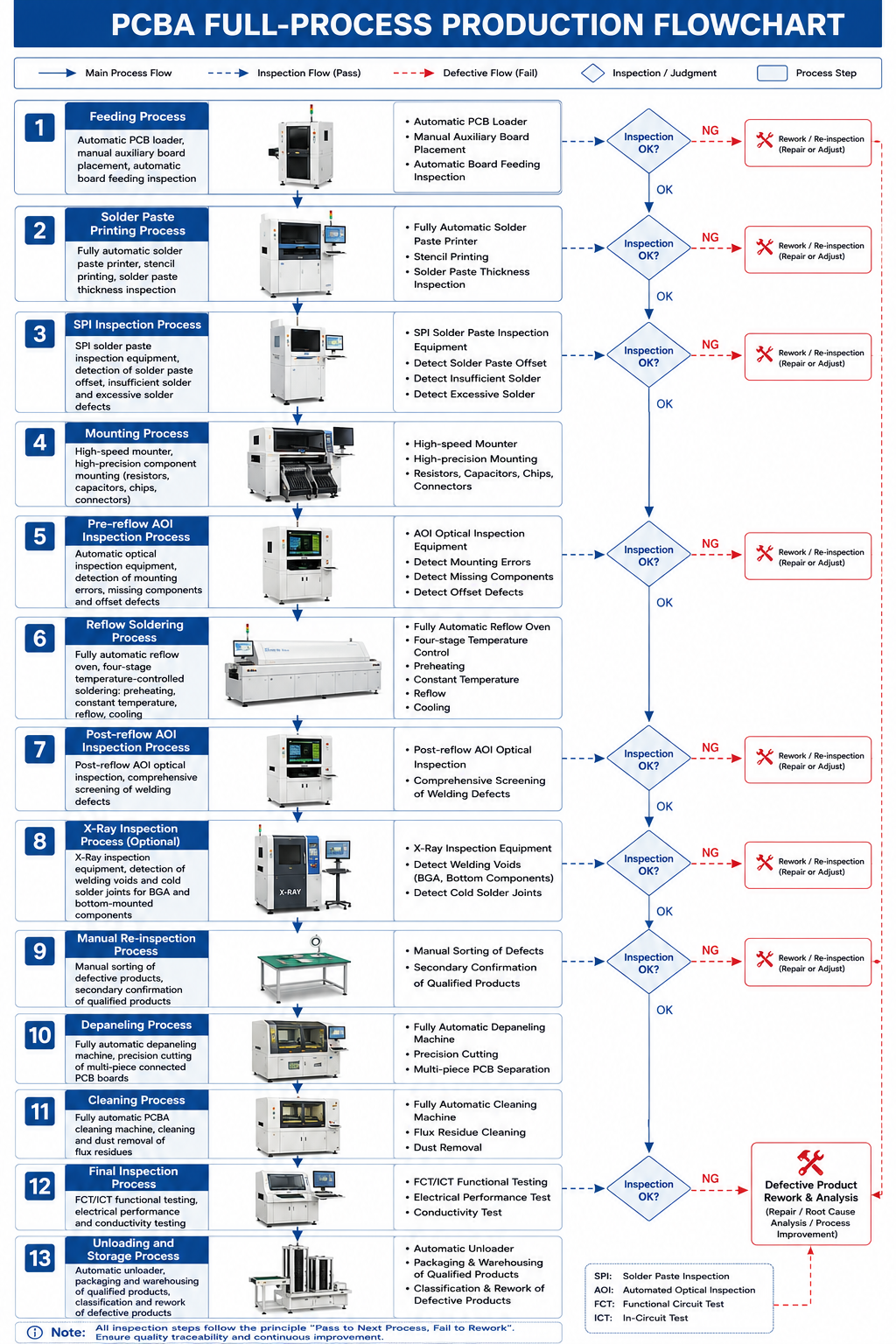
Essential Equipment in an SMT Production Line
PCB Loader
The PCB loader automatically feeds bare PCBs into the production line.
Main Functions
Automatic board loading
Continuous production
Reduced manual handling
Improved production efficiency
ESD-safe transportation
Suitable for both single-sided and double-sided PCB assembly.
The solder paste printer deposits solder paste onto PCB pads through a precision stencil.
Modern printers typically feature:
- Automatic stencil alignment
- Vision positioning systems
- Automatic stencil cleaning
- Closed-loop printing control
- High repeatability
Since solder paste quality directly affects solder joint reliability, printing is one of the most critical stages in SMT manufacturing.
SPI (Solder Paste Inspection)
SPI verifies the quality of solder paste immediately after printing.
Typical inspection items include:
- Paste volume
- Paste height
- Paste area
- Printing offset
- Bridge risk
- Missing paste
Benefits
- Detect defects before component placement
- Improve first-pass yield
- Reduce rework costs
- Enable closed-loop printer feedback
SPI helps prevent downstream defects rather than correcting them after assembly.
Pick and Place Machine
The pick and place machine is the core of any SMT production line.
It automatically places electronic components onto the PCB with high speed and precision.
Reflow Oven
After component placement, the PCB enters the reflow oven where solder paste melts and forms permanent solder joints.
Important features include:
- Multi-zone temperature control
- Precise thermal profiling
- Nitrogen reflow (optional)
- Uniform heating
- Stable cooling
Proper temperature control minimizes defects such as:
- Cold solder joints
- Tombstoning
- Voids
- Head-in-pillow
- Solder bridges
AOI (Automatic Optical Inspection)
AOI automatically inspects assembled PCBs after reflow soldering.
Typical detectable defects include:
- Missing components
- Incorrect components
- Polarity errors
- Component shift
- Tombstoning
- Solder bridges
- Poor solder joints
PCB Unloader
The unloader automatically collects finished PCBs at the end of the production line, reducing manual handling and ensuring smooth production flow.
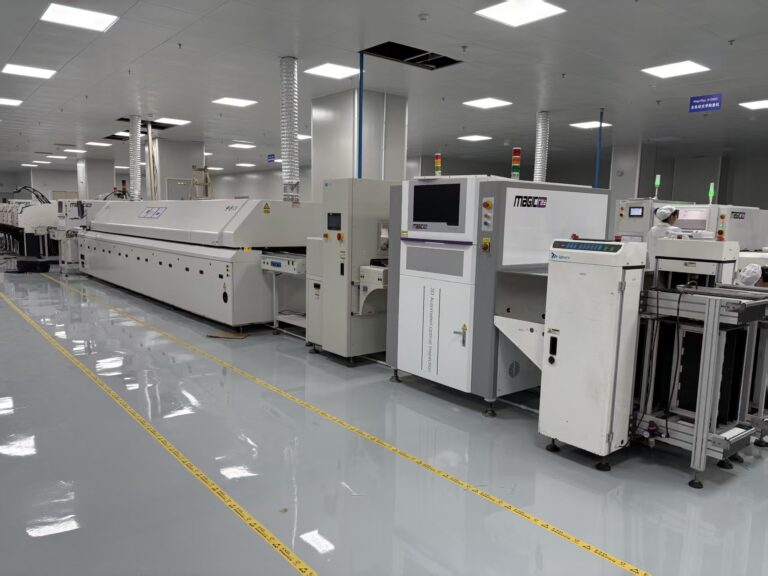
Common SMT Production Line Configurations
Entry-Level SMT Line
Suitable for:
Electronics startups
Prototype manufacturers
Small EMS companies
Typical configuration:
- Loader
- Printer
- Pick and Place Machine
- Reflow Oven
- AOI
- Unloader
Capacity: 10,000–20,000 CPH
Standard SMT Line
Suitable for:
- Consumer electronics
- Industrial control
- LED manufacturing
Typical configuration:
- Loader
- Printer
- SPI
- High-speed placement machine
- Multifunction placement machine
- Reflow oven
- AOI
- Unloader
Capacity: 20,000–60,000 CPH
Advanced SMT Line
Suitable for:
- Automotive electronics
- Medical devices
- Aerospace
- Communication equipment
Typical configuration:
- Smart Loader
- High-end Printer
- 3D SPI
- High-Speed Mounter
- Precision Mounter
- Nitrogen Reflow Oven
- Inline AOI
- X-Ray Inspection
- MES Integration
- Traceability System
Capacity: 60,000–120,000+ CPH
Benefits of an SMT Production Line
A modern SMT production line offers significant advantages over manual assembly:
- Higher production efficiency
- Superior placement accuracy
- Consistent product quality
- Lower labor costs
- Faster product changeovers
- Better traceability
- Reduced material waste
- Higher return on investment (ROI)
These benefits make SMT the preferred manufacturing technology across nearly every electronics industry.
Industries That Use SMT Production Lines
SMT production lines are widely used in:
- Consumer electronics
- Automotive electronics
- Medical devices
- Industrial automation
- LED lighting
- Telecommunications
- Aerospace and defense
- New energy systems
- Smart home devices
- IoT products
Each industry requires different production capacities, quality standards, and inspection systems, making customized SMT line planning essential.
How to Choose the Right SMT Production Line
Before investing in an SMT production line, consider the following factors:
- Production volume: Prototype, low-volume, or mass production
- PCB complexity: Component size, package types, and board density
- Quality requirements: AOI, SPI, X-Ray, ICT, and traceability
- Factory space: Available floor area and future expansion plans
- Budget: Initial investment versus long-term ROI
- Automation level: Manual, semi-automatic, or fully automated
- Future scalability: Ability to add equipment as production grows
A turnkey solution provider can help balance these factors to deliver the most cost-effective configuration.
Frequently Asked Questions
An SMT production line is a series of automated machines used to assemble electronic components onto printed circuit boards (PCBs) using Surface Mount Technology.
What is the most important machine in an SMT line?
The pick and place machine is considered the core equipment because it determines production speed, flexibility, and placement accuracy.
Do I need both AOI and SPI?
For high-quality PCB assembly, yes. SPI prevents solder paste defects before placement, while AOI detects assembly defects after soldering.
Can an SMT line be expanded later?
Yes. Most modern SMT production lines are modular, allowing additional placement machines, inspection systems, or automation equipment to be integrated as production demand increases.
Investment varies widely depending on capacity and automation level. Entry-level lines may start around US$50,000, while advanced automotive or medical production lines can exceed US$2 million.
Conclusion
An SMT production line is the foundation of modern electronics manufacturing. By integrating solder paste printing, precision component placement, reflow soldering, automated inspection, and intelligent process control, it enables manufacturers to produce high-quality PCB assemblies with exceptional efficiency and consistency.
Selecting the right SMT production line is not simply about purchasing individual machines. The compatibility between equipment, inspection capabilities, software integration, and future scalability all play critical roles in achieving long-term productivity and return on investment.
Whether you are building a new PCB assembly factory or upgrading an existing production line, a well-designed turnkey SMT solution can reduce project risks, improve product quality, and support sustainable business growth.
About FULIU Electronics
FULIU Electronics is a professional provider of turnkey SMT and PCBA production line solutions for global electronics manufacturers. We offer:
- Complete SMT production line design and integration
- New and refurbished SMT equipment
- ASMPT, Panasonic, Yamaha, Fuji, and JUKI machine solutions
- AOI, SPI, and X-Ray inspection systems
- Reflow soldering and wave soldering equipment
- Factory layout planning and capacity optimization
- MES and production traceability integration
- Installation, commissioning, operator training, and global after-sales support
With extensive experience serving industries such as consumer electronics, automotive, medical devices, industrial control, and new energy, FULIU Electronics helps manufacturers build efficient, reliable, and scalable PCB assembly factories that maximize productivity and long-term ROI.