
What Equipment Is Needed for PCBA Manufacturing?
A Complete Guide to Building an Efficient PCB Assembly Production Line
Modern electronics manufacturing relies on highly automated and precisely coordinated production equipment. Whether producing consumer electronics, automotive control units, medical devices, industrial controllers, or communication products, a well-designed PCBA (Printed Circuit Board Assembly) production line is essential for ensuring consistent product quality, high manufacturing efficiency, and long-term return on investment.
Many companies planning a new PCB assembly factory ask the same question:
“What equipment is actually required for PCBA manufacturing?”
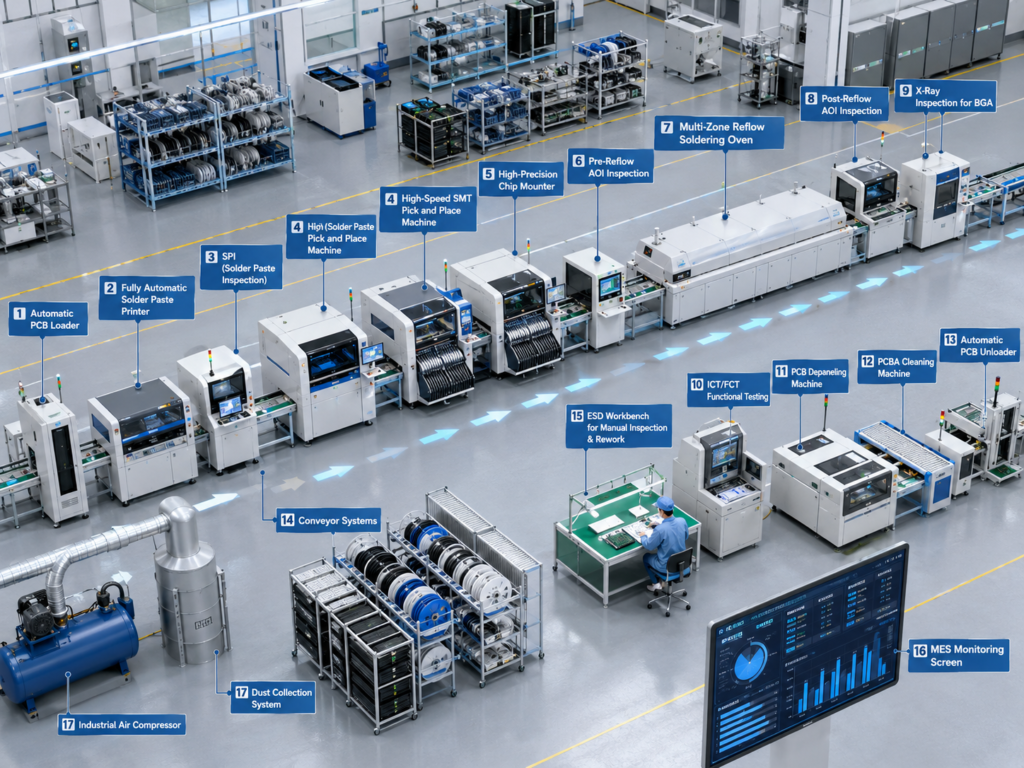
The answer involves much more than simply purchasing a pick-and-place machine. A complete PCBA production line is an integrated system that combines solder paste printing, component placement, soldering, inspection, testing, traceability, and material handling. Every piece of equipment performs a specific function, and the compatibility between these machines directly influences production yield, operating costs, and scalability.
Choosing equipment based solely on purchase price often results in bottlenecks, increased defect rates, higher maintenance costs, and difficulties in future expansion. By contrast, a properly planned turnkey SMT production line enables manufacturers to maximize throughput, improve first-pass yield, and achieve a lower total cost of ownership.
This guide explains the complete range of equipment required for PCBA manufacturing, how each machine contributes to the production process, and how to select the most suitable configuration based on your production goals.
Whether you are building a new SMT factory, expanding an existing facility, or evaluating equipment for prototype or mass production, this article provides practical guidance to help you make informed investment decisions.
What Is PCBA Manufacturing?
Understanding the PCB Assembly Process
Before discussing the equipment required, it is important to understand what PCBA manufacturing actually involves.
A PCB (Printed Circuit Board) is an unpopulated board that provides electrical connections between electronic components.
A PCBA (Printed Circuit Board Assembly) is the completed electronic assembly after components have been mounted, soldered, inspected, and tested.
Unlike PCB fabrication, which focuses on producing the circuit board itself, PCBA manufacturing is responsible for transforming the bare board into a fully functional electronic product ready for integration into its final application.
Today, PCBA manufacturing combines several highly specialized production technologies, including:
- Surface Mount Technology (SMT)
- Through-Hole Technology (THT or DIP)
- Automated Optical Inspection (AOI)
- Solder Paste Inspection (SPI)
- X-Ray Inspection
- In-Circuit Testing (ICT)
- Functional Testing (FCT)
- Traceability and MES Integration
These processes work together to ensure high reliability, precise component placement, and compliance with increasingly demanding quality standards across industries such as:
- Consumer Electronics
- Automotive Electronics
- Medical Devices
- Industrial Automation
- LED Lighting
- Telecommunications
- Aerospace
- New Energy Systems
As electronic products become smaller, faster, and more complex, manufacturers must rely on advanced automation to maintain production consistency while minimizing defects and labor costs.

SMT vs. DIP: Two Core Assembly Processes
Most PCBA factories use a combination of Surface Mount Technology (SMT) and Dual In-line Package (DIP) assembly to accommodate different component types.
Surface Mount Technology (SMT)
SMT is the primary assembly process used in modern electronics manufacturing. Components are mounted directly onto the surface of the PCB using automated equipment, enabling:
- High component density
- Miniaturized product designs
- Faster production speeds
- Superior placement accuracy
- High levels of automation
SMT is widely used in smartphones, laptops, automotive ECUs, industrial controllers, IoT devices, and medical electronics.
Through-Hole Technology (DIP)
Certain components, such as large connectors, transformers, relays, and high-power devices, still require through-hole mounting.
After SMT assembly is completed, these components are manually or automatically inserted into plated holes and soldered using wave soldering or selective soldering equipment.
Industries including industrial control, automotive power electronics, and power supply manufacturing continue to rely heavily on DIP processes.
As a result, a complete PCBA production line often integrates both SMT and DIP equipment to support a wider range of electronic products.
Essential Equipment for PCBA Manufacturing
A modern PCBA production line consists of multiple specialized machines, each designed to perform a specific task within the PCB assembly process. From material handling and solder paste printing to component placement and inspection, every piece of equipment contributes to product quality, production efficiency, and long-term manufacturing reliability.
Understanding the function of each machine helps manufacturers select the right equipment configuration based on production volume, product complexity, quality requirements, and future expansion plans.
Recommended PCBA Production Line Configurations & Equipment Selection Guide
Choosing the right PCBA production line is not simply a matter of purchasing the most advanced equipment. The ideal configuration depends on your production volume, product complexity, quality requirements, factory size, available budget, and long-term expansion plans.
A startup producing IoT devices requires a different solution than an automotive electronics manufacturer building ECU control boards or a medical device company producing CT scanner controller PCBs.
This section introduces three common SMT production line configurations, discusses optional equipment, compares new and refurbished machines, and explains the most important factors to consider when selecting equipment.
Recommended PCBA Production Line Configurations
Entry-Level SMT Production Line
Best For
- Startup EMS companies
- Prototype manufacturers
- Small PCB assembly factories
- Electronics R&D centers
- IoT device manufacturers
This configuration provides an economical entry point into automated SMT manufacturing while maintaining sufficient flexibility for low-volume production.
Typical Production Capacity
10,000–20,000 CPH
Estimated Investment
US$50,000–150,000
Standard SMT Production Line
Best For
- Consumer electronics manufacturers
- Industrial electronics
- Medium-sized EMS companies
- LED lighting manufacturers
- Home appliance electronics
This configuration balances productivity, automation, and investment, making it one of the most common SMT line layouts worldwide.
Typical Production Capacity
20,000–60,000 CPH
Estimated Investment
US$150,000–500,000
Advanced PCBA Manufacturing Line
Best For
- Automotive electronics
- Medical devices
- Aerospace
- Communication equipment
- Military electronics
- Semiconductor equipment
This configuration represents a modern smart factory capable of supporting high-reliability electronic products with complete process control and full production traceability.
Typical Production Capacity
60,000–120,000+ CPH
Estimated Investment
US$500,000–2,000,000+
Why Turnkey PCBA Production Lines Are Becoming More Popular
As electronics manufacturing becomes increasingly complex, many companies are moving away from purchasing individual machines from multiple suppliers. Instead, they are choosing turnkey PCBA production line solutions that provide a fully integrated manufacturing system—from factory planning and equipment selection to installation, commissioning, and after-sales support.
A turnkey solution minimizes project risks, shortens deployment time, and ensures that every piece of equipment works seamlessly together.
Single Supplier Responsibility
Managing multiple equipment suppliers often leads to communication gaps, compatibility issues, and delays during installation.
With a turnkey solution, one experienced supplier is responsible for:
- Production line planning
- Equipment selection
- Factory layout design
- Software integration
- Installation and commissioning
- Operator training
- Technical support
- Spare parts supply
This significantly simplifies project management while reducing implementation risks.
Better Equipment Compatibility
A PCBA production line is only as efficient as the coordination between its machines.
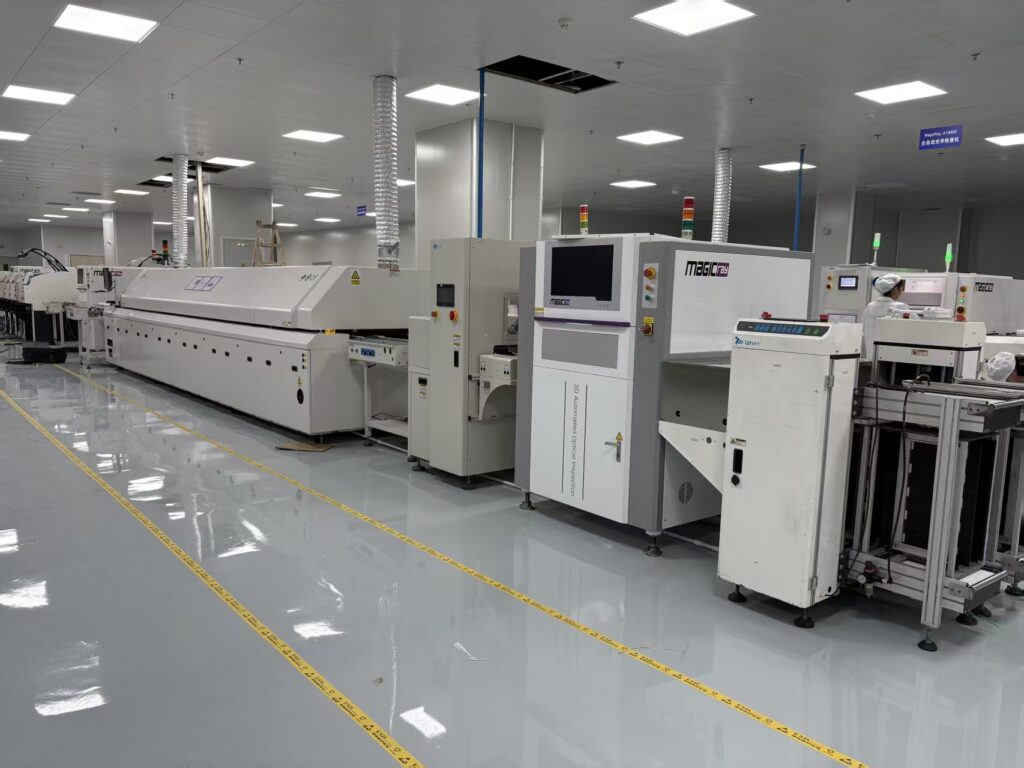
Turnkey suppliers carefully select compatible equipment, including:
- PCB Loaders & Unloaders
- Solder Paste Printers
- SPI Systems
- Pick and Place Machines
- Reflow Ovens
- AOI Systems
- X-Ray Inspection
- Wave Soldering Machines
- MES Software
- Traceability Systems
Proper integration minimizes communication errors and ensures stable production.
Faster Factory Deployment
Because every stage of the project is coordinated by a single supplier, installation and commissioning proceed much more efficiently.
Benefits include:
- Reduced installation time
- Faster production startup
- Lower engineering workload
- Shorter return-on-investment cycle
For new factory investors, reducing time-to-market can provide a significant competitive advantage.
Lower Project Risk
An experienced turnkey provider evaluates the entire production process before equipment is delivered.
This includes:
Capacity planning
Utility requirements
Material flow
Factory layout optimization
Production balancing
Future expansion planning
Comprehensive planning helps avoid costly redesigns and production bottlenecks.
Simplified Maintenance
Maintaining equipment from multiple brands can be challenging when service procedures and spare parts differ.
Turnkey solutions offer:
- Unified maintenance schedules
- Centralized technical support
- Simplified spare parts management
- Consistent software updates
- Preventive maintenance programs
This reduces downtime and improves long-term equipment reliability.
Comprehensive Operator Training
Proper training is essential for maximizing equipment performance.
Professional turnkey providers typically offer training on:
- Machine operation
- Programming
- Preventive maintenance
- Process optimization
- Quality control
- Troubleshooting
Well-trained operators contribute directly to higher productivity and better product quality.
Lower Total Cost of Ownership (TCO)
While turnkey solutions may require a larger initial investment, they often deliver lower lifetime operating costs through:
- Higher equipment utilization
- Better process integration
- Reduced maintenance
- Fewer production interruptions
- Lower defect rates
- Improved production efficiency
For most manufacturers, the long-term financial benefits outweigh the initial investment.
Conclusion
Building a successful PCBA manufacturing facility requires much more than purchasing individual machines. Every stage of the production process—from solder paste printing and component placement to inspection, testing, and packaging—plays a critical role in ensuring product quality, manufacturing efficiency, and long-term profitability.
The most effective PCBA production lines are carefully planned around specific manufacturing goals, balancing production volume, product complexity, quality standards, automation requirements, and future expansion. Investing in compatible equipment and advanced inspection technologies such as SPI, AOI, and X-Ray not only reduces defects and rework but also improves first-pass yield and lowers the total cost of ownership.
For manufacturers aiming to build a competitive, scalable, and future-ready PCB assembly factory, a turnkey SMT solution offers clear advantages. Integrated equipment selection, optimized factory layout, seamless software integration, and comprehensive technical support help minimize implementation risks while accelerating production readiness and maximizing long-term return on investment.
Whether you are launching a new factory, expanding production capacity, or upgrading an existing SMT line, partnering with an experienced solution provider is one of the most important decisions you can make.
About FULIU Electronics
FULIU Electronics is a professional provider of turnkey SMT and PCBA production line solutions, helping electronics manufacturers worldwide build efficient, reliable, and scalable PCB assembly factories.
Our comprehensive solutions include:
- Turnkey SMT & PCBA production line planning
- New and professionally refurbished SMT equipment
- Integration of ASMPT (SIPLACE), Panasonic, Yamaha, Fuji, and JUKI placement machines
- AOI, SPI, X-Ray, ICT, and testing solutions
- Reflow soldering and wave soldering equipment
- PCB loader, conveyor, and automation systems
- MES and production traceability integration
- Factory layout planning and production optimization
- Installation, commissioning, and operator training
- Global delivery and responsive after-sales technical support
With extensive experience serving customers in automotive electronics, medical devices, industrial control, LED lighting, telecommunications, and consumer electronics, FULIU Electronics delivers customized solutions that improve manufacturing efficiency, product quality, and long-term business success.