
As the global demand for LED lighting, LED displays, automotive lighting, and smart illumination products continues to grow, manufacturers are under increasing pressure to improve production efficiency while maintaining consistent product quality.
For LED PCB assembly manufacturers, selecting the right SMT production line is one of the most important investment decisions. A well-designed SMT line can significantly improve production capacity, reduce labor costs, minimize defects, and shorten delivery times.
However, many factory investors and procurement managers face common questions:
- What is the best SMT line for LED manufacturing?
- Which SMT equipment is essential for LED PCB assembly?
- How much does an LED SMT production line cost?
- Should I choose a high-speed line or a flexible configuration?
- How can I maximize ROI while maintaining product quality?
In this guide, we will explain the ideal SMT line configuration for LED manufacturing, compare different production scales, and provide practical recommendations for building an efficient and cost-effective LED PCB assembly factory.

What Makes LED Manufacturing Different from Other PCB Assembly Industries?
Although LED products use standard PCB assembly technology, their production characteristics differ from many consumer electronics applications.
LED PCB assembly typically involves:
- Large production volumes
- Repetitive product designs
- Long PCB boards
- High placement accuracy requirements
- Strict brightness consistency requirements
- Cost-sensitive manufacturing environments

Common LED products include:
LED Lighting Products
- LED bulbs
- LED tubes
- LED panels
- Street lights
- Industrial lighting
LED Display Products
- Indoor LED displays
- Outdoor LED billboards
- Fine-pitch LED screens
Automotive LED Products
- Headlights
- Tail lights
- Daytime running lights
- Interior lighting systems
Smart LED Products
- Smart home lighting
- IoT-enabled lighting
- Intelligent control modules
Because of these requirements, LED manufacturers need SMT lines that combine productivity, stability, and cost efficiency.

Typical SMT Process for LED Manufacturing
A standard LED SMT production line follows the process below:
PCB Loader
↓
Solder Paste Printer
↓
SPI Inspection
↓
Pick and Place Machine
↓
Reflow Oven
↓
AOI Inspection
↓
PCB Unloader
Each stage plays a critical role in ensuring LED assembly quality.
Essential SMT Equipment for LED Manufacturing
PCB Loader
The PCB loader automatically feeds circuit boards into the SMT line.
Benefits include:
- Reduced manual handling
- Improved production consistency
- Increased line efficiency
- Lower labor costs
For LED manufacturing with long production runs, automatic loading systems are highly recommended.
Solder Paste Printer
The solder paste printer applies solder paste onto PCB pads before component placement.
Key considerations:
- Printing accuracy
- Repeatability
- Stencil alignment
- Support for long LED boards
A high-quality printer directly impacts solder joint quality and production yield.
SPI Inspection System
SPI (Solder Paste Inspection) verifies solder paste quality immediately after printing.
SPI checks:
- Paste volume
- Paste height
- Paste area
- Offset printing
- Potential bridging defects
Why SPI Is Important for LED Production
Even a small solder paste deviation can lead to:
- LED brightness inconsistency
- Open circuits
- Early product failure
SPI prevents these problems before components are mounted.
Pick and Place Machine
The pick and place machine is the core equipment of any SMT production line.
For LED manufacturing, it must handle:
- LED chips
- Resistors
- Capacitors
- ICs
- Connectors
High-Speed Mounters
Best for:
- LED strip production
- LED bulb manufacturing
- High-volume LED boards
Advantages:
- Maximum productivity
- Lower unit production cost
Multifunction Mounters
Best for:
- LED driver boards
- Smart LED controllers
- Complex LED products
Advantages:
- Flexibility
- Wide component compatibility
Many LED factories combine both machine types to achieve optimal performance.
Reflow Oven
After placement, the PCB enters the reflow oven where solder joints are formed.
Important factors:
- Temperature profile control
- Heating zone stability
- Conveyor consistency
- Cooling performance
Benefits of Modern Reflow Ovens
- Improved solder joint quality
- Reduced defect rates
- Better thermal consistency
- Lower energy consumption
For high-end LED products, nitrogen reflow ovens can further improve solder quality.
AOI Inspection System
AOI (Automatic Optical Inspection) verifies assembly quality after soldering.
AOI detects:
- Missing LEDs
- Incorrect polarity
- Component shifts
- Solder bridges
- Missing components
- Tombstoning
Why AOI Is Critical for LED Manufacturing
LED products often contain hundreds or thousands of identical components.
Manual inspection is:
- Slow
- Inconsistent
- Expensive
AOI provides fast and reliable quality verification.
PCB Unloader
The unloader automatically collects finished boards.
Benefits:
- Improved production flow
- Reduced labor
- Lower handling damage risk
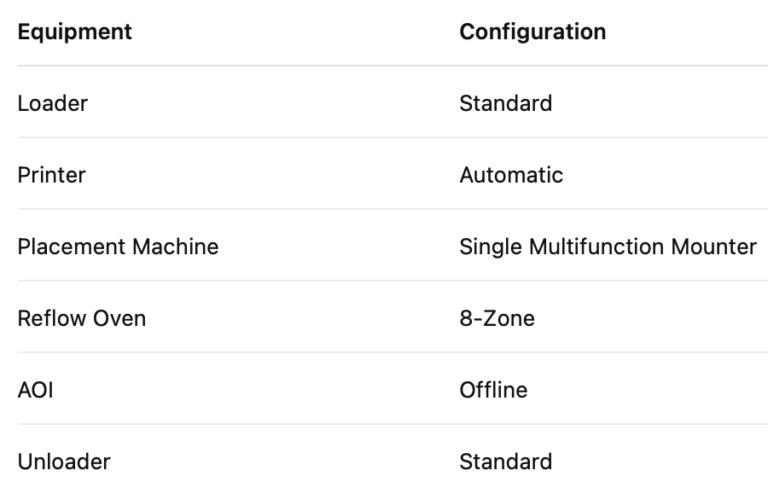
Best SMT Line Configurations for LED Manufacturing
Entry-Level LED SMT Line
Suitable for:
- Startup factories
- Small LED manufacturers
- Prototype production
Production Capacity
10,000–20,000 CPH
Investment Range
$50,000–150,000
Medium-Scale LED SMT Line
Suitable for:
- Commercial LED manufacturers
- LED module factories
- LED driver board production
Production Capacity
30,000–80,000 CPH
Investment Range
$150,000–500,000
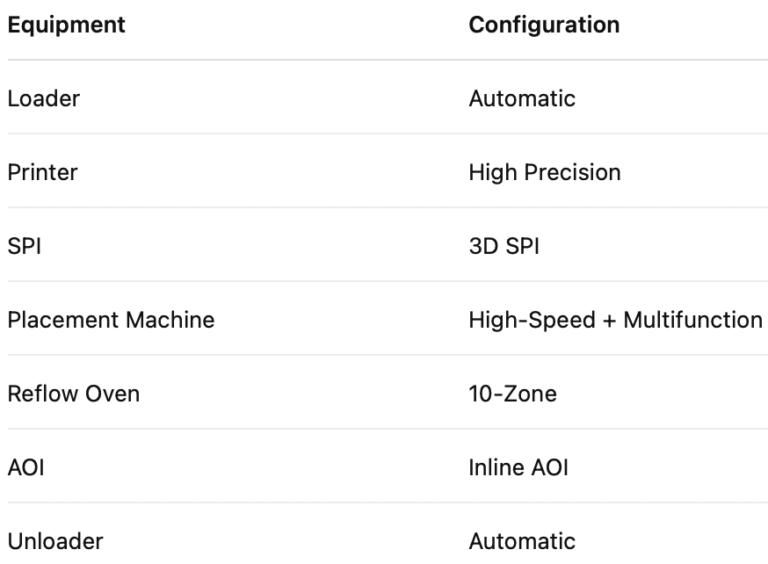
Large-Scale LED SMT Line
Suitable for:
- LED display manufacturers
- Automotive lighting suppliers
- Global EMS providers
Production Capacity
100,000+ CPH
Investment Range
$500,000–2,000,000+
How to Choose the Best SMT Line for LED Manufacturing
Consider Production Volume
Ask:
How many LED boards will be produced daily?
What is the expected growth over the next 3–5 years?
Selecting equipment solely based on current demand may limit future expansion.
Evaluate Product Complexity
Simple products:
- LED strips
- LED bulbs
Require:
- High-speed placement
Complex products:
- Smart lighting
- Automotive LED systems
Require:
- High precision
- Multifunction placement capability

Consider Automation Requirements
Higher automation provides:
- Lower labor costs
- Better consistency
- Improved traceability
- Faster production
Especially important in regions with rising labor costs.
Plan for Future Expansion
Choose equipment that supports:
- Additional placement machines
- AOI upgrades
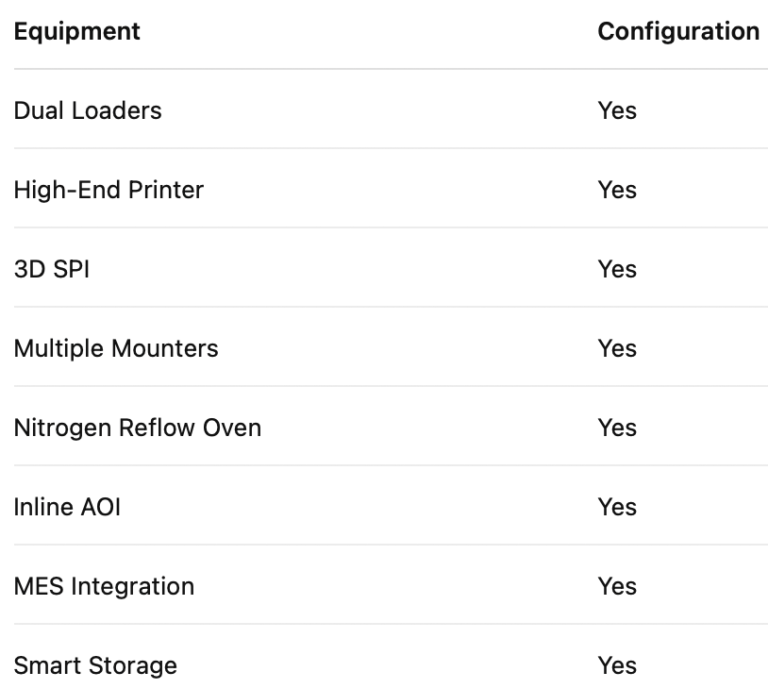
- MES integration
- Smart factory systems
Scalability protects long-term investment.
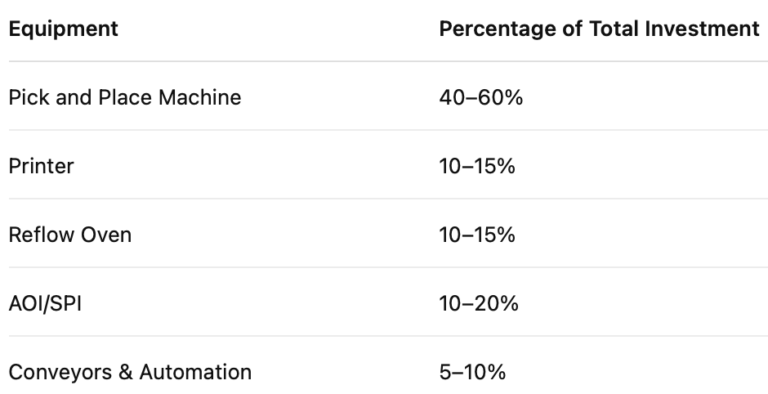
SMT Line Cost Breakdown for LED Manufacturing
The placement machine typically represents the largest investment.

Common Mistakes When Building an LED SMT Factory
Buying High-Speed Equipment Too Early
Many startups purchase oversized machines.
Result:
- Low utilization
- Poor ROI
Instead, invest according to realistic production demand.
Ignoring Inspection Systems
Skipping SPI or AOI may reduce initial investment but often increases:
- Rework costs
- Scrap rates
- Customer complaints
Choosing Equipment Based Only on Price
The lowest-priced machine is rarely the most economical over its lifetime.
Consider:
- Reliability
- Service support
- Spare parts availability
- Software upgrades
Poor Factory Layout Planning
Bad layouts create:
- Material bottlenecks
- Operator inefficiency
- Reduced throughput
Professional layout planning significantly improves productivity
Why Turnkey SMT Solutions Are Ideal for LED Manufacturing
More LED manufacturers are choosing turnkey SMT production lines because they offer:
Faster Deployment
One supplier manages the entire project.
Better Equipment Compatibility
All machines work together seamlessly.
Lower Project Risk
Reduced integration issues.
Easier Training
Single-source technical support.
Simplified Maintenance
Unified service and spare parts management.
Lower Total Cost of Ownership
Improved efficiency and reduced downtime.
Real-World Applications
LED Lighting Manufacturing
Recommended Configuration:
Medium-speed SMT line with AOI and SPI.
LED Display Manufacturing
Recommended Configuration:
High-speed SMT line with multiple mounters and inline AOI.
Automotive LED Production
Recommended Configuration:
High-precision SMT line with 3D SPI, inline AOI, and full traceability.
Smart Lighting Products
Recommended Configuration:
Flexible SMT line with multifunction placement capability.
Frequently Asked Questions
What is the best SMT line for LED manufacturing?
The best SMT line depends on production volume, product complexity, and automation requirements. Most medium-scale LED factories benefit from a printer, SPI, high-speed mounter, reflow oven, and AOI system.
How much does an LED SMT production line cost?
A complete LED SMT line typically ranges from $50,000 to over $2 million, depending on capacity and automation level.
Is SPI necessary for LED production?
Yes. SPI helps detect solder paste defects before placement, reducing rework and improving yield.
Do LED factories need AOI?
Absolutely. AOI ensures component placement accuracy and solder joint quality.
Can used SMT equipment be used for LED production?
Yes. High-quality refurbished equipment can provide excellent ROI for startups and budget-conscious manufacturers.
How many operators are required?
A typical automated LED SMT line requires 2–6 operators depending on capacity.
Can the SMT line be expanded later?
Most modern SMT lines are modular and support future expansion.
What is the ROI of an LED SMT line?
ROI depends on utilization and production volume, but many manufacturers achieve payback within 2–4 years.
Conclusion
Choosing the best SMT line for LED manufacturing requires balancing production volume, product complexity, automation goals, and budget.
For most LED manufacturers, a complete SMT production line consisting of a solder paste printer, SPI system, pick and place machine, reflow oven, AOI inspection system, and supporting automation equipment provides the ideal combination of efficiency, quality, and ROI.
As LED technology continues to evolve, manufacturers that invest in flexible, scalable, and high-quality SMT solutions will be better positioned to remain competitive in global markets.
Before purchasing equipment, it is always advisable to consult an experienced SMT solution provider who can recommend the most suitable line configuration based on your production requirements.
About FULIU Electronics
FULIU Electronics is a professional provider of turnkey SMT production line solutions for global electronics manufacturers.
Our solutions include:
- Turnkey SMT production lines
- LED SMT production solutions
- New and used SMT equipment
- AOI and SPI inspection systems
- Reflow soldering equipment
- Factory layout planning
- Installation and training services
- Global delivery and after-sales support
With extensive experience serving LED manufacturers, EMS providers, and PCB assembly factories worldwide, FULIU Electronics helps customers build efficient, reliable, and cost-effective SMT manufacturing facilities that support long-term growth and profitability.
Contact FULIU Electronics today to discuss the best SMT line configuration for your LED manufacturing project.