
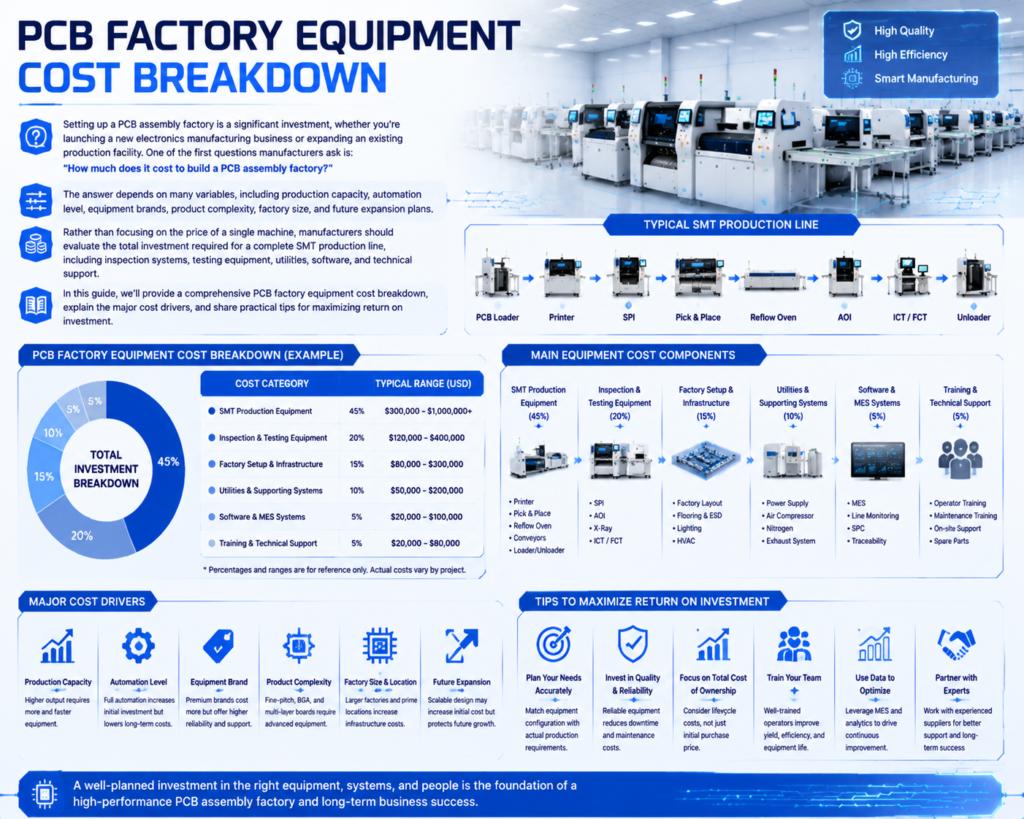
Setting up a PCB assembly factory is a significant investment, whether you’re launching a new electronics manufacturing business or expanding an existing production facility. One of the first questions manufacturers ask is:
“How much does it cost to build a PCB assembly factory?”
The answer depends on many variables, including production capacity, automation level, equipment brands, product complexity, factory size, and future expansion plans.
Rather than focusing on the price of a single machine, manufacturers should evaluate the total investment required for a complete SMT production line, including inspection systems, testing equipment, utilities, software, and technical support.
In this guide, we’ll provide a comprehensive PCB factory equipment cost breakdown, explain the major cost drivers, and share practical tips for maximizing return on investment.
What Determines PCB Factory Equipment Cost?
The total investment for a PCB assembly factory depends on several key factors.
These include:
- Production volume
- Product complexity
- Automation level
- Equipment configuration
- Equipment brands
- Factory layout
- Inspection requirements
- Testing requirements
- Future expansion plans
A prototype production line may require only a few essential machines, while a high-volume EMS factory may include multiple placement lines, advanced inspection systems, and intelligent manufacturing software.
Major Equipment Required for a PCB Assembly Factory
Although every factory differs, a complete SMT production line generally consists of the following equipment.
PCB Loader
Automatically feeds bare PCBs into the production line while reducing manual handling.
Purpose:
- Continuous production
- Stable board transfer
- Labor reduction
Automatic Solder Paste Printer
Applies solder paste accurately through a precision stencil.
This machine has a major impact on solder joint quality and overall production yield.
SPI (Solder Paste Inspection)
Measures solder paste:
- Volume
- Height
- Area
- Position
- Shape
SPI helps detect printing defects before component placement.
Pick and Place Machine
The pick and place machine represents the core investment of an SMT production line.
Equipment selection depends on:
- Placement speed
- PCB size
- Component types
- Placement accuracy
- Production volume
High-volume factories often install multiple placement machines to balance throughput.
Reflow Oven
The reflow oven forms reliable solder joints using carefully controlled heating profiles.
Modern multi-zone ovens improve solder consistency while reducing energy consumption.
AOI Inspection System
AOI automatically detects:
- Missing components
- Wrong polarity
- Component rotation
- Solder bridges
- Lifted leads
AOI improves product quality while reducing manual inspection.
X-Ray Inspection (Optional)
Products containing BGA, QFN, LGA, or hidden solder joints often require X-ray inspection.
Although optional for some applications, it is essential in industries with strict quality requirements.
Functional Testing Equipment
Testing systems may include:
- ICT (In-Circuit Testing)
- FCT (Functional Circuit Testing)
- Flying Probe Testing
Testing verifies electrical performance before products leave the factory.
PCB Cleaning Equipment (Optional)
Certain industries require post-assembly cleaning to remove:
Flux residues
- Ionic contamination
- Dust
- Oils
Cleaning improves long-term product reliability.
PCB Unloader
Automatically collects completed boards and supports continuous production.
Additional Equipment Costs
Besides the primary SMT equipment, manufacturers should also budget for supporting systems.
Common auxiliary equipment includes:
- Conveyor systems
- Automatic board buffers
- Feeder carts
- Air compressors
- Nitrogen generators
- Dust collection systems
- ESD workstations
- Material storage racks
- Barcode systems
- MES software
- Production monitoring displays
Although individually smaller investments, these systems contribute significantly to production efficiency.
Typical Equipment Investment by Factory Size
While exact costs vary depending on brands and configurations, the relative investment generally increases with production capacity.
The most cost-effective configuration depends on production goals rather than simply purchasing the largest available equipment.
Factors That Influence Equipment Costs
Several variables can significantly affect total factory investment.
Equipment Brand
International brands such as Fuji, Panasonic, ASM, Yamaha, JUKI, and Hanwha generally offer higher productivity, precision, and long-term reliability.
New vs. Refurbished Equipment
Refurbished SMT machines can substantially reduce capital investment while delivering dependable performance when supplied by qualified providers.
Benefits include:
- Lower purchase cost
- Faster delivery
- Lower depreciation
- Attractive return on investment
Automation Level
Higher automation reduces labor costs but increases initial equipment investment.
Manufacturers should balance automation with expected production volume.
Inspection Requirements
Adding SPI, AOI, X-ray, and testing systems increases investment but often reduces long-term operating costs by improving product quality and minimizing rework.
Smart Factory Integration
Modern factories increasingly implement:
- MES
- SPC
- Production dashboards
- Barcode traceability
- Equipment networking
Although these systems require additional investment, they significantly improve production management.
Hidden Costs Many Manufacturers Overlook
Equipment purchase is only part of the total investment.
Additional costs may include:
- Factory renovation
- Electrical installation
- Compressed air systems
- ESD flooring
- Air conditioning
- Operator training
- Spare parts inventory
- Preventive maintenance
- Software licenses
- Equipment transportation
- Installation and commissioning
Considering these expenses during project planning helps prevent unexpected budget overruns.
How to Reduce Initial Investment
Manufacturers can control startup costs without compromising production capability.
Practical strategies include:
Choose a Turnkey Solution
A turnkey supplier optimizes equipment compatibility, installation, and commissioning while reducing project management complexity.
Purchase Refurbished Equipment
High-quality refurbished machines provide excellent performance at a lower capital cost.
Invest According to Production Needs
Avoid purchasing excessive capacity during the initial project phase.
A scalable production line allows future expansion while controlling initial investment.
Partner with an Experienced Supplier
Professional suppliers help manufacturers:
- Select appropriate equipment
- Optimize production layout
- Reduce unnecessary investment
- Improve long-term operational efficiency

Why Choose Fuliu Electronics?
Established in 2014, Fuliu Electronics is dedicated to providing customers with high-quality PCBA intelligent manufacturing solutions and comprehensive technical services.
With extensive experience in the SMT industry, Fuliu Electronics supplies complete SMT production line solutions featuring internationally recognized brands such as Fuji, Panasonic, ASM, Yamaha, JUKI, and Hanwha, together with ERSA reflow ovens, MagicRay SPI/AOI inspection systems, automatic solder paste printers, refurbished SMT equipment, SMT spare parts, equipment leasing, and maintenance services.
Serving customers across India, Vietnam, the Philippines, Indonesia, the Middle East, South Africa, and Europe, Fuliu Electronics provides customized turnkey SMT solutions covering factory planning, equipment configuration, installation, commissioning, technical training, and long-term after-sales support to help manufacturers maximize investment efficiency.
Cost Optimization Tips for New PCB Factories
Before purchasing equipment, manufacturers should consider the following recommendations:
- Clearly define production capacity targets.
- Select equipment based on actual product requirements.
- Balance investment between production and inspection equipment.
- Consider refurbished equipment for faster ROI.
- Plan for future production expansion.
- Integrate MES and production monitoring where appropriate.
- Choose suppliers with strong technical support and spare parts availability.
- Evaluate total lifecycle cost—not just equipment purchase price.
These practices help manufacturers build efficient, scalable, and financially sustainable PCB assembly operations.
Conclusion
Building a PCB assembly factory requires careful planning and a clear understanding of equipment investment. While the PCB factory equipment cost varies depending on production scale, automation level, and product requirements, focusing solely on machine prices can lead to costly decisions.
A well-designed SMT production line balances production capacity, inspection capability, testing, and future scalability while minimizing unnecessary capital expenditure. By working with an experienced turnkey solution provider and selecting equipment that aligns with business objectives, manufacturers can maximize return on investment and establish a competitive, high-quality PCB assembly operation.
Frequently Asked Questions
The total investment depends on production capacity, automation level, equipment brands, inspection requirements, and factory infrastructure. Small prototype facilities require far less investment than fully automated high-volume manufacturing plants.
The pick and place machine is typically the largest equipment investment because it determines placement speed, accuracy, and overall production capacity.
SPI is highly recommended for medium- and high-volume production because it detects solder paste defects early, improving first-pass yield and reducing rework.
Yes. Professionally refurbished equipment can significantly lower capital investment while maintaining reliable production performance.
In addition to equipment purchases, budget for factory renovation, utilities, compressed air systems, ESD protection, installation, training, spare parts, software, and preventive maintenance.
A turnkey solution simplifies project implementation by providing equipment selection, factory layout planning, installation, commissioning, training, and ongoing technical support through a single supplier.