
With the rapid growth of consumer electronics, automotive electronics, telecommunications, and industrial automation, manufacturers are increasingly adopting SMT (Surface Mount Technology) to produce high-quality printed circuit boards (PCBs) efficiently. At the center of this manufacturing process is the SMT production line, an integrated system that automates PCB assembly with speed, precision, and consistency.
If you’re new to electronics manufacturing or planning to invest in PCB assembly equipment, understanding how an SMT production line works is the first step toward making informed decisions.
In this beginner’s guide, we’ll explain what an SMT production line is, introduce its core equipment, walk through the complete production process, and provide practical tips for choosing the right solution for your factory.
What Is an SMT Production Line?
An SMT production line is a series of automated machines that assemble electronic components directly onto the surface of a printed circuit board (PCB). Compared with traditional through-hole assembly, SMT enables faster production, higher component density, improved reliability, and lower manufacturing costs.
A complete SMT line integrates multiple machines, each performing a specific task—from applying solder paste to placing components, soldering, inspection, and final quality control.
Today, SMT manufacturing is widely used in the production of:
- Consumer electronics
- Automotive electronics
- Industrial control systems
- Medical devices
- Telecommunications equipment
- LED lighting products
- Smart home devices
Why Is SMT Manufacturing So Popular?
Compared with manual assembly methods, SMT manufacturing offers several important advantages.
Higher Production Efficiency
Modern SMT equipment can place tens of thousands of components per hour, significantly increasing production capacity.
Improved Product Quality
Automated processes reduce human error and ensure consistent component placement and soldering quality.
Lower Manufacturing Costs
Although the initial investment is higher, automation reduces labor costs, minimizes material waste, and improves long-term productivity.
Compact PCB Design
SMT supports smaller electronic components, allowing manufacturers to design lighter, thinner, and more powerful products.
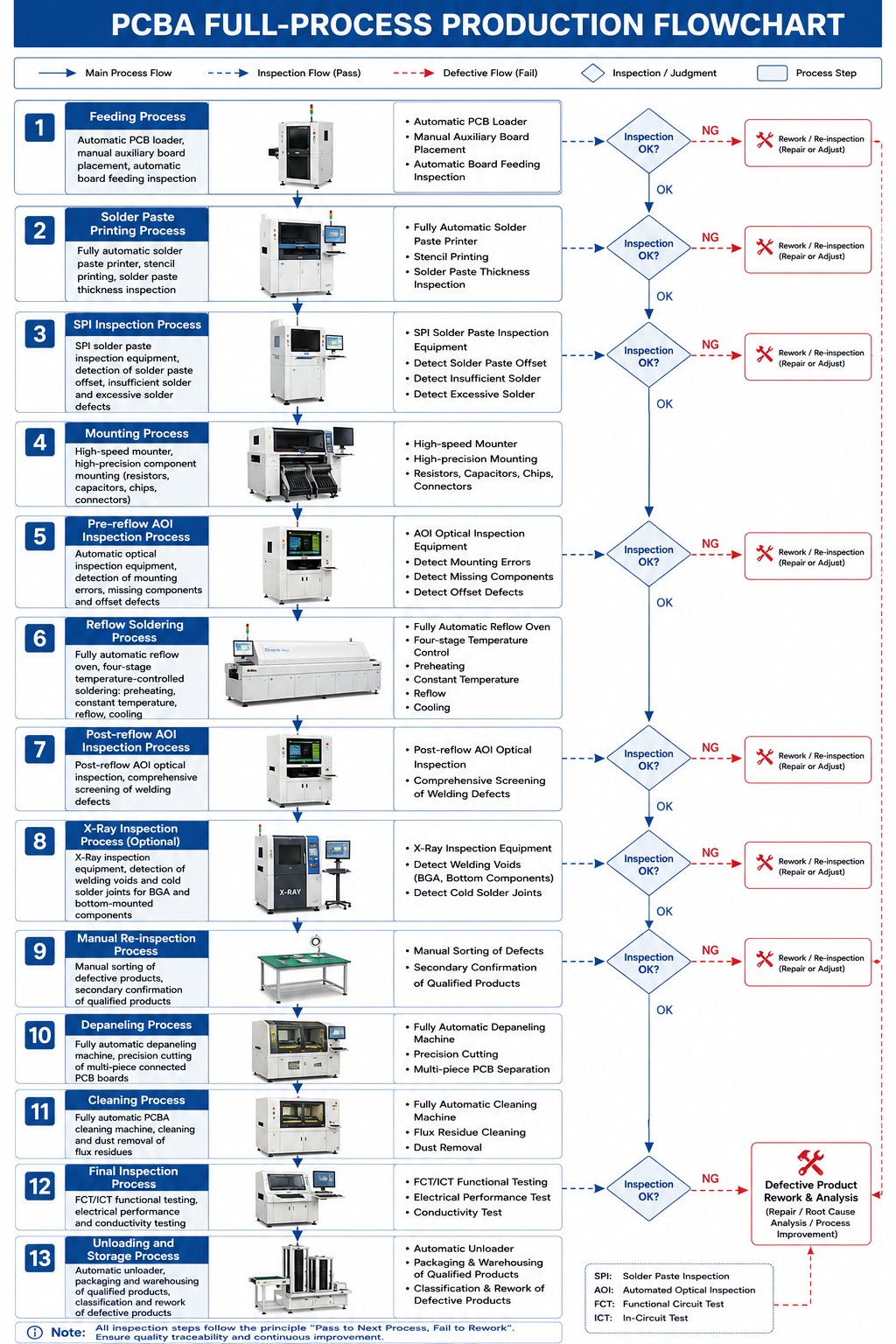
Main Equipment in an SMT Production Line
A complete SMT production line consists of several interconnected machines working together.
PCB Loader
The production process begins with an automatic PCB loader, which feeds bare circuit boards into the assembly line while maintaining a stable production flow.
Automatic Solder Paste Printer
The solder paste printer applies solder paste accurately onto PCB pads through a precision stencil.
Proper solder paste printing is essential because it directly affects solder joint quality during reflow.
SPI (Solder Paste Inspection
Many modern production lines include an SPI system immediately after printing.
SPI measures:
- Solder paste volume
- Paste height
- Alignment accuracy
- Printing consistency
Detecting printing defects early helps reduce downstream assembly problems.
SMT Pick and Place Machine
The pick and place machine is the core of every SMT line.
Using high-speed vision systems and precision motion control, it automatically places electronic components onto the PCB according to programmed coordinates.
Leading brands include:
Reflow Oven
After component placement, the PCB enters a reflow oven where controlled heating melts the solder paste, permanently attaching components to the board.
Modern multi-zone reflow ovens provide precise temperature control to ensure reliable solder joints while protecting sensitive components.
Following soldering, an AOI system inspects each PCB for assembly defects such as:
- Missing components
- Component misalignment
- Polarity errors
- Solder bridges
- Insufficient solder
- Lifted leads
Automated Optical Inspection improves product quality while reducing manual inspection time.
Unloader
Finally, completed PCBs are automatically transferred to an unloader or the next manufacturing stage, such as functional testing or final assembly.
How Does an SMT Production Line Work?
Understanding the SMT production line process helps manufacturers optimize efficiency and maintain product quality.
The standard workflow includes:
- PCB Loading
- Solder Paste Printing
- SPI Inspection
- Component Placement
- Reflow Soldering
- AOI Inspection
- PCB Unloading
- Functional Testing (if required)
Each stage plays a critical role in ensuring reliable PCB assembly.
Types of SMT Production Lines
Not every factory requires the same production configuration.
Prototype SMT Line
Suitable for:
- Research and development
- Product validation
- Engineering samples
- Small production batches
Flexibility is prioritized over production speed.
Medium-Volume SMT Production Line
Ideal for:
- Contract manufacturers
- Industrial electronics
- Medical equipment
- Consumer electronics
This configuration balances efficiency, flexibility, and investment cost.
High-Speed SMT Production Line
Designed for mass production of:
- Smartphones
- Home appliances
- Automotive electronics
- Telecommunications equipment
High-speed lines emphasize maximum throughput and continuous automation.
How to Choose the Right SMT Production Line
Selecting the right SMT production line requires more than comparing machine prices.
Consider the following factors before investing.
Production Capacity
Estimate your expected daily or monthly PCB output.
A production line should satisfy current demand while allowing room for future expansion.
Product Type
Different products require different manufacturing capabilities.
Factors include:
- PCB size
- Component density
- Fine-pitch ICs
- BGA packages
- Double-sided assembly
Automation Level
Automation improves consistency and reduces labor requirements.
Manufacturers with higher production volumes generally benefit from fully automated SMT lines.
Equipment Compatibility
Ensure all equipment communicates efficiently to minimize production interruptions and simplify maintenance.
After-Sales Support
Reliable technical support is just as important as equipment performance.
Choose an SMT equipment supplier that provides:
- Installation
- Operator training
- Spare parts
- Preventive maintenance
- Software updates
- Technical consultation
Common Challenges in SMT Production
Even modern production lines require continuous optimization.
Typical challenges include:
- Solder paste printing defects
- Component placement errors
- Temperature profile optimization
- Machine maintenance
- Feeder management
- Production changeovers
Routine maintenance, operator training, and process monitoring help minimize downtime and maintain stable product quality.
Why Choose Fuliu Electronics?
Established in 2014, Fuliu Electronics is dedicated to providing customers with high-quality PCBA intelligent manufacturing solutions and comprehensive technical services.
With extensive experience in the SMT industry, the company supplies complete SMT production line solutions featuring internationally recognized brands such as Fuji, Panasonic, ASM, Yamaha, JUKI, and Hanwha, together with ERSA reflow ovens from Germany, MagicRay SPI/AOI inspection systems, automatic solder paste printers, pre-owned SMT equipment, SMT spare parts, machine leasing, and maintenance services.
As part of its global growth strategy, Fuliu Electronics serves customers across India, Vietnam, the Philippines, Indonesia, the Middle East, South Africa, and Europe, helping electronics manufacturers build efficient, reliable, and scalable SMT production lines tailored to their production goals.
Conclusion
An SMT production line is the foundation of modern PCB assembly, combining advanced automation, precision equipment, and intelligent inspection technologies to produce reliable electronic products efficiently.
Whether you are establishing your first SMT factory or expanding an existing production facility, understanding the complete SMT manufacturing process will help you choose the right equipment and maximize your investment.
Working with an experienced SMT equipment supplier ensures not only access to high-quality machinery but also the technical expertise, training, and after-sales support necessary for long-term manufacturing success.
Frequently Asked Questions
An SMT production line is an automated manufacturing system that assembles electronic components onto printed circuit boards using Surface Mount Technology.
Typical equipment includes a PCB loader, solder paste printer, SPI system, pick and place machine, reflow oven, AOI inspection system, conveyors, and PCB unloader.
The process includes PCB loading, solder paste printing, solder paste inspection, component placement, reflow soldering, optical inspection, and final unloading or testing.
SMT manufacturing is widely used in consumer electronics, automotive electronics, telecommunications, industrial automation, medical devices, and LED lighting.
The investment depends on production capacity, equipment configuration, automation level, and whether new or refurbished machines are selected.
Evaluate your production volume, product complexity, automation requirements, budget, future expansion plans, and the technical support provided by your equipment supplier.